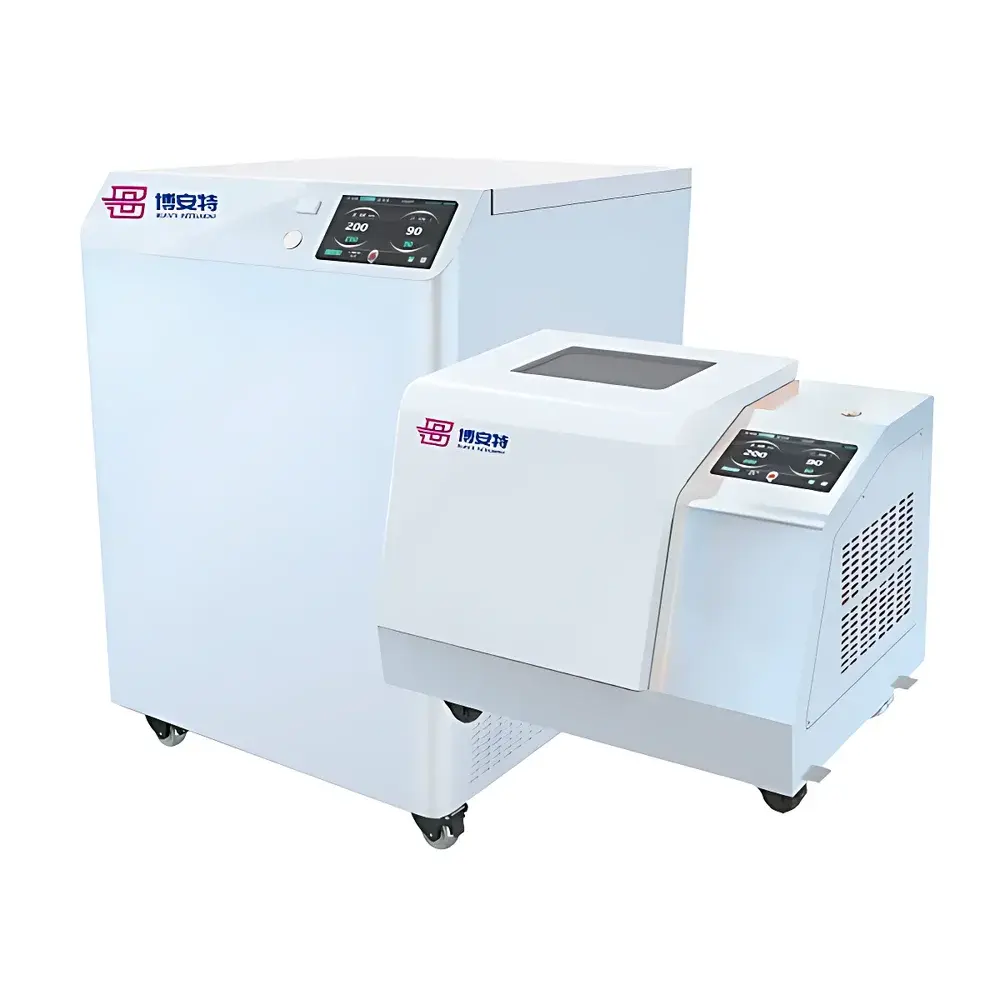
Boante Grind-96P Vertical Cryogenic Multi-Sample Ball Mill
| Brand | Boante |
|---|---|
| Origin | Hubei, China |
| Manufacturer Type | Authorized Distributor |
| Instrument Type | Cryogenic Ball Mill |
| Model | Grind-96P |
| Sample Capacity | 96 × 2 mL PE or alloy rack (optional: 24×2 mL, 48×2 mL, 12×5 mL, 4×10 mL, 4×25 mL, 2×50 mL) |
| Display | 5-inch OLED touchscreen |
| Programmable Methods | ≥20 preset protocols (e.g., heart, spleen, lung, kidney, bone, hair) |
| Multi-Step Grinding | Yes, cyclic execution across up to 5 parameter sets |
| Frequency Range | 0–70 Hz |
| Grinding Time | 0 s–99 min |
| Cryogenic Range | +20 °C to –50 °C |
| Cooling Rate | ~40 min from +20 °C to –50 °C |
| Grinding Media Diameter | 0.1–30 mm |
| Vertical Stroke | 34 mm |
| Acceleration | ≤2 s to max speed |
| Final Particle Size | ≤5 µm |
| Noise Level | <55 dB(A) |
| Grinding Mechanism | Vertical bead-based impact and shear |
| Cooling Method | Integrated cryo-cooling system with programmable temperature control |
| Construction | Full metal housing with electromagnetic safety lock, acoustic insulation, and auto-centering clamping system |
| Dimensions (W×D×H) | 450×450×720 mm |
| Weight | 55 kg |
Overview
The Boante Grind-96P Vertical Cryogenic Multi-Sample Ball Mill is engineered for high-throughput, reproducible sample homogenization under controlled low-temperature conditions. Utilizing vertical-axis bead-milling mechanics combined with integrated cryogenic cooling, the instrument enables efficient mechanical disruption of biological, botanical, and material science specimens while minimizing thermal degradation and enzymatic activity. Its design conforms to core principles of cryo-mechanical comminution—where rapid kinetic energy transfer from grinding media (e.g., zirconia, tungsten carbide, stainless steel beads) to samples occurs within a thermally stabilized environment. This ensures structural integrity of labile analytes such as nucleic acids, proteins, metabolites, and polymers during processing. The Grind-96P is widely deployed in genomics, proteomics, pharmacology, forensic toxicology, and advanced materials R&D laboratories where batch consistency, cross-contamination avoidance, and GLP-aligned operational traceability are mandatory.
Key Features
- Vertical dual-platform oscillation architecture delivering synchronized, three-dimensional motion (up/down + lateral displacement) for uniform energy distribution across all sample positions.
- Electromagnetically interlocked chamber door with automatic centering clamping mechanism ensures secure containment of cryogenic vessels during operation—critical for compliance with ISO 13857 (safety distances) and IEC 61000-6-2 (EMC immunity).
- Full-metal enclosure with internal acoustic damping foam reduces operational noise to <55 dB(A), meeting OSHA and EU Directive 2003/10/EC occupational exposure limits.
- Programmable cryo-control system maintains precise temperature setpoints between +20 °C and –50 °C; cooling ramp time from ambient to –50 °C is approximately 40 minutes, enabling pre-chill stabilization prior to grinding initiation.
- OLED touchscreen interface supports ≥20 user-defined method templates with dedicated presets for tissues (heart, spleen, lung, kidney), mineralized structures (bone), keratinous matrices (hair), and fibrous plant matter.
- Multi-segment grinding protocol capability allows automated cycling among up to five distinct frequency/time/temperature configurations per run—reducing operator intervention and enhancing inter-batch repeatability.
Sample Compatibility & Compliance
The Grind-96P accommodates diverse sample formats via interchangeable racks: standard 96-well polyethylene or alloy plates (2 mL), plus optional adapters for 24×2 mL, 48×2 mL, 12×5 mL, 4×10 mL, 4×25 mL, and 2×50 mL grinding vials. Compatible grinding media include stainless steel, chrome steel, yttria-stabilized zirconia, tungsten carbide, and quartz—selected based on hardness, density, and chemical inertness relative to sample matrix. All sample tubes remain hermetically sealed during processing, eliminating aerosol generation and cross-contamination risks—supporting adherence to CLSI GP26-A4 (biosafety handling) and ISO 55001 (asset integrity management). The system’s closed-loop design meets requirements for use in ISO Class 5–7 cleanrooms and complies with general laboratory safety standards including ANSI Z9.5 and EN 61000-3-2.
Software & Data Management
Method parameters—including frequency (0–70 Hz), duration (0 s–99 min), temperature setpoint, and multi-step sequence logic—are stored locally on the embedded controller with timestamped execution logs. While the Grind-96P does not feature network connectivity or remote data export by default, its onboard memory retains ≥20 protocol configurations with full audit trail functionality (start time, end time, actual temperature profile, final frequency achieved). For regulated environments operating under FDA 21 CFR Part 11 or EU Annex 11, integration with third-party LIMS or ELN systems can be implemented via RS-232 or USB-to-serial interfaces for manual log export and electronic signature validation workflows. All methods support revalidation per ICH Q5C guidelines when used in biopharmaceutical QC/QA settings.
Applications
- RNA/DNA extraction from frozen animal tissues with minimized nuclease-mediated degradation.
- Homogenization of plant roots, leaves, and seeds for metabolomic profiling and pesticide residue analysis (per EPA Method 1694 and ISO 17025-accredited workflows).
- Preparation of polymer composites, battery electrode materials, and ceramic precursors requiring sub-5 µm particle size distribution.
- Cell lysis of yeast, bacteria, and fungal cultures under cryo-stasis to preserve membrane protein conformation.
- Forensic sample preparation (e.g., hair shafts, bone fragments) prior to LC-MS/MS toxicant screening.
- Standardized milling of pharmaceutical excipients and active ingredients for dissolution testing per USP .
FAQ
What types of grinding media are compatible with the Grind-96P?
Stainless steel, chrome steel, yttria-stabilized zirconia, tungsten carbide, and quartz grinding beads ranging from 0.1 mm to 30 mm in diameter may be selected based on sample hardness and desired particle size reduction efficiency.
Can the instrument operate without cryogenic cooling?
Yes—the Grind-96P supports ambient-temperature dry grinding, wet grinding (with solvents), and cryogenic grinding. Temperature is independently programmable and decoupled from mechanical operation.
Is the Grind-96P suitable for GMP-regulated environments?
While the base configuration lacks 21 CFR Part 11-compliant electronic signatures, its method logging, parameter locking, and physical safety features (electromagnetic door lock, sealed chamber, acoustic shielding) align with foundational GMP infrastructure requirements for equipment qualification (IQ/OQ/PQ).
How is cross-contamination prevented between samples?
All sample vessels remain fully enclosed and mechanically isolated throughout the grinding cycle; no shared fluid paths or airflow channels exist between wells or racks.
What maintenance intervals are recommended?
Biannual inspection of electromagnetic latch integrity, vibration dampening mounts, and cryo-system refrigerant pressure is advised. Grinding media should be replaced after 200–500 cycles depending on abrasiveness of processed materials.