
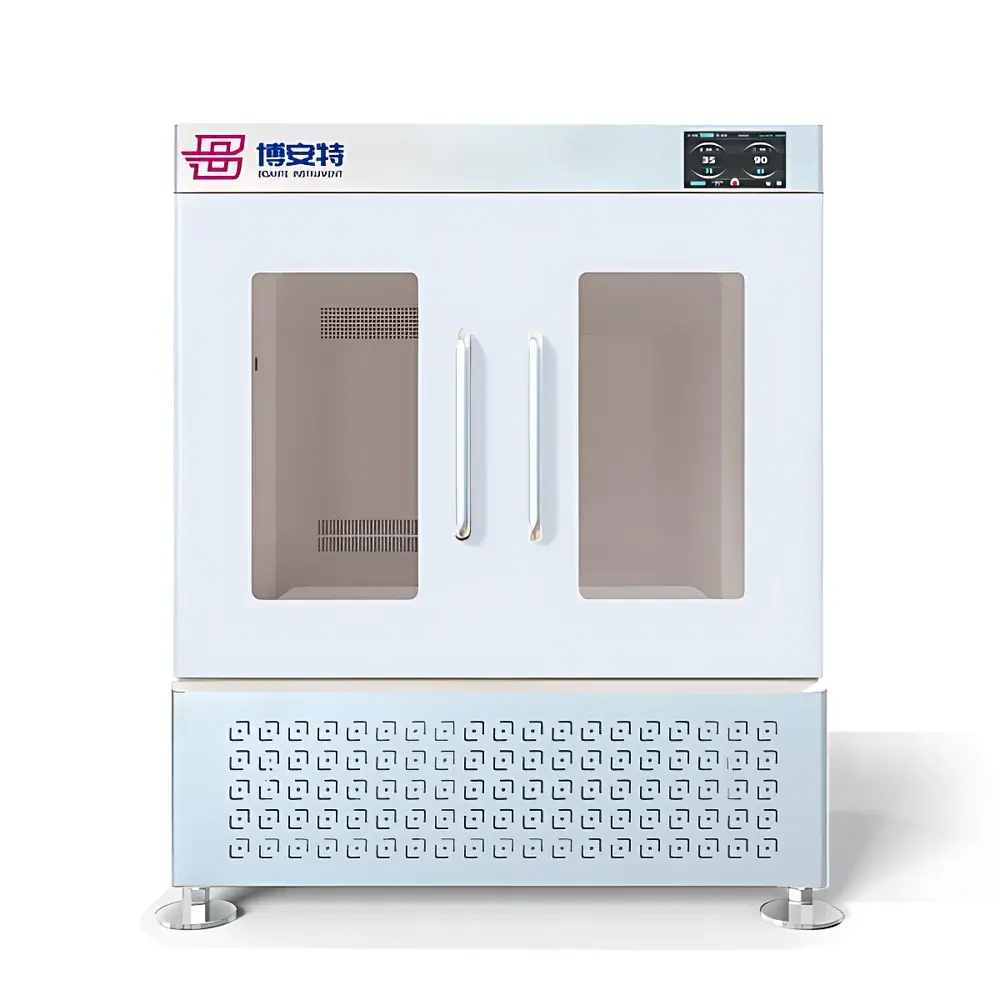
Boante IBS-1060LSS Cabinet-Style Intelligent Full-Temperature Shaking Incubator
| Brand | Boante |
|---|---|
| Origin | Hubei, China |
| Manufacturer Type | Authorized Distributor |
| Instrument Type | Temperature-Controlled Shaking Incubator |
| Drive System | DC Motor Drive |
| Speed Range | 0–300 rpm |
| Speed Accuracy | ±1 rpm |
| Orbit Diameter | φ26 mm |
| Temperature Range | 4–60 °C |
| Temperature Fluctuation | ±1 °C |
| Temperature Uniformity | ±0.1 °C |
| External Dimensions | 1235 mm × 855 mm × 1400 mm |
| Power Supply | AC 220 V, 50–60 Hz |
| Rated Power | 1500 W |
| Net Weight | 300 kg |
Overview
The Boante IBS-1060LSS Cabinet-Style Intelligent Full-Temperature Shaking Incubator is an integrated laboratory platform engineered for precise, reproducible cultivation of microbial, mammalian, and suspension-cell cultures under dynamically controlled thermal and mechanical conditions. It operates on the principle of orbital shaking combined with active refrigeration and forced-air convection to maintain uniform temperature distribution across the entire chamber volume while simultaneously delivering consistent agitation. Designed for continuous operation in QC labs, bioprocess development facilities, and academic research environments, the system supports aerobic culture expansion, protein expression, fermentation optimization, and long-term stability studies requiring tight control over temperature (4–60 °C), rotational speed (0–300 rpm), and environmental consistency. Its cabinet architecture maximizes usable internal volume (1095 mm × 680 mm × 990 mm) within a footprint-optimized external frame, enabling high-capacity parallel processing without compromising spatial efficiency.
Key Features
- High-efficiency DC motor drive with precision mechanical transmission ensures stable low-speed torque delivery (no overheating at ≤50 rpm) and accurate high-speed control (±1 rpm tolerance).
- Three-axis synchronized orbital drive mechanism eliminates the need for load balancing—flasks may be placed freely on the 1000 mm × 580 mm stainless-steel shaker plate without positional constraints.
- Electropolished mirror-finish 304 stainless-steel inner chamber with R-corner design minimizes microbial adhesion points and facilitates complete decontamination via water-resistant floor wash-down capability.
- Double-glazed, tempered glass observation door with inert gas-filled interlayer provides thermal insulation and unobstructed multi-angle visual access without door opening.
- Imported eco-friendly refrigeration compressor (R134a or equivalent non-ozone-depleting refrigerant) coupled with programmable defrost cycles (1–89 min duration; 30–600 min interval) prevents ice accumulation during extended low-temperature operation (down to 4 °C).
- OLED capacitive touchscreen interface with PID-based microprocessor control enables simultaneous setting and real-time monitoring of temperature, speed, time, lighting intensity, humidity, and CO2 concentration (when equipped with optional sensor modules).
- Programmable operation modes include fixed-point control and up to five customizable protocols, each supporting 30-step sequences with independent parameter ramping for temperature, speed, illumination, and gas concentration.
Sample Compatibility & Compliance
The IBS-1060LSS accommodates standard laboratory vessels including Erlenmeyer flasks (250–2000 mL), culture bottles, and custom-configured bioreactor bags using interchangeable clamping systems—including standard three-prong polymer fixtures and OEM-designed adapters for irregular geometries. Internal chamber geometry and airflow dynamics comply with ISO 13408-2 (aseptic processing of pharmaceuticals) guidelines for uniform heat transfer and minimal thermal gradient deviation (<±0.1 °C). The unit’s firmware architecture supports audit-trail generation and user-access-level password protection in alignment with GLP and GMP documentation requirements. While not pre-certified to FDA 21 CFR Part 11, its data logging framework (timestamped, encrypted USB export of minute-interval records spanning up to 90 days) is structured to facilitate validation under regulated workflows.
Software & Data Management
Onboard data acquisition captures temperature, speed, runtime, and optional environmental parameters at one-minute intervals, storing up to 129,600 data points locally. All entries are time-stamped and associated with active program identifiers. Trend visualization is rendered directly on the OLED display as dynamic line graphs; historical datasets can be exported in CSV format via USB-A port for post-acquisition analysis in MATLAB, Python (Pandas), or LIMS-integrated platforms. The system includes automatic power-failure recovery logic that resumes interrupted programs from last-saved state, preserving experimental integrity. Alarm logs retain timestamps and event codes for thermal excursion (>±2 °C), motor stall, door-open anomalies, and refrigeration fault conditions—accessible via scrollable diagnostic menu.
Applications
- Microbial growth kinetics and antibiotic susceptibility testing under variable shear stress regimes.
- Recombinant protein production in E. coli and yeast expression systems requiring strict temperature-phase transitions.
- Suspension cell culture maintenance for hybridoma lines and CHO bioprocessing scale-up trials.
- Enzyme activity assays where consistent orbital mixing prevents sedimentation-induced assay drift.
- Environmental simulation studies involving temperature-cycling stress responses in algal or fungal isolates.
- Stability testing of liquid formulations per ICH Q1A(R3) guidance, leveraging programmable ramp-and-hold thermal profiles.
FAQ
What is the maximum flask capacity per shelf layer?
Up to 60 × 250 mL flasks (plastic clamp), 38 × 500 mL, 28 × 1000 mL, or 15 × 2000 mL—configurable across two independently accessible shelves.
Does the unit support CO2 concentration control out of the box?
No—CO2 sensing and regulation require optional add-on modules; base configuration maintains ambient atmospheric composition.
Is remote monitoring or Ethernet connectivity available?
Not natively supported; however, USB-exported datasets are compatible with third-party SCADA and LabVIEW integration via serial-to-USB converters.
Can the shaker operate continuously at 4 °C?
Yes—the refrigeration subsystem and adaptive defrost algorithm ensure stable sub-ambient operation for durations exceeding 72 hours without performance degradation.
How is calibration traceability addressed?
Factory calibration certificates are provided for temperature and speed sensors; users may perform field verification using NIST-traceable PT100 probes and optical tachometers per ASTM E2875-22.




