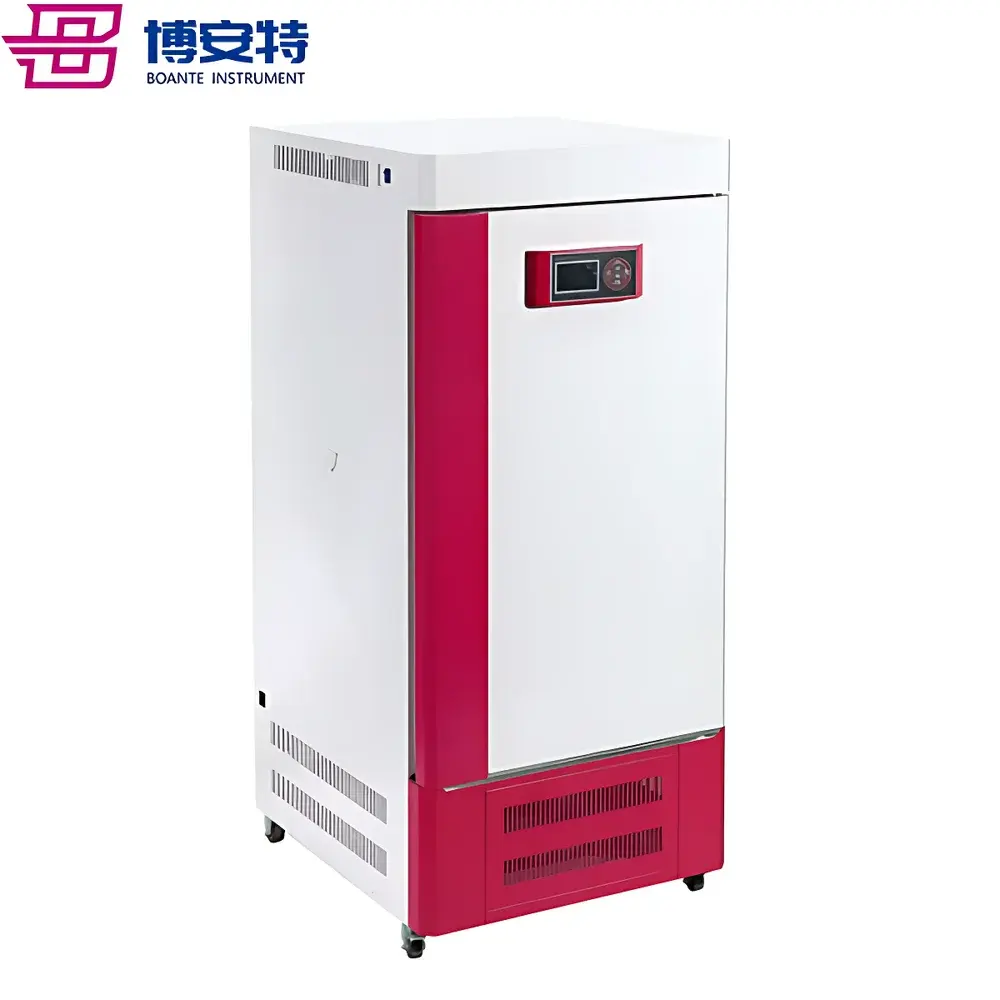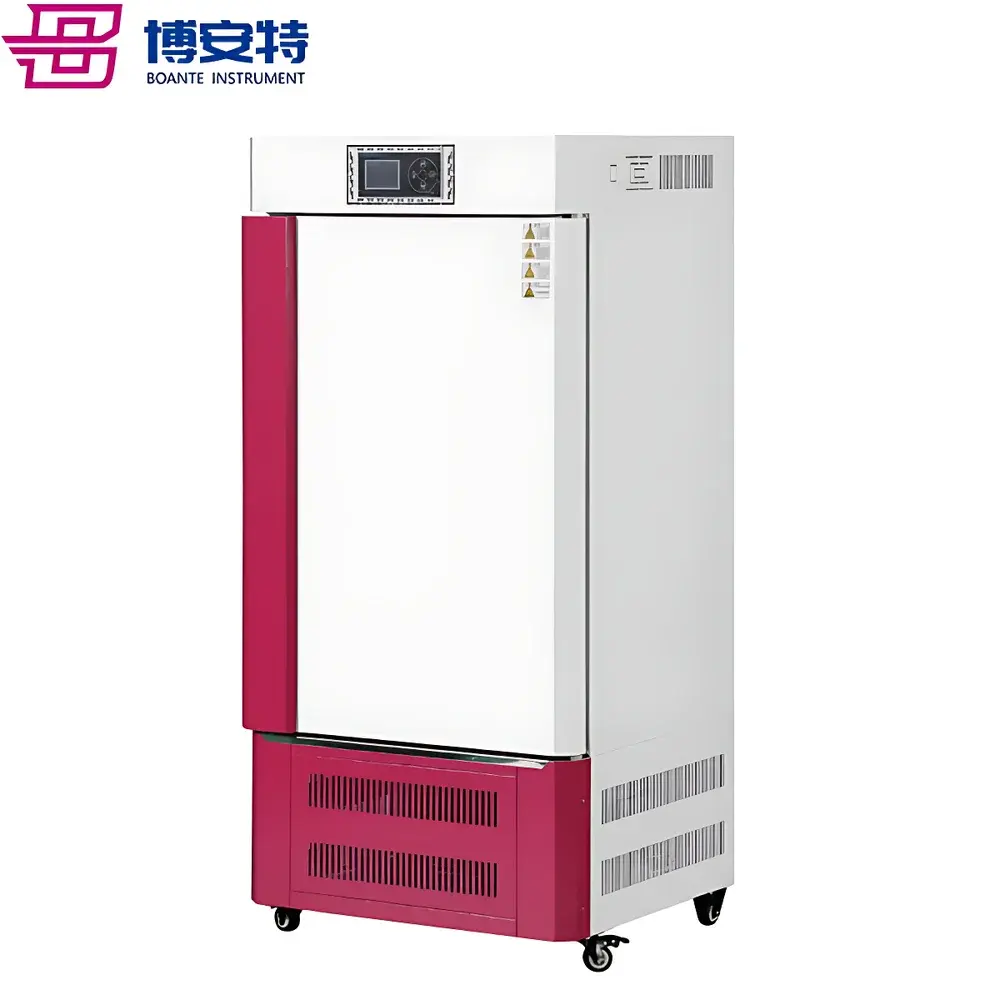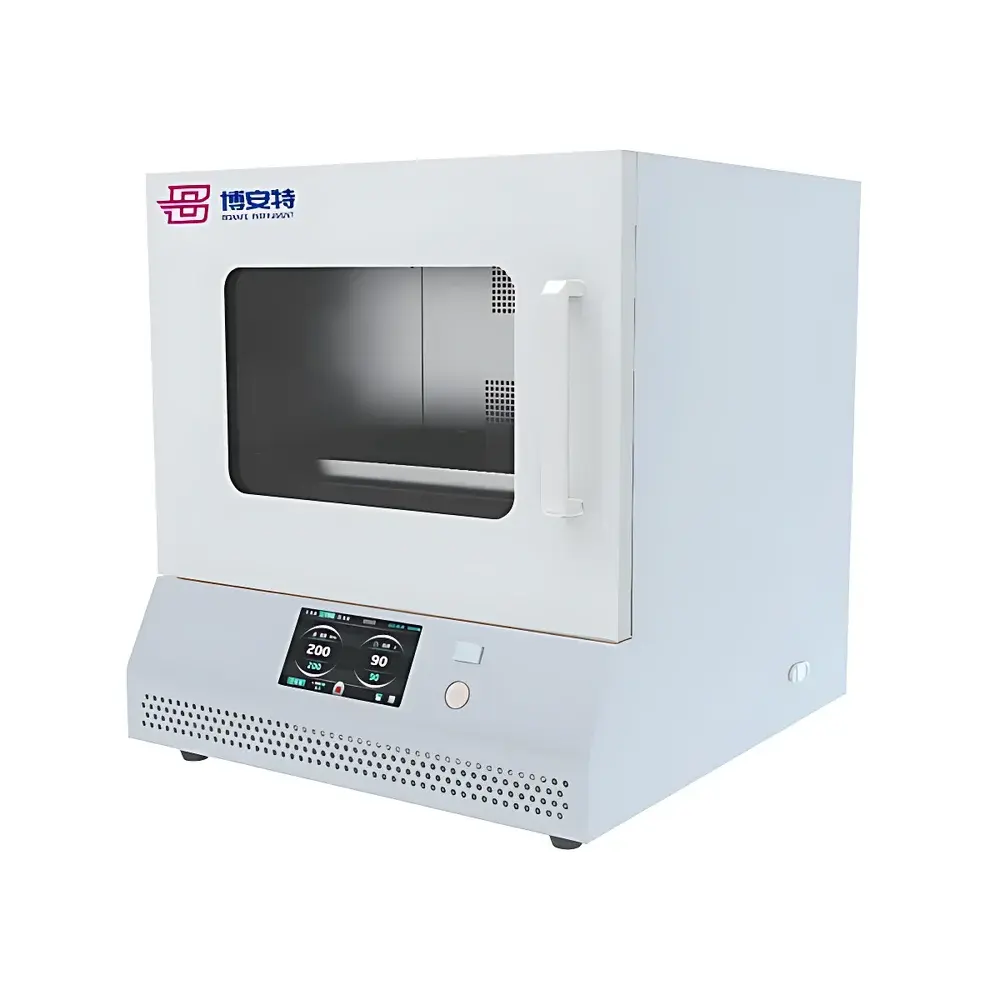
Boante IBS-320TS Compact Intelligent Full-Range Shaking Incubator
| Brand | Boante |
|---|---|
| Origin | Hubei, China |
| Manufacturer Type | Authorized Distributor |
| Country of Origin | China |
| Model | IBS-320TS |
| Instrument Type | Temperature-Controlled Shaking Incubator |
| Drive Mechanism | DC Motor Drive |
| Orbital Amplitude | φ26 mm |
| Temperature Range | 4–60 °C |
| Temperature Fluctuation | ±1 °C |
| Temperature Uniformity | ±0.1 °C |
| External Dimensions | 595 × 620 × 620 mm (W × D × H) |
| Internal Chamber Dimensions | 265 × 410 × 509 mm (W × D × H) |
| Shelf Plate Size | 440 × 320 mm |
| Max Capacity | 12 × 250 mL flasks, 8 × 500 mL flasks, or 6 × 1000 mL flasks |
| Oscillation Speed Range | 0–300 rpm |
| Speed Accuracy | ±1 rpm |
| Temperature Control Resolution | 0.1 °C |
| Timer Range | 0–999.9 h |
| Air Circulation | Forced Convection |
| Display | OLED Touchscreen |
| Control System | PID Microcomputer-Based Intelligent Control |
| Multi-Stage Programming | Yes |
| Data Logging | Continuous recording at 1-min intervals |
| Data Export | USB interface |
| Power Supply | AC 220 V, 50–60 Hz |
| Power Consumption | 1000 W |
| Net Weight | 92 kg |
Overview
The Boante IBS-320TS Compact Intelligent Full-Range Shaking Incubator is a precision-engineered platform for controlled microbial growth, cell culture expansion, and biochemical reaction optimization under dynamically regulated temperature and orbital agitation. Designed for laboratories with space constraints yet uncompromising performance requirements, it integrates thermoelectric stability, low-noise mechanical oscillation, and programmable environmental control into a single compact footprint. Its operating principle relies on forced-air convection combined with precise PID-regulated heating and refrigeration—enabled by an eco-friendly, high-efficiency compressor—and synchronized with smooth, low-vibration DC motor-driven orbital shaking (φ26 mm amplitude). This architecture ensures reproducible physiological conditions across diverse biological samples, from aerobic bacterial cultures to suspension-adapted mammalian cells, while maintaining compliance with core GLP-aligned operational integrity.
Key Features
- Robust thermal management system featuring imported hermetic compressor and R134a-free refrigerant, supporting stable operation across the full 4–60 °C range with ±0.1 °C uniformity and ±1 °C fluctuation tolerance.
- High-fidelity DC motor drive with integrated multi-axis transmission mechanism eliminates need for load balancing—enabling arbitrary flask placement on the 440 × 320 mm stainless steel shaker plate without compromising motion consistency or torque delivery.
- Electropolished mirror-finish 304 stainless steel interior chamber with seamless R-corner construction minimizes microbial adhesion points and supports routine sterilization via UV irradiation or aqueous cleaning; bottom pan rated IPX4 for safe water rinsing.
- OLED touchscreen interface with user-configurable lock screen password, real-time parameter visualization (temperature, speed, elapsed time), and intuitive multi-stage programming for sequential condition transitions (e.g., ramp-and-hold temperature profiles paired with variable-speed shaking).
- Comprehensive data governance: onboard logging at 1-minute intervals (retaining ≥90 days of timestamped temperature, RPM, and runtime data); exportable via USB to standard CSV format for audit-ready traceability in ISO/IEC 17025 or FDA 21 CFR Part 11–aligned workflows.
- Safety-critical firmware functions including auto-restart after power interruption, over-temperature cut-off with persistent alarm history, lid-activated deceleration (soft-stop protocol), and programmable defrost cycles (1–89 min duration, 30–600 min interval).
Sample Compatibility & Compliance
The IBS-320TS accommodates standard laboratory vessels—including Erlenmeyer flasks (250 mL × 12, 500 mL × 8, or 1000 mL × 6), test tubes, and custom bioreactor cartridges—via interchangeable polypropylene three-prong clamps or OEM-designed adapters. Its internal geometry and airflow design meet ASTM E171-22 criteria for uniform thermal distribution in incubation equipment. The unit complies with IEC 61010-1:2010 for electrical safety in laboratory instruments and incorporates insulation materials certified to UL 94 V-0 flame retardancy standards. While not certified for GMP manufacturing environments, its design supports validation protocols required for QC microbiology labs operating under USP , , and ISO 11133:2014 guidelines.
Software & Data Management
No external software installation is required—the embedded microcontroller handles all logic execution, event logging, and user interaction locally. The PID algorithm continuously adjusts heating/cooling output and motor PWM signals based on dual-sensor feedback (chamber air + plate surface), ensuring minimal overshoot during setpoint transitions. All logged parameters are stored in non-volatile memory with write-protection against accidental deletion. USB data export generates time-stamped, comma-delimited files compatible with Excel, MATLAB, or LIMS integration. Audit trail functionality records operator ID (if configured), parameter changes, alarm triggers, and maintenance timestamps—supporting documentation needs for GLP audits and internal SOP adherence.
Applications
- Aerobic microbial cultivation (e.g., E. coli, Bacillus subtilis) requiring precise oxygen transfer rates and thermal consistency.
- Suspension-based eukaryotic cell line propagation (CHO, HEK293) where shear stress mitigation via gentle orbital motion is critical.
- Enzyme kinetics assays and protein expression studies involving temperature-dependent induction protocols.
- Environmental microbiology testing, including water quality analysis per APHA Standard Methods.
- Biopharmaceutical process development at lab scale, especially for media optimization and seed train expansion.
- Teaching laboratories requiring robust, intuitive instrumentation for undergraduate biotechnology curricula.
FAQ
What is the maximum flask size supported without modification?
The standard configuration supports up to six 1000 mL Erlenmeyer flasks using the included heavy-duty clamp set.
Does the unit support CO₂ or humidity control?
No—IBS-320TS is optimized for ambient-air shaking incubation only; CO₂ and humidity modules are not available as factory options.
Is remote monitoring or Ethernet connectivity possible?
Not natively; data retrieval requires physical USB connection. Third-party IoT gateways may be integrated via analog output signals (0–10 V) if enabled by firmware revision.
How often does the automatic defrost cycle activate?
Defrost interval is fully configurable between 30 and 600 minutes, with duration adjustable from 1 to 89 minutes—ideal for extended low-temperature runs (e.g., 4 °C overnight cultures).
Can the shaker operate without temperature control?
Yes—users may disable thermal regulation while retaining full speed control and data logging functionality for ambient-temperature shaking applications.
Related Products