
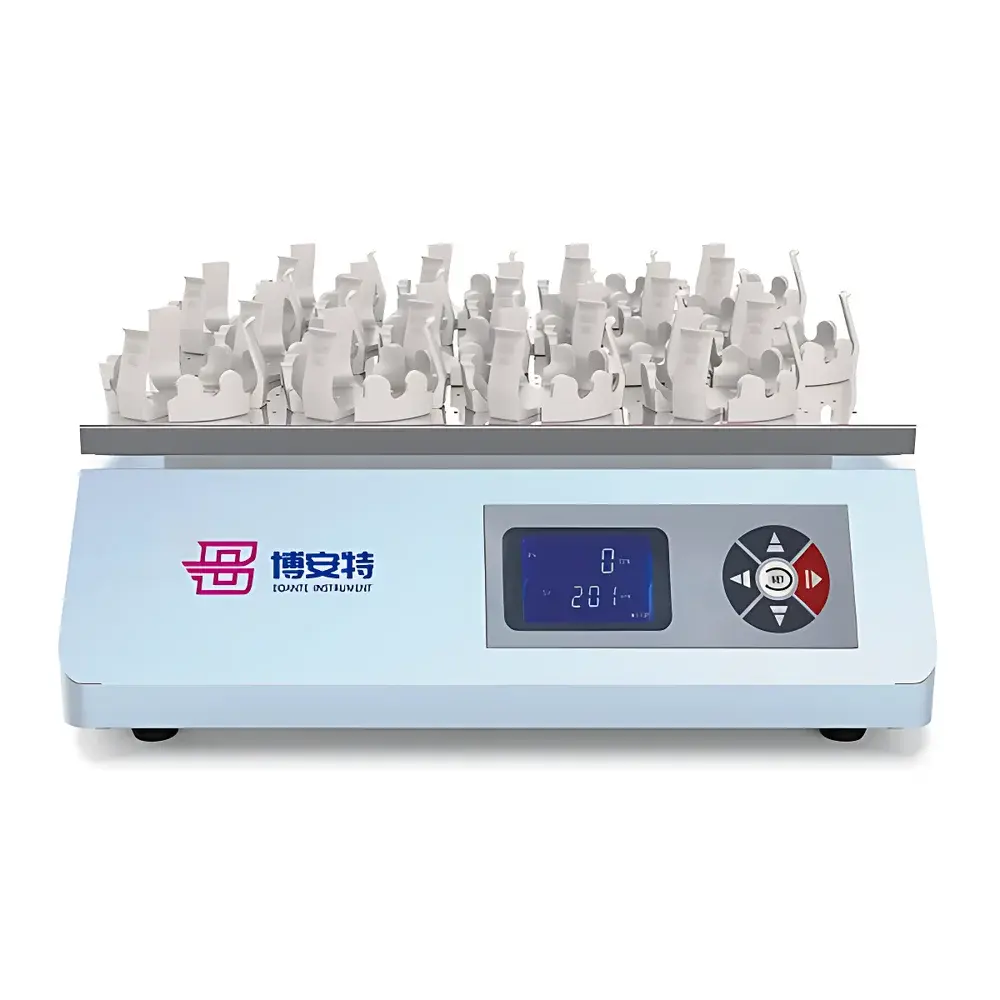
Boante IBS-610TS Benchtop Orbital Shaker
| Brand | Boante |
|---|---|
| Model | IBS-610TS |
| Instrument Type | Temperature-Controlled Orbital Shaker |
| Timing Range | 0–999.9 h |
| Oscillation Frequency | 0–300 rpm |
| Frequency Accuracy | ±1 rpm |
| Orbit Diameter | 26 mm |
| Display | LED Touchscreen |
| Control System | PID Microprocessor-Based |
| Max Capacity (per Deck) | 250 mL × 30, 500 mL × 16, 1000 mL × 12, or 2000 mL × 6 |
| Shelf Dimensions | 550 mm × 540 mm |
| External Dimensions (3-Deck) | 550 mm × 550 mm × 240 mm |
| Weight | 30 kg |
| Power Supply | AC 220 V, 50–60 Hz |
| Power Consumption | 200 W |
| Construction | 316 Stainless Steel Deck with Reinforced Corner Steel Frame |
| Finish | High-Temperature Electrostatic Powder Coating |
| Features | Power-Fail Recovery, Multi-Axis Balanced Drive, No-Balance Required Placement |
Overview
The Boante IBS-610TS Benchtop Orbital Shaker is an engineered solution for consistent, reproducible orbital agitation in microbiological culture, cell suspension, solubility testing, and reagent mixing applications. Designed around a precision-controlled DC motor and multi-axis mechanical transmission architecture, the unit delivers stable rotational motion across its full frequency range (0–300 rpm) with ±1 rpm accuracy—critical for kinetic studies requiring tight parameter control. Unlike conventional shakers relying on single-axis eccentric drives, the IBS-610TS employs a proprietary three-dimensional balanced drive system that eliminates the need for load balancing during setup. This design ensures uniform energy transfer to all vessel positions on the deck, minimizing shear gradient variation and improving culture homogeneity—particularly beneficial for sensitive eukaryotic cell lines or low-density bacterial inocula. The shaker operates without active temperature regulation; however, its insulated housing and thermally stable structural components make it suitable for integration into controlled-environment incubators or cold rooms where ambient thermal conditions are externally maintained.
Key Features
- Precision DC motor coupled with high-tolerance mechanical transmission for low-speed high-torque operation and minimal thermal drift at extended runtimes
- Proprietary thermally compensated drive shaft manufactured via controlled thermal expansion/contraction process—reducing wear and extending service life beyond 20,000 operational hours
- True multi-axis orbital mechanism enabling unrestricted flask placement across the entire 550 mm × 540 mm stainless steel deck—no centering or counterweight adjustments required
- 316-grade brushed stainless steel deck with reinforced internal corner steel framing for long-term rigidity and vibration damping under full-load conditions
- Electrostatically applied high-temperature powder coating on external chassis—resistant to ethanol, 70% isopropanol, and common laboratory disinfectants while inhibiting microbial adhesion
- Intelligent PID microprocessor controller with LED touchscreen interface supporting programmable ramping, segmented timing, and automatic power-fail recovery with non-volatile memory retention
Sample Compatibility & Compliance
The IBS-610TS accommodates standard laboratory vessels including Erlenmeyer flasks (250–2000 mL), test tubes, deep-well plates, and custom bioreactor bags mounted on compatible adapters. Its 26 mm orbit diameter meets ISO 8573-1 Class 4 requirements for mechanical consistency in aerobic culture protocols. While not certified as a medical device, the unit conforms to IEC 61010-1:2010 safety standards for laboratory electrical equipment and supports GLP-compliant workflows through audit-trail-capable logging when integrated with external data acquisition systems. Its static design and absence of moving external covers simplify decontamination validation per ISO 14644-1 Class 7 cleanroom maintenance protocols.
Software & Data Management
The onboard PID controller stores up to 10 independent user-defined protocols with timestamped start/stop events. All parameters—including actual RPM, elapsed time, and fault codes—are accessible via real-time display and exportable via USB port in CSV format. Though the IBS-610TS does not feature native Ethernet or Wi-Fi connectivity, its RS-232 serial interface enables integration with LIMS platforms or centralized monitoring systems using Modbus RTU protocol. For regulated environments, optional external data loggers compliant with FDA 21 CFR Part 11 can be deployed to capture electronic records with user authentication, change tracking, and digital signature support.
Applications
- Aerobic microbial cultivation (E. coli, Pseudomonas spp., Bacillus subtilis) under standardized aeration conditions
- Mammalian and insect cell suspension culture in serum-free or low-serum media formulations
- Enzyme kinetics assays requiring continuous gentle agitation to prevent sedimentation without introducing air bubbles
- Solubility and dissolution profiling of APIs during early-stage pharmaceutical development
- Antibiotic susceptibility testing using broth microdilution methods per CLSI M07-A11 guidelines
- Environmental sample homogenization prior to nucleic acid extraction or flow cytometry analysis
FAQ
Does the IBS-610TS include temperature control?
No—the IBS-610TS is a benchtop orbital shaker without integrated heating or cooling. It is intended for use in externally controlled environments such as incubators or cold rooms.
Can the shaker operate continuously for more than 100 hours?
Yes—its robust drive system and thermal management architecture support uninterrupted operation up to the maximum timer setting of 999.9 hours.
Is the stainless steel deck resistant to sodium hypochlorite solutions?
The 316 stainless steel surface exhibits strong resistance to diluted bleach (≤0.5% NaOCl); however, prolonged exposure to concentrated solutions is not recommended without post-rinse validation.
What safety certifications does the unit hold?
It complies with IEC 61010-1:2010 for electrical safety and electromagnetic compatibility (EMC) per IEC 61326-1:2013 Class A.
How is calibration verified for frequency accuracy?
Users may validate performance using a calibrated optical tachometer; factory calibration documentation includes traceable RPM verification at 50, 150, and 250 rpm points.
Related Products





