
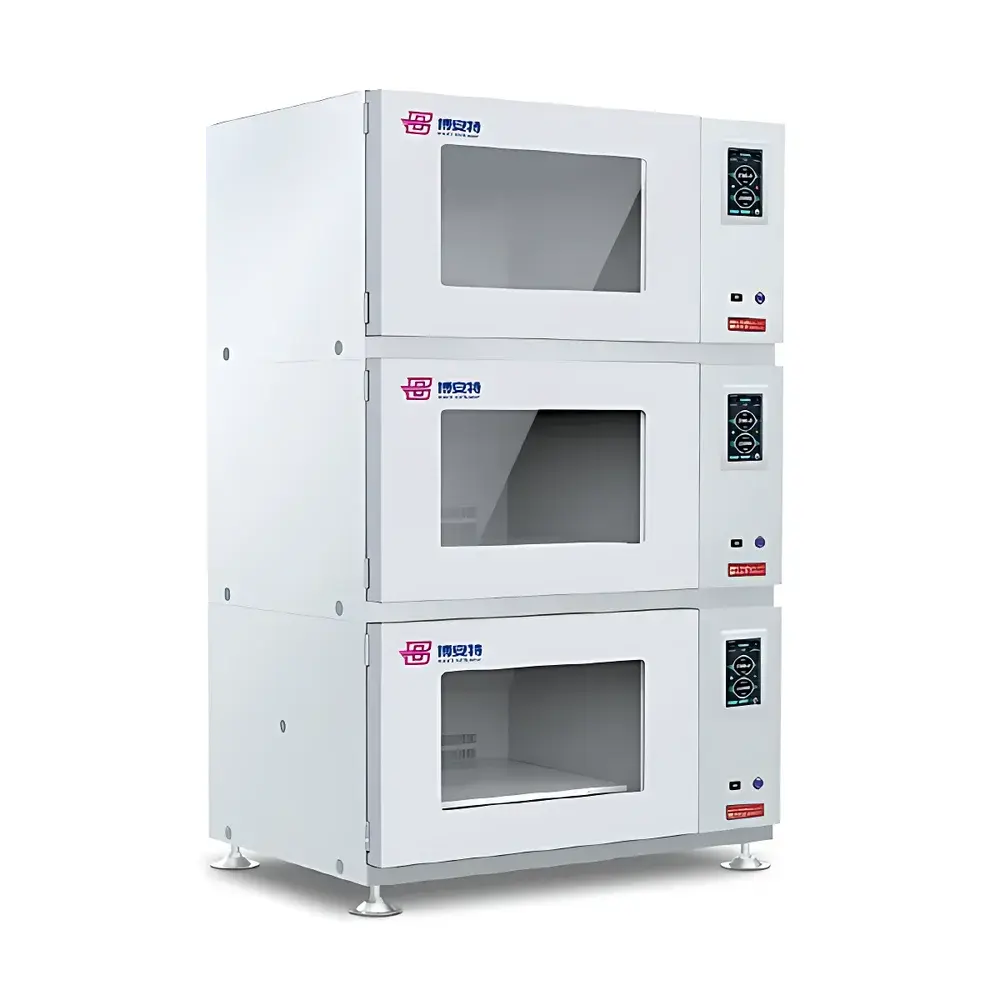
Boante IBS-830C Modular Intelligent Full-Temperature Shaking Incubator
| Brand | Boante |
|---|---|
| Origin | Hubei, China |
| Model | IBS-830C |
| Instrument Type | Temperature-Controlled Shaking Incubator |
| Drive Mechanism | DC Motor Drive |
| Amplitude | φ3 mm |
| Temperature Range | 4–60 °C |
| Temperature Fluctuation | ±0.6 °C |
| Temperature Uniformity | ±1 °C |
| External Dimensions (3-Layer) | 970 mm × 720 mm × 1800 mm |
| Shaking Frequency | 0–1200 rpm |
| Frequency Accuracy | ±1 rpm |
| Internal Chamber Dimensions (per layer) | 580 mm × 550 mm × 360 mm |
| Shelf Plate Size (per layer) | 530 mm × 500 mm |
| Max Capacity (per layer) | 20 × 96-well plates |
| Power Supply | AC 220 V, 50–60 Hz |
| Power Consumption | 1300 W |
| Weight (3-layer) | 495 kg |
Overview
The Boante IBS-830C Modular Intelligent Full-Temperature Shaking Incubator is an engineered platform for simultaneous temperature-controlled incubation and orbital shaking—designed to support aerobic microbial growth, cell suspension culture, enzyme kinetics, protein expression, and biochemical assay development under precisely regulated environmental conditions. Its core operational principle integrates forced-air convection thermal management with low-inertia DC motor-driven orbital motion (25 mm diameter, φ3 mm nominal amplitude), ensuring uniform heat distribution and consistent mechanical stimulation across the entire shaker plate surface. Unlike fixed-chamber units, the IBS-830C employs a vertically modular architecture—allowing up to three independently controlled layers to be stacked in a single footprint—thereby optimizing lab space while maintaining full parameter autonomy per tier. Each layer operates as a thermally isolated zone, enabling parallel experiments at distinct temperatures (4–60 °C), shaking frequencies (0–1200 rpm), and timing profiles without cross-interference.
Key Features
- Modular 3-layer stackable design with independent PID-based temperature and speed control per layer—ideal for high-throughput comparative studies or multi-condition screening.
- DC motor drive system with precision gear reduction and proprietary thermal-expansion-compensated transmission shaft—delivering stable torque output at low speeds (≤50 rpm) and minimal thermal drift during extended operation (>72 h).
- Forced-air convection system with dual-directional airflow ducts and optimized baffle geometry—achieving ±1 °C temperature uniformity across the full chamber volume (per layer), validated per ISO 15271:2022 Annex A.
- OLED capacitive touchscreen interface with user-configurable lockout password, real-time graphical data overlay (temperature, rpm, elapsed time), and intuitive icon-based navigation—supporting both English and multilingual firmware options.
- Comprehensive environmental programmability: 5 user-defined programs, each with up to 30 segments; parameters include temperature, shaking speed, duration, direction (forward/reverse toggle), UV sterilization cycle, and optional illumination (if equipped with LED light module).
- Integrated data logging: continuous timestamped recording (1-min interval) of temperature, speed, humidity (if sensor-equipped), and CO2 concentration (with optional IR sensor); local storage retains ≥90 days of data; export via USB 2.0 to CSV-compatible formats for traceability and GLP-compliant reporting.
- Safety-engineered mechanical features: lid-actuated gentle deceleration (soft-stop), IPX4-rated waterproof interior base, R-corner stainless steel chamber (304 grade), and auto-defrost scheduling (1–89 min duration, 30–600 min interval) to prevent evaporator icing below 10 °C.
Sample Compatibility & Compliance
The IBS-830C accommodates standard microbiological and cell culture formats—including Erlenmeyer flasks (50–2000 mL), test tubes, deep-well plates, and 96-well microplates—via interchangeable clamp systems (standard three-point polymer clamps included; custom fixtures available for irregular vessels). The mirror-finish stainless-steel chamber and seamless R-corner construction meet ISO 13485 cleanability requirements for Class II biosafety environments. Optional UV-C germicidal lamps (254 nm) enable routine decontamination cycles compliant with CLSI M29-A4 guidelines. While not certified for GMP manufacturing, the instrument’s audit-trail-capable logging, password-protected parameter modification, and power-loss recovery function align with FDA 21 CFR Part 11 expectations for laboratory data integrity in QC/QA workflows.
Software & Data Management
No proprietary software installation is required. All configuration, monitoring, and data retrieval occur directly through the onboard OLED interface. Logged datasets are stored in non-volatile memory and exported as plain-text CSV files via USB flash drive—ensuring compatibility with LIMS, ELN, and statistical analysis platforms (e.g., JMP, GraphPad Prism, Python pandas). Timestamps are synchronized to internal RTC with ±2 s/month accuracy. For labs requiring centralized monitoring, optional RS-485 Modbus RTU output enables integration into building management systems (BMS) or SCADA networks—supporting remote alarm relay triggering and basic setpoint telemetry.
Applications
- Aerobic bacterial and yeast fermentation optimization (e.g., E. coli, S. cerevisiae) under variable O2 transfer rates.
- Mammalian suspension cell line expansion (CHO, HEK293) with shear-sensitive media formulations.
- Enzyme activity assays requiring precise thermal ramping combined with mixing (e.g., kinetic ELISA, ligand-binding studies).
- Environmental microbiology: soil slurry enrichment, biodegradation rate testing, and wastewater treatment simulation.
- Biopharmaceutical upstream process development—particularly for clone screening and media optimization where multi-temperature parallelism reduces timeline risk.
FAQ
Can the IBS-830C operate at 4 °C while shaking at 300 rpm continuously?
Yes. The unit uses a high-efficiency hermetic compressor with eco-friendly R134a refrigerant and adaptive defrost logic, enabling stable sub-ambient operation down to 4 °C at any speed within its 0–1200 rpm range.
Is third-party calibration support available?
Boante provides NIST-traceable calibration certificates (optional add-on) for temperature and rotational speed sensors, performed pre-shipment using Fluke 1524 and Ono Sokki HT-3000 standards.
What is the maximum load capacity per shaker plate?
The rated dynamic load is 25 kg per layer. This supports up to twenty 96-well plates (total ~12 kg) or twelve 1-L flasks with medium (total ~22 kg), assuming balanced placement.
Does the system comply with electromagnetic compatibility (EMC) directives?
It meets IEC 61326-1:2013 Class B emission limits and immunity requirements for laboratory equipment, with CE marking applied for EU market deployment.
Can humidity be controlled?
Humidity control is not built-in but can be added via external humidification module (model HUM-IBS, sold separately), delivering 30–95% RH with ±3% accuracy when integrated with the main controller.




