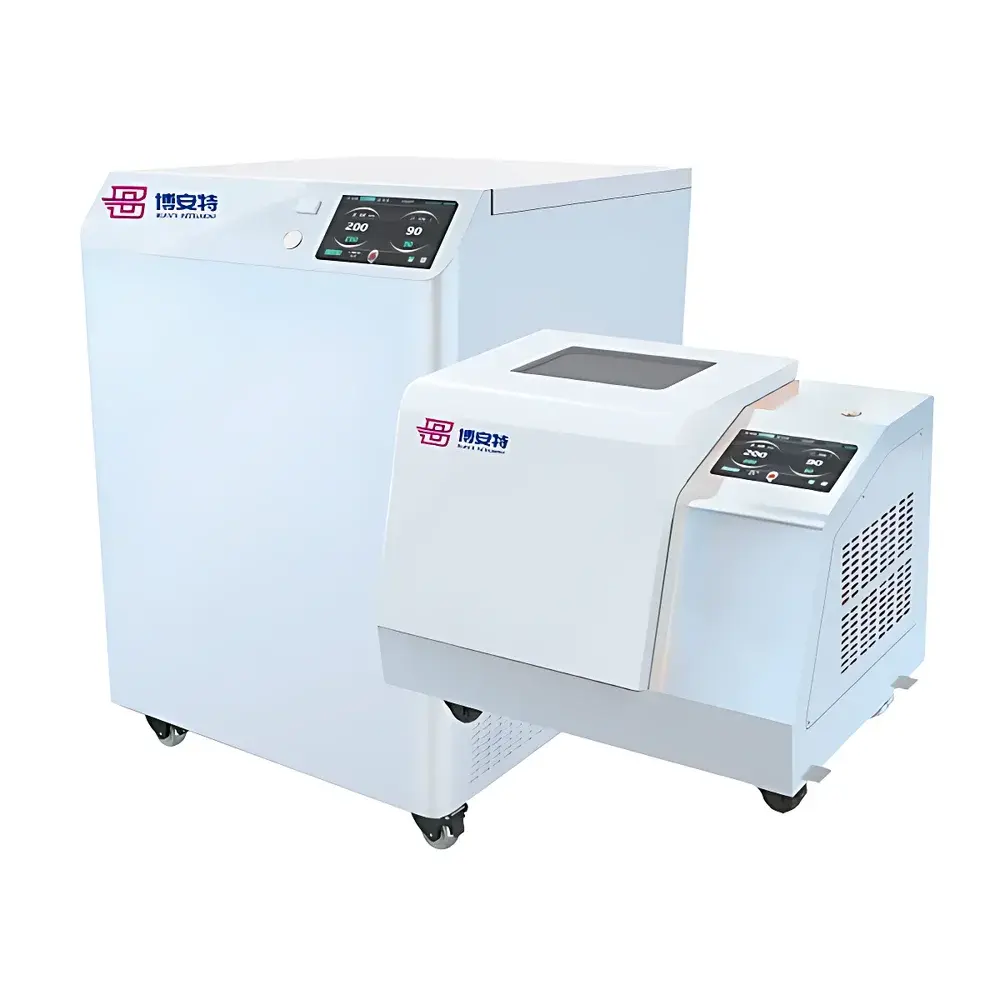
Boante Mini-4plus Portable High-Efficiency Bead Mill Grinder
| Brand | Boante |
|---|---|
| Model | Mini-4plus |
| Instrument Type | Benchtop Bead Mill Grinder |
| Construction | All-Metal Housing |
| Sample Capacity | 4 or 6 Tubes Simultaneously |
| Grinding Motion | 3D “Figure-8” Orbital Motion (Vortexing + Oscillation + Suction) |
| Max Speed | 6000 rpm |
| Acceleration Time | ≤2 s to Max Speed |
| Grinding Time Range | 0–9999 s (Programmable) |
| Final Particle Size | ≤5 µm |
| Noise Level | <55 dB(A) |
| Display | LCD Interface |
| Dimensions (W×D×H) | 210 × 185 × 220 mm |
| Weight | 4.8 kg |
| Power Consumption | 35 W |
| Safety | Interlocked Lid Sensor, Sealed Tube Processing, Zero Cross-Contamination Design |
| Compliance | Designed for GLP-compliant sample prep workflows |
Overview
The Boante Mini-4plus Portable High-Efficiency Bead Mill Grinder is an engineered solution for rapid, reproducible mechanical lysis and particle size reduction of biological, botanical, and synthetic samples in resource-constrained or field-deployable laboratory environments. Utilizing a patented 3D orbital motion principle—commonly referred to as “Figure-8” motion—the instrument induces simultaneous vortexing, oscillation, and suction forces within sealed sample tubes. This multi-axis kinetic profile ensures uniform energy distribution across the grinding matrix (e.g., stainless steel, zirconia, or tungsten carbide beads), enabling efficient cell disruption, tissue homogenization, and nano-scale dispersion without thermal runaway or operator-induced variability. Unlike conventional vortexers or rotary shakers, the Mini-4plus operates on a true bead-milling principle grounded in impact and shear mechanics, making it suitable for applications requiring sub-5 µm particle size distributions and high nucleic acid/protein integrity retention.
Key Features
- All-metal housing construction provides structural rigidity, vibration damping, and long-term operational stability under repeated high-speed cycling.
- Interlocked safety lid mechanism halts operation instantly upon lid opening—meeting IEC 61010-1 requirements for laboratory equipment safety.
- Sealed-tube processing eliminates aerosol generation and cross-contamination between samples; compatible with standard 2 mL, 5 mL, and 15 mL centrifuge tubes.
- LCD interface supports precise time (0–9999 s), speed (100–6000 rpm), and repeat-cycle programming with real-time status feedback.
- Ultra-low acoustic signature (<55 dB[A]) enables use in shared lab spaces, cleanrooms, or mobile biosafety units without auxiliary sound enclosures.
- Energy-efficient 35 W drive system delivers full torque at all speeds—no performance degradation during extended runs or multi-sample batches.
Sample Compatibility & Compliance
The Mini-4plus accommodates diverse sample matrices including hair follicles, frozen animal tissues, plant leaves, microbial pellets, polymer composites, and pharmaceutical excipients. Its closed-tube architecture supports cryogenic grinding (with pre-chilled tubes/beads) and ambient-temperature protocols alike. The device is routinely deployed in workflows aligned with ISO 17025-accredited laboratories for sample preparation prior to downstream analysis (e.g., qPCR, LC-MS, SEM, XRD). While not certified to FDA 21 CFR Part 11 out-of-the-box, its programmable parameters and non-volatile memory log support audit-ready documentation when integrated into validated SOPs. It complies with electromagnetic compatibility (EMC) standards per EN 61326-1 and meets RoHS Directive 2011/65/EU for hazardous substance restrictions.
Software & Data Management
The Mini-4plus operates via embedded firmware with no external PC dependency. All method parameters—including speed, duration, pause intervals, and cycle count—are stored in non-volatile memory with timestamped execution logs accessible through the LCD menu. For integration into LIMS or ELN ecosystems, users may export run metadata manually via screen capture or integrate via optional RS-232/USB-to-serial adapters (sold separately). Firmware updates are delivered via microSD card slot (not included), supporting version-controlled method validation and traceability per GLP/GMP Annex 11 guidelines.
Applications
- Rapid genomic DNA/RNA extraction from fibrous or lipid-rich tissues (e.g., liver, brain, root nodules).
- Homogenization of forensic hair samples for STR profiling without keratin interference.
- Nanoparticle dispersion in battery electrode slurries and catalyst precursor formulations.
- Cell wall disruption of Gram-positive bacteria (e.g., Staphylococcus aureus) and yeast (Saccharomyces cerevisiae) for proteomic workflows.
- Pre-analytical sample conditioning for elemental analysis (ICP-MS/OES) requiring complete mineral dissolution precursors.
- High-throughput screening of formulation stability in pharmaceutical solid dispersions.
FAQ
What types of grinding beads are compatible with the Mini-4plus?
Standard bead diameters of 0.1 mm, 0.5 mm, and 1.0 mm zirconia or stainless steel beads are supported; bead volume must occupy 10–30% of total tube capacity.
Can the instrument be used for cryogenic grinding?
Yes—pre-chilled tubes and beads may be loaded manually; however, the unit itself lacks active cooling and should not exceed ambient temperature limits of −10 °C to +40 °C.
Is method validation documentation available?
Boante provides a basic IQ/OQ template upon request; full PQ validation requires user-defined acceptance criteria per ISO/IEC 17025 Clause 5.5.2.
Does the Mini-4plus support remote monitoring or network connectivity?
No native Ethernet or Wi-Fi capability exists; remote control requires third-party serial-to-IP gateways and custom scripting.
What maintenance is required for long-term reliability?
Annual inspection of drive coupling alignment and lid interlock switch functionality is recommended; no lubrication or calibration is required under normal operating conditions.