
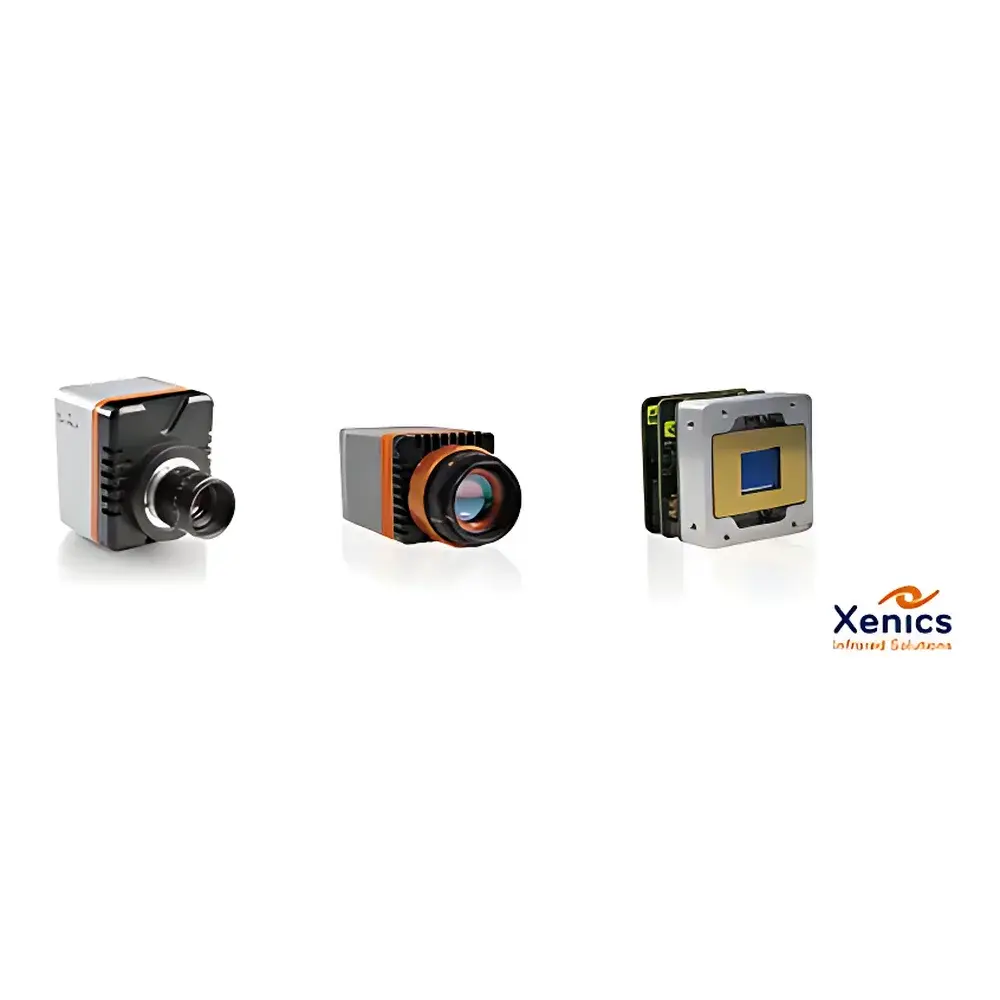
Bobcat/XSW Series Short-Wave Infrared (SWIR) Camera
| Brand | LUSTER |
|---|---|
| Origin | Belgium |
| Manufacturer Type | Authorized Distributor |
| Origin Category | Imported |
| Model | Bobcat/XSW |
| Pricing | Available Upon Request |
| Sensor Spectral Range | 0.9–1.7 μm |
| Pixel Pitch | 15 μm |
| Cooling | Thermoelectric (TE) for XSW-640-TE1, Uncooled for Bobcat variants |
| Interface Options | GigE Vision (PoE-capable), Camera Link, USB 2.0 |
| Max Frame Rate | 100 fps (640×512), 60 fps (320×256), 50 fps (gated mode) |
| Minimum Gated Exposure | 80 ns |
| Readout Circuit | Custom On-Chip ROIC |
| Dark Current | <0.1 e⁻/pix/s (at −10°C TE cooling) |
| Noise Floor | <30 e⁻ rms (typical, 12-bit ADC) |
Overview
The Bobcat/XSW Series Short-Wave Infrared (SWIR) Cameras are engineered for high-fidelity imaging in the 0.9–1.7 μm spectral band—enabling non-destructive visualization of subsurface features, carrier dynamics, and optical anomalies invisible to visible-light sensors. Based on indium gallium arsenide (InGaAs) focal plane arrays with optimized quantum efficiency (>70% peak QE), these cameras leverage advanced on-chip readout integrated circuit (ROIC) architecture to deliver low-noise, high-temporal-resolution acquisition. Unlike conventional SWIR systems constrained by bulk or thermal instability, the Bobcat/XSW platform integrates compact mechanical design (as small as 45 × 45 × 50 mm for core modules) with industrial-grade environmental tolerance (operating range: −10°C to +60°C ambient, with optional TE stabilization). The series supports both continuous-wave and time-gated operation—making it suitable for applications requiring synchronization with pulsed lasers, high-speed motion analysis, or suppression of ambient background radiation.
Key Features
- Ultra-compact form factor: Among the smallest commercially available SWIR cameras for integration into OEM instruments, endoscopes, and portable field systems.
- Sub-100 ns temporal gating: The Bobcat-320-gated variant achieves 80 ns minimum exposure width with precise electronic shutter control—critical for time-resolved photoluminescence (TRPL) and laser-induced breakdown spectroscopy (LIBS) applications.
- Dual interface flexibility: GigE Vision-compliant output with Power-over-Ethernet (PoE) support simplifies cabling and deployment in industrial automation; Camera Link option enables deterministic low-latency streaming for machine vision line-scan or multi-camera synchronization.
- Low dark current architecture: Thermoelectrically cooled XSW-640-TE1 model maintains <0.1 e⁻/pix/s dark current at −10°C, ensuring stable baseline performance over extended acquisitions required in semiconductor wafer inspection.
- High dynamic range & linearity: 12-bit ADC with >60 dB intra-scene dynamic range and <0.5% integral nonlinearity across full well capacity—validated per EMVA 1288 standards.
- Embedded firmware controls: On-device region-of-interest (ROI), binning, flat-field correction, and non-uniformity correction (NUC) reduce host CPU load and accelerate real-time processing pipelines.
Sample Compatibility & Compliance
The Bobcat/XSW series is compatible with standard C-mount and M42 optical interfaces, supporting off-the-shelf SWIR lenses (e.g., f/1.4, 25 mm focal length) and custom collimators. It meets CE, FCC Class A, and RoHS directives. Firmware supports GenICam-compliant parameter enumeration, enabling seamless integration into HALCON, Common Vision Blox (CVB), and MATLAB Image Acquisition Toolbox environments. For regulated environments—including semiconductor fab metrology and medical device R&D—the camera’s deterministic trigger response (<1 µs jitter), audit-trail-capable configuration logging, and consistent frame timestamping align with GLP-aligned data integrity requirements. While not FDA-cleared as a standalone diagnostic device, its use in OCT and preclinical optical imaging workflows complies with ISO 13485-aligned system validation practices when embedded within certified platforms.
Software & Data Management
Cameras ship with LUSTER’s SDK (Windows/Linux/macOS), providing C/C++, Python, and .NET APIs for full register-level control and memory-mapped frame access. The included GUI application supports real-time histogram analysis, multi-camera synchronization via hardware trigger lines, and NUC calibration workflow management. All acquired frames include embedded metadata (exposure time, temperature, gain, timestamp with µs resolution) compliant with TIFF-based SWIR image standards (TIFF-SWIR v1.1). Export options include raw binary, HDF5, and AVI (uncompressed) formats—preserving bit-depth fidelity for quantitative post-processing. Integration with third-party platforms such as National Instruments LabVIEW (via IMAQdx driver) and Beckhoff TwinCAT Vision is validated and documented.
Applications
- Material science: Subsurface crack detection in composites, grain boundary mapping in polycrystalline silicon, and moisture distribution analysis in pharmaceutical tablets.
- Semiconductor metrology: Photoluminescence imaging of GaAs/InP wafers, defect localization in LED epitaxial layers, and IR transmission inspection of SiC substrates.
- Fiber optics: Leakage characterization of single-mode fiber connectors, splice loss quantification, and cladding mode suppression verification.
- Biomedical research: Optical coherence tomography (OCT) light source monitoring, in vivo murine vascular imaging using indocyanine green (ICG) contrast, and label-free tissue differentiation in ex vivo histopathology.
- Industrial sorting: Real-time identification of polymer types (e.g., PET vs. PVC) and contaminant detection in food packaging based on spectral absorption signatures.
FAQ
What is the spectral response range of the Bobcat/XSW cameras?
The standard models operate from 900 nm to 1700 nm, optimized for InGaAs photodiode sensitivity. Custom cut-on/cut-off filters can be integrated at the sensor window level upon request.
Is PoE supported across all GigE Vision models?
Yes—GigE Vision variants (Bobcat-1.7-320, Bobcat-1.7-640, Bobcat-320-gated) comply with IEEE 802.3af (Class 0) and support power delivery up to 15.4 W, eliminating separate power cabling in factory-floor deployments.
Can the Bobcat-320-gated camera be synchronized with external laser sources?
Absolutely—the camera provides TTL-compatible input and output trigger ports with programmable delay (10 ns resolution) and configurable gate enable logic, supporting master-slave configurations with picosecond-jitter femtosecond lasers.
Does the SDK support real-time GPU-accelerated preprocessing?
Yes—CUDA-enabled functions for on-the-fly flat-field correction, bad-pixel replacement, and histogram equalization are provided in the optional Advanced Processing Module (APM), reducing host-side latency by >40% in high-throughput sorting applications.
Are calibration certificates traceable to NIST or PTB standards available?
Factory calibration reports—including responsivity uniformity, dark signal nonuniformity (DSNU), and photoresponse nonuniformity (PRNU)—are supplied with each unit. NIST-traceable radiometric calibration is available as an optional service, performed in accordance with ISO/IEC 17025-accredited procedures.





