
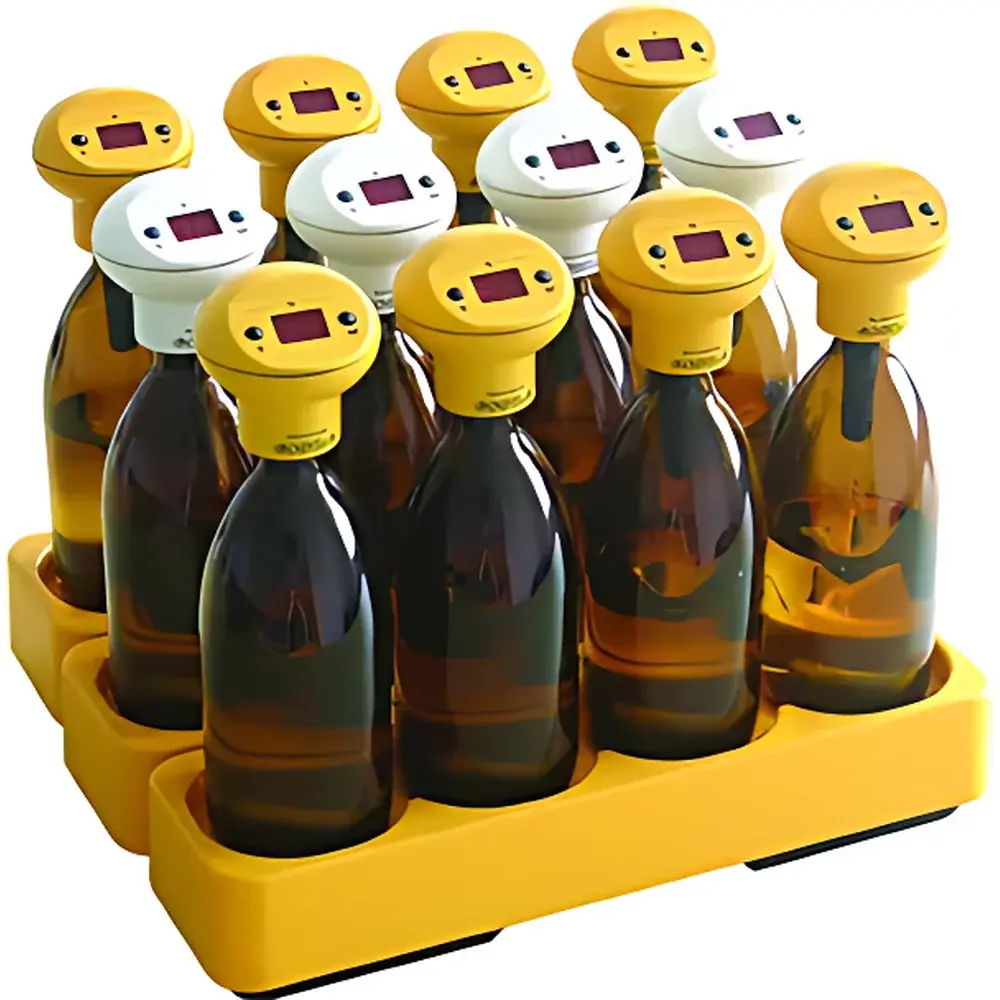
BODTECH-8 Laboratory BOD Analyzer by Environ Lab
| Brand | Environ Lab |
|---|---|
| Origin | USA |
| Model | BODTECH-8 |
| Instrument Type | Laboratory BOD Analyzer |
| Measurement Principle | Mercury-Free Pressure-Based Dissolved Oxygen Consumption Detection (Piezoelectric Crystal Sensor) |
| Measurement Range | 0–4000 mg/L (extendable to 5000 mg/L) |
| Accuracy | ±1 mg/L (±3.55 hPa) |
| Operating Pressure Range | 500–1100 hPa |
| Temperature Compensation | Automatic, Real-Time |
| Stirring Speed | 180–450 rpm |
| IP Rating | IP54 |
| Ambient Operating Temperature | +5°C to +50°C |
| Power Supply | Button-Cell Lithium Battery |
| Max Concurrent Samples | 4 × n (modular 4-bottle units) |
| Display | 2-Digit 7-Segment LED |
| Sample Handling | Undiluted, Direct Measurement |
| Stirring Configuration | Electromagnetic, Continuous |
| Data Logging | Daily Automated BOD Value Capture and Storage |
Overview
The BODTECH-8 Laboratory BOD Analyzer is an advanced, mercury-free biochemical oxygen demand (BOD) measurement system engineered for precision, safety, and regulatory compliance in environmental laboratories. It operates on a sealed, closed-loop pressure detection principle grounded in Henry’s Law and stoichiometric oxygen consumption kinetics. During the standard 5-day (or variable-duration) aerobic incubation at 20 °C, microorganisms in the water sample oxidize biodegradable organic matter, consuming dissolved oxygen (DO) and releasing carbon dioxide (CO₂). The CO₂ is chemically absorbed by sodium hydroxide or barium hydroxide pellets within the sealed sample bottle, preventing gas-phase re-equilibration and inducing a proportional negative pressure change. This pressure differential—measured continuously via a high-stability piezoelectric crystal sensor—is directly correlated to the mass of oxygen consumed, enabling direct conversion to BOD (mg O₂/L) without empirical calibration curves or manual titration.
Key Features
- Mercury-free pressure transduction using a solid-state piezoelectric crystal sensor—eliminates hazardous material handling, aligning with EPA Method 405.1 and EU Directive 2011/65/EU (RoHS).
- Real-time, automatic temperature compensation algorithm that dynamically corrects for thermal expansion effects in the sealed headspace; ensures metrological integrity when instruments enter or exit controlled incubators (e.g., ASTM D5210-92-compliant 20 °C ±0.5 °C environments).
- Undiluted sample analysis capability—preserves native microbial community dynamics and avoids dilution-induced bias, supporting accurate representation of actual biodegradation kinetics per ISO 5815-1:2019.
- Modular 4-bottle unit architecture—enables scalable deployment (4×n configurations); fault isolation ensures continued operation of unaffected modules during maintenance or failure.
- Continuous electromagnetic stirring (180–450 rpm)—maintains homogeneous DO distribution and mimics natural reaeration conditions, improving reproducibility across heterogeneous wastewater matrices.
- Onboard daily data capture and non-volatile storage—records time-stamped BOD values at 24-hour intervals, compliant with GLP audit trail requirements for raw data integrity.
Sample Compatibility & Compliance
The BODTECH-8 accepts standard 60 mL or 250 mL BOD bottles (glass or certified polymer), accommodating raw wastewater, treated effluent, surface water, and industrial process streams. Its undiluted measurement protocol meets the technical intent of US EPA Method 405.1, ISO 5815-1, and APHA Standard Methods 5210B. The system’s pressure-based detection avoids interference from colored, turbid, or high-suspended-solid samples that compromise optical or electrochemical BOD methods. All materials in contact with samples or CO₂ absorbent are chemically inert (borosilicate glass, PTFE-sealed lids, stainless-steel sensor housing), ensuring no leaching or catalytic side reactions. Device firmware and hardware design support alignment with FDA 21 CFR Part 11 for electronic records where laboratory information management systems (LIMS) integration is implemented via optional RS-232 output.
Software & Data Management
While the BODTECH-8 operates as a standalone instrument with local 2-digit LED readout, its embedded microcontroller logs all pressure-derived BOD values with date/time stamps in internal memory (retention ≥30 days). Data export is supported via serial interface for traceable transfer into validated LIMS or spreadsheet-based QA/QC workflows. The firmware implements write-protected memory sectors to prevent accidental overwriting, satisfying basic ALCOA+ principles (Attributable, Legible, Contemporaneous, Original, Accurate). Optional PC software (BODTECH Manager v3.x) provides graphical trend visualization, batch report generation (PDF/CSV), and deviation flagging against user-defined acceptance criteria—facilitating internal audits per ISO/IEC 17025:2017 Clause 7.7.
Applications
- Regulatory compliance testing for municipal wastewater treatment plants (NPDES permit monitoring).
- Industrial pretreatment program verification (e.g., food processing, pharmaceutical manufacturing, pulp & paper discharge).
- Research on biodegradability kinetics of emerging contaminants (e.g., surfactants, pharmaceutical residues) under controlled aerobic conditions.
- Educational laboratory instruction in environmental engineering and analytical chemistry curricula—low operational barrier supports rapid student proficiency.
- Field-deployable lab verification where portability, battery operation, and minimal consumables reduce logistical overhead versus manometric or dilution-based alternatives.
FAQ
How does the BODTECH-8 eliminate mercury use while maintaining accuracy?
It replaces traditional mercury manometers with a calibrated piezoelectric pressure sensor and CO₂ absorption chemistry—achieving ±1 mg/L accuracy per NIST-traceable validation protocols.
Can the system measure BOD beyond 5 days?
Yes—user-defined incubation durations (1–28 days) are supported; the instrument automatically calculates BODn based on cumulative O₂ consumption, consistent with ISO 5815-2 for extended testing.
Is sample dilution ever required?
No—undiluted analysis is standard; only samples exceeding 5000 mg/L BOD (rare in routine monitoring) require pre-dilution to remain within sensor dynamic range.
What maintenance is required for long-term reliability?
Annual sensor zero-point verification using certified pressure reference; replacement of CO₂ absorbent before each batch; no moving parts beyond the electromagnetic stirrer—designed for >10,000 operating hours.
Does the device comply with ISO/IEC 17025 documentation requirements?
Yes—raw pressure-to-BOD conversion algorithms are documented in the manufacturer’s technical file; instrument-specific calibration certificates and uncertainty budgets are provided upon request for accredited lab implementation.
Related Products







