
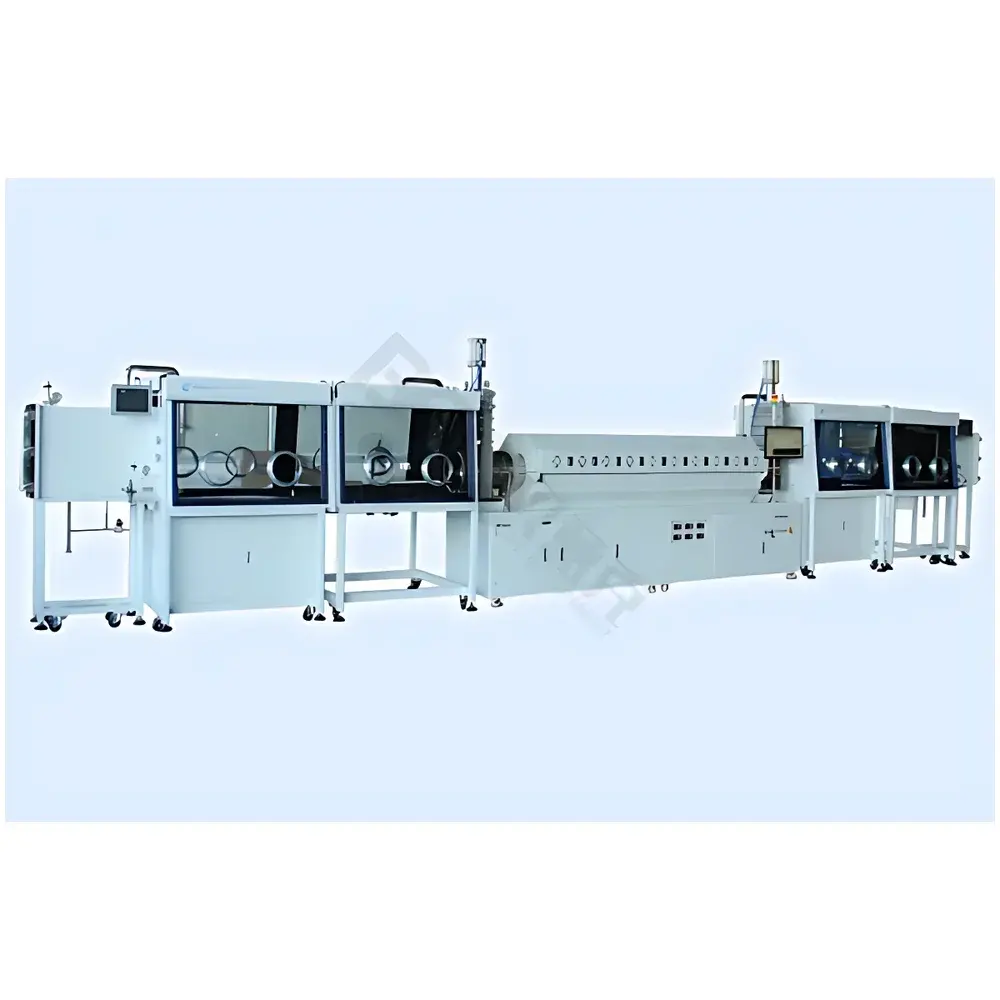
BOF-4-300-11-GB Sublimation System with Dual Integrated Gloveboxes
| Brand | BEQ |
|---|---|
| Origin | Anhui, China |
| Model | BOF-4-300-11-GB |
| Max Temperature | 600°C |
| Temperature Control Accuracy | ±1°C |
| Max Power | 15 kW |
| Heating Rate to Max Temp | ≤10°C/min |
| Heating Method | Resistance Wire Heating |
| Control System | Fuzzy PID + Auto-Tuning, 30-Stage Programmable Logic Controller with Over-Temperature and Thermocouple Failure Alarms |
| Tube Dimensions | Φ300 mm × 3000 mm |
| Glovebox Integration | Dual Front/Back Integrated Inert Atmosphere Enclosures (O₂ < 1 ppm, H₂O < 1 ppm) |
| Sample Loading Ports | 8 Access Ports (4 per glovebox) |
Overview
The BOF-4-300-11-GB Sublimation System is a high-precision, dual-glovebox-integrated thermal processing instrument engineered for solvent-free purification and phase-transfer synthesis of air- and moisture-sensitive functional materials. Unlike conventional vacuum sublimation ovens or standalone muffle furnaces, this system integrates two fully sealed inert-atmosphere gloveboxes—front and rear—directly flanged to a horizontal quartz or high-purity alumina tube furnace. This architecture enables uninterrupted material handling under continuous inert gas purge (N₂ or Ar), maintaining O₂ and H₂O concentrations below 1 ppm throughout the entire process chain: from sample loading and pre-conditioning, through controlled thermal ramping and isothermal sublimation, to post-processing collection and packaging. The core principle relies on thermally induced solid-to-vapor phase transition under reduced pressure (typically 10⁻²–10⁻⁴ mbar), followed by selective condensation in temperature-gradient zones—enabling separation of volatile precursors (e.g., metal-organic complexes, small-molecule emitters) from non-volatile residues or dopants. Its design conforms to fundamental requirements for reproducible purification of organic semiconductors, as defined in ASTM D7819-22 (Standard Guide for Purification of Organic Electronic Materials).
Key Features
- Dual integrated gloveboxes with welded stainless-steel chambers, ethylene-propylene-diene monomer (EPDM) gloves, and integrated gas purification systems (O₂/H₂O scrubbers), ensuring long-term inertness during multi-hour sublimation cycles.
- Horizontal tubular furnace with Φ300 mm internal diameter and 3000 mm active heating zone, constructed from high-density alumina fiber insulation and Kanthal A1 resistance wire heating elements for uniform axial temperature distribution (±2°C over 2000 mm at 500°C).
- 30-stage programmable temperature controller with fuzzy PID algorithm and auto-tuning capability—supporting complex thermal profiles including hold-ramp-hold sequences, cooling rate modulation, and real-time deviation compensation.
- Eight standardized CF-63 or KF-40 vacuum flange ports (four per glovebox), accommodating feedthroughs for thermocouples, pressure transducers, gas inlets/outlets, and auxiliary instrumentation without compromising seal integrity.
- Robust mechanical design featuring water-cooled flanges, reinforced ceramic tube supports, and corrosion-resistant internal coatings (electroless nickel plating on stainless steel components) to withstand repeated thermal cycling and halogen-containing precursor vapors.
Sample Compatibility & Compliance
The BOF-4-300-11-GB accommodates substrates and powders ranging from 1 g to 500 g per run, including metal phthalocyanines, iridium(III) complexes, triazoles, and perovskite precursors. Its inert-atmosphere workflow meets critical handling requirements for materials governed by IEC 61215-2 (photovoltaic module qualification) and JEDEC JESD22-A108 (moisture sensitivity level classification). All electrical and thermal safety systems comply with IEC 61010-1:2010 for laboratory equipment. Data logging functionality supports audit-ready records aligned with GLP and GMP Annex 11 principles, including user authentication, timestamped parameter changes, and alarm event history.
Software & Data Management
The embedded control interface provides local HMI operation via a 7-inch resistive touchscreen with intuitive graphical workflow navigation. Optional Ethernet/RS485 connectivity enables integration into centralized lab automation platforms (e.g., LabVantage, Thermo Fisher SampleManager). Process data—including setpoint trajectories, actual thermocouple readings (Type K, dual-channel), chamber pressure (capacitance manometer), and alarm logs—are exportable in CSV or XML format. Firmware supports optional 21 CFR Part 11-compliant electronic signatures when paired with validated third-party LIMS modules.
Applications
- Purification of OLED host/emitter materials (e.g., TCTA, CBP, Ir(ppy)₃) prior to vacuum thermal evaporation deposition.
- Sublimation-based fractionation of mixed-ligand lanthanide complexes for lighting phosphor development.
- Thermal deprotection and volatile byproduct removal in synthetic routes to high-purity perovskite quantum dots (e.g., CsPbBr₃).
- Preparation of ultra-dry catalyst precursors (e.g., Ni(acac)₂, Pd(dba)₂) for cross-coupling reactions requiring strict anhydrous conditions.
- Stability testing of air-sensitive battery electrode additives (e.g., LiFSI derivatives) under controlled thermal stress.
FAQ
What inert gas purity levels are maintained inside the gloveboxes during operation?
Standard configuration achieves ≤0.1 ppm O₂ and ≤0.1 ppm H₂O after 24-hour purge; optional heated getter modules extend stability to >1000 hours under continuous operation.
Can the furnace tube be replaced with quartz for UV-transparent sublimation studies?
Yes—customizable tube options include high-purity fused silica (up to 1100°C), recrystallized alumina (1650°C), or silicon carbide (1800°C), subject to pressure and thermal gradient constraints.
Is remote monitoring supported without additional hardware?
Basic status telemetry (temperature, pressure, alarm state) is accessible via built-in web server; full SCADA integration requires optional industrial Ethernet gateway module.
How is temperature uniformity verified across the 3-meter heating zone?
Factory calibration includes multi-point mapping using NIST-traceable thermocouples at five axial positions; certificate of conformance documents spatial deviation ≤±2°C at 500°C.
Does the system support dynamic pressure control during sublimation?
Yes—optional variable-speed vacuum pump controller and proportional throttle valve enable closed-loop pressure regulation between 10⁻⁴ and 10² mbar, synchronized with thermal profile stages.



