
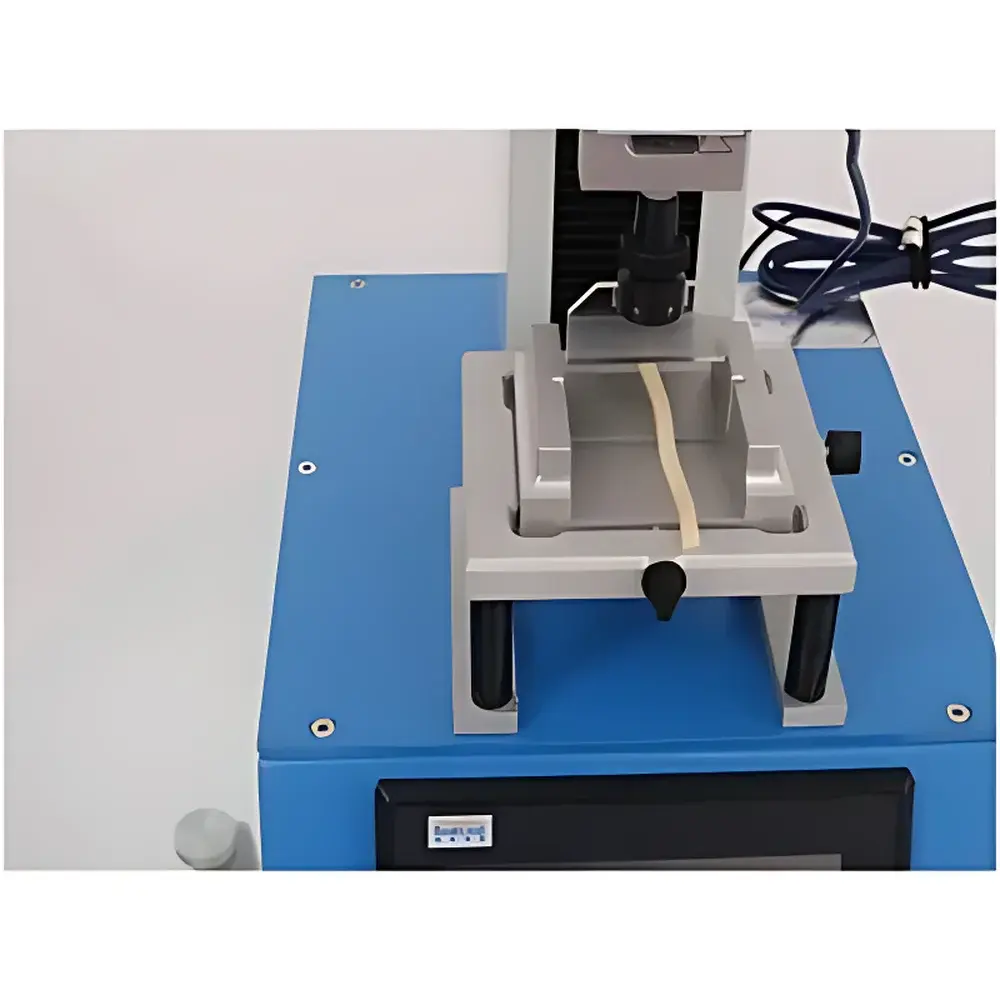
Bosin NS01 Noodle Breakage Tester – Texture Analyzer for Food Quality Control
| Brand | Bosin |
|---|---|
| Model | NS01 |
| Origin | Shanghai, China |
| Force Sensor Capacity | 20 kg (optional: 1/5/10/30/50 kg) |
| Force Accuracy | < ±0.5% FS |
| Load Cell Calibration | Traceable to international standard weights |
| Integrated Weighing Function | 0.1 g resolution |
| Displacement Resolution | 0.01 mm |
| Maximum Travel Distance | 320 mm |
| Test Speed Range | 0.01–20 mm/s (adjustable in 0.01 mm/s increments) |
| Data Acquisition Rate | 20 / 50 / 100 / 200 Hz (user-selectable) |
| Touchscreen Interface | Integrated high-definition capacitive display |
| Safety Features | Emergency stop, mechanical upper/lower limit switches, overload protection |
| Compliance | Designed for GLP-compliant food texture testing per ISO 11036 and ASTM STP 1594 guidelines |
Overview
The Bosin NS01 Noodle Breakage Tester is a dedicated single-axis texture analyzer engineered for objective, quantitative assessment of tensile and shear failure behavior in fresh, dried, and cooked noodles. It operates on the fundamental principle of controlled compression-shear force measurement: a precision-ground stainless-steel blade descends at a user-defined velocity onto a horizontally supported noodle strand, recording the peak shear force (in Newtons or kgf) required to induce complete fracture. This value—reported as “break force” or “noodle breaking strength”—serves as a direct mechanical correlate to consumer-perceived attributes such as chewiness, elasticity, and cooking durability. Unlike subjective sensory panels, the NS01 delivers repeatable, operator-independent metrics traceable to calibrated load cells, making it suitable for QC release testing, raw material qualification (e.g., wheat flour protein content validation), and R&D formulation optimization in commercial noodle production facilities and food science laboratories.
Key Features
- High-fidelity dual-function load cell: 20 kg capacity (with optional ranges up to 50 kg), certified accuracy < ±0.5% full scale, and integrated calibration verification using NIST-traceable standard weights.
- Integrated analytical balance function: Simultaneous sample weighing with 0.1 g resolution—eliminating need for external scales during pre-test mass normalization.
- Precision electromechanical actuation: Brushless DC motor with closed-loop speed control ensures stable, vibration-free displacement across the full 0.01–20 mm/s range; speed resolution ≤ 0.01 mm/s.
- Onboard touchscreen interface: 7-inch HD capacitive display enables full instrument control—including method setup, real-time force-displacement curve visualization, and result export—without external PC dependency.
- Configurable data acquisition: Sampling rates selectable from 20 to 200 Hz to capture transient failure events with sufficient temporal resolution for post-hoc analysis of fracture onset and energy absorption.
- Robust safety architecture: Hardware-enforced upper/lower mechanical limits, programmable emergency stop, and automatic load cell overrange cutoff prevent damage during abnormal test conditions.
Sample Compatibility & Compliance
The NS01 accommodates standard noodle specimens (diameter 1.0–2.5 mm, length 50–80 mm) mounted horizontally between two support fixtures. Its modular probe system allows rapid interchange of cutting blades, cylindrical probes, and three-point bending fixtures—enabling extension beyond breakage testing to include firmness, springiness, cohesiveness, and adhesiveness per ISO 11036:2022 (Sensory analysis — Methodology — General guidance for texture profile analysis). The instrument’s firmware supports audit trail logging, user access levels, and encrypted data storage—aligning with basic GLP documentation requirements for regulated food testing environments. While not FDA 21 CFR Part 11-certified out-of-the-box, its data export formats (CSV, PDF reports) are compatible with validated LIMS integration workflows.
Software & Data Management
The embedded TA.TOUCH software provides intuitive method templates for standardized noodle break tests (e.g., “ASTM D638-inspired single-strand shear”), with editable parameters for trigger threshold, dwell time, return speed, and auto-zero delay. Real-time plotting displays force (N) vs. displacement (mm) curves during acquisition, with automatic annotation of peak force, fracture displacement, and area under curve (energy to break). Historical datasets are stored with timestamp, operator ID, sample ID, and environmental metadata (if connected to optional ambient sensor module). Export options include raw ASCII time-series files for MATLAB/Python analysis and summary reports compliant with internal QA documentation protocols.
Applications
- Quality control of dry and fresh noodle batches against breaking strength specifications (e.g., ≥ 1.8 N for alkaline ramen strands).
- Evaluation of flour quality: Correlating gluten strength (via SDS sedimentation or Mixolab) with empirical break force to optimize blending ratios.
- Process validation: Assessing impact of drying temperature, steaming duration, or alkaline addition (kansui) on structural integrity.
- Shelf-life studies: Monitoring mechanical degradation of noodles during accelerated aging or humidity cycling.
- Ingredient substitution trials: Quantifying functional equivalence of gluten-free flours (e.g., rice + tapioca blends) versus wheat-based controls.
FAQ
What standards does the NS01 comply with for food texture testing?
It adheres to the mechanical test methodology frameworks outlined in ISO 11036 and ASTM STP 1594, supporting reproducible shear-force measurement aligned with internationally recognized texture analysis practice.
Can the NS01 be used for other food products besides noodles?
Yes—its modular probe design and programmable test sequences allow adaptation for pasta, rice vermicelli, udon, soba, and other elongated cereal-based foods; supplementary fixtures enable fruit firmness, cheese hardness, or cracker fracture testing.
Is calibration traceable to national metrology institutes?
Load cell calibration uses certified standard weights with documented uncertainty; users may perform in-house verification or contract third-party calibration accredited to ISO/IEC 17025.
Does the system support automated reporting for regulatory submissions?
While the base unit generates auditable CSV and PDF outputs, formal 21 CFR Part 11 compliance requires integration with validated enterprise software layers—contact Bosin Application Support for validated LIMS interfacing options.
What maintenance is required for long-term accuracy?
Annual verification of load cell linearity and displacement encoder accuracy is recommended; routine cleaning of guide rails and blade edges ensures consistent mechanical performance across >10,000 test cycles.






