
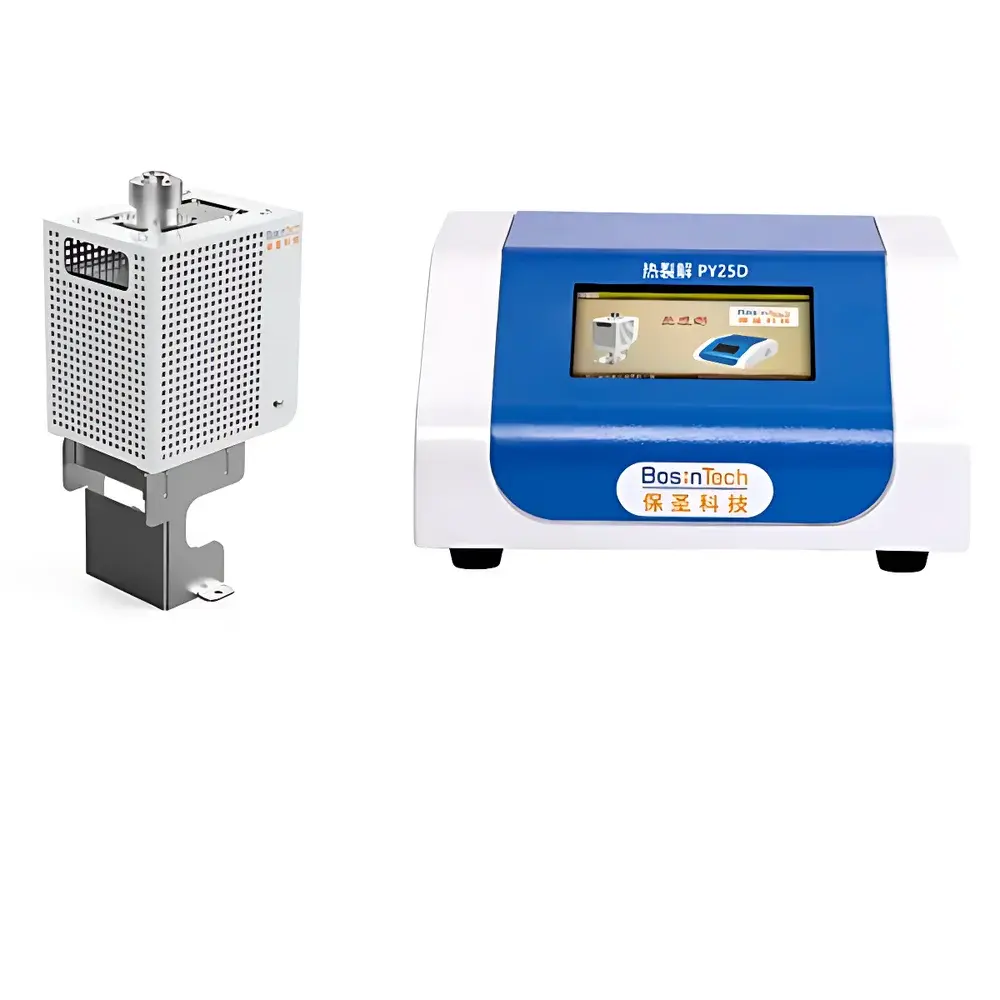
Bosin PY-1050 High-Temperature Programmable Pyrolyzer
| Brand | Bosin |
|---|---|
| Origin | Shanghai, China |
| Model | PY-1050 |
| Temperature Range | Ambient to 1050 °C |
| Heating Rate | 0.1–100 °C/min |
| Pyrolysis Chamber Material | High-Purity Stainless Steel |
| Carrier Gas | Nitrogen (N₂) |
| Gas Flow Control | 0.1–100 mL/min |
| GC/MS Interface | Standard Transfer Line with Independent Temperature Control (up to 350 °C) |
| Safety Features | Over-Temperature Protection, Real-Time Gas Leak Detection |
| Software | Dual-Language (English/Chinese) Control & Data Acquisition Interface |
| Compliance | Designed for ASTM D7269, ISO 18242, and USP <621> chromatographic method integration |
Overview
The Bosin PY-1050 is a high-temperature, programmable pyrolyzer engineered for precise thermal degradation of polymeric, organic, and complex solid/liquid samples prior to gas chromatography–mass spectrometry (GC-MS) analysis. It operates on the principle of controlled flash pyrolysis—rapid, reproducible thermal dissociation under inert nitrogen atmosphere—to convert thermally labile macromolecules into volatile, structurally diagnostic fragments. Unlike conventional oven-based thermal desorption systems, the PY-1050 employs resistive heating of a quartz or metal sample cup within a sealed stainless-steel chamber, enabling millisecond-level thermal response and minimal secondary reactions. Its design supports both evolved gas analysis (EGA) and double-shot pyrolysis protocols, making it suitable for routine QC labs, academic research facilities, and regulatory testing environments where molecular fingerprinting of polymers, microplastics, cultural heritage materials, and industrial organics is required.
Key Features
- Temperature range from ambient +10 °C to 1050 °C with ±0.5 °C accuracy and stability maintained over 60 min at maximum setpoint.
- Programmable multi-segment heating profiles (up to 8 steps), supporting ramp rates from 0.1 to 100 °C/min—enabling simulation of real-world thermal degradation kinetics.
- Dual-mode operation: single-shot pyrolysis for bulk polymer characterization; double-shot mode for sequential low-temperature desorption (e.g., plasticizers, additives) followed by high-temperature backbone cleavage.
- Stainless-steel pyrolysis chamber with inert surface finish resists catalytic side reactions and ensures long-term reproducibility across >5,000 cycles.
- Integrated carrier gas flow control (0.1–100 mL/min N₂) with mass-flow sensor feedback and pressure-compensated delivery to GC inlet.
- Heated transfer line (up to 350 °C) with independent PID temperature regulation prevents condensation of semi-volatiles and maintains chromatographic integrity.
- Real-time safety monitoring including dual redundant over-temperature cutoffs and continuous helium/nitrogen leak detection via integrated pressure decay algorithm.
Sample Compatibility & Compliance
The PY-1050 accommodates solid, powder, gel, and liquid specimens—including rubber crumbs, paint chips, archaeological lacquer fragments, soil extracts, and microplastic filters—without derivatization or solvent extraction. Sample loading is performed manually using disposable quartz boats or reusable stainless cups (1–5 mg typical mass). The system meets mechanical and electrical safety requirements per IEC 61010-1 and is designed to operate within GLP/GMP-compliant workflows. Its software architecture supports audit-trail generation, user access levels, and electronic signature capability in alignment with FDA 21 CFR Part 11 when deployed with validated third-party LIMS or GC-MS data systems. Method parameters are exportable in CSV/XML formats for traceability in ISO/IEC 17025-accredited laboratories.
Software & Data Management
The embedded control software provides a bilingual (English/Chinese), touch-optimized interface for method creation, real-time temperature/gas flow visualization, and event-triggered data logging. All pyrolysis events—including start time, ramp profile, hold duration, and gas flow history—are timestamped and stored locally with SHA-256 checksum integrity verification. Raw output files (.txt/.csv) include full metadata headers compatible with Open Chrom, Chromeleon, MassHunter, and Compound Discoverer workflows. Remote operation via Ethernet is supported, and optional OPC UA integration enables seamless coordination with automated sample introduction systems or robotic GC autosamplers.
Applications
- Polymer Characterization: Identification of synthetic rubbers (e.g., SBR, EPDM), thermoplastics (PP, PE, PET), and biopolymers per GB/T 39699-2020 and ASTM D7269; quantification of antioxidant residues (e.g., BHT, Irganox 1010) and plasticizer migration (DEHP, DINP).
- Environmental Analysis: Direct identification and semi-quantitative profiling of microplastics in seawater, sediment, and air filters; source apportionment of organic pollutants in coatings and adhesives.
- Cultural Heritage Science: Non-invasive analysis of historic lacquer layers, binding media in East Asian polychrome woodwork, and proteinaceous adhesives—supporting conservation decisions aligned with ICOM-CC guidelines.
- Industrial Process Support: Catalyst deactivation studies in petrochemical refining; thermal stability assessment of battery binders (e.g., PVDF); feedstock evaluation in tire pyrolysis valorization processes.
- Regulatory Screening: Rapid RoHS-compliant screening of phthalates and brominated flame retardants in electronics housings per EN 62321-8:2017.
FAQ
What sample types are compatible with the PY-1050?
Solid polymers, elastomers, composites, soils, biological tissues, and viscous liquids—including microplastic-laden filters and aged lacquer cross-sections—can be analyzed directly without solvent extraction or derivatization.
Is the PY-1050 compatible with all GC-MS systems?
Yes—it features a universal heated transfer line with standard 1/16″ Swagelok fittings and supports direct coupling to Agilent, Thermo Fisher, Shimadzu, and JEOL GC-MS platforms via vendor-specific interface kits.
How is method validation supported?
The system records full thermal and gas parameter logs for each run, enabling retrospective review of instrument performance against reference standards such as NIST SRM 2484 (polyethylene) or certified polymer mixtures.
Can the PY-1050 be used for quantitative analysis?
When paired with internal standard calibration and matrix-matched reference materials, it delivers RSDs <5% for repeat injections of polymer additives and plasticizers across multiple days.
What maintenance is required?
Routine maintenance includes quarterly inspection of quartz liner integrity, annual recalibration of thermocouples and mass flow controllers, and replacement of O-rings every 12 months under continuous operation.






