
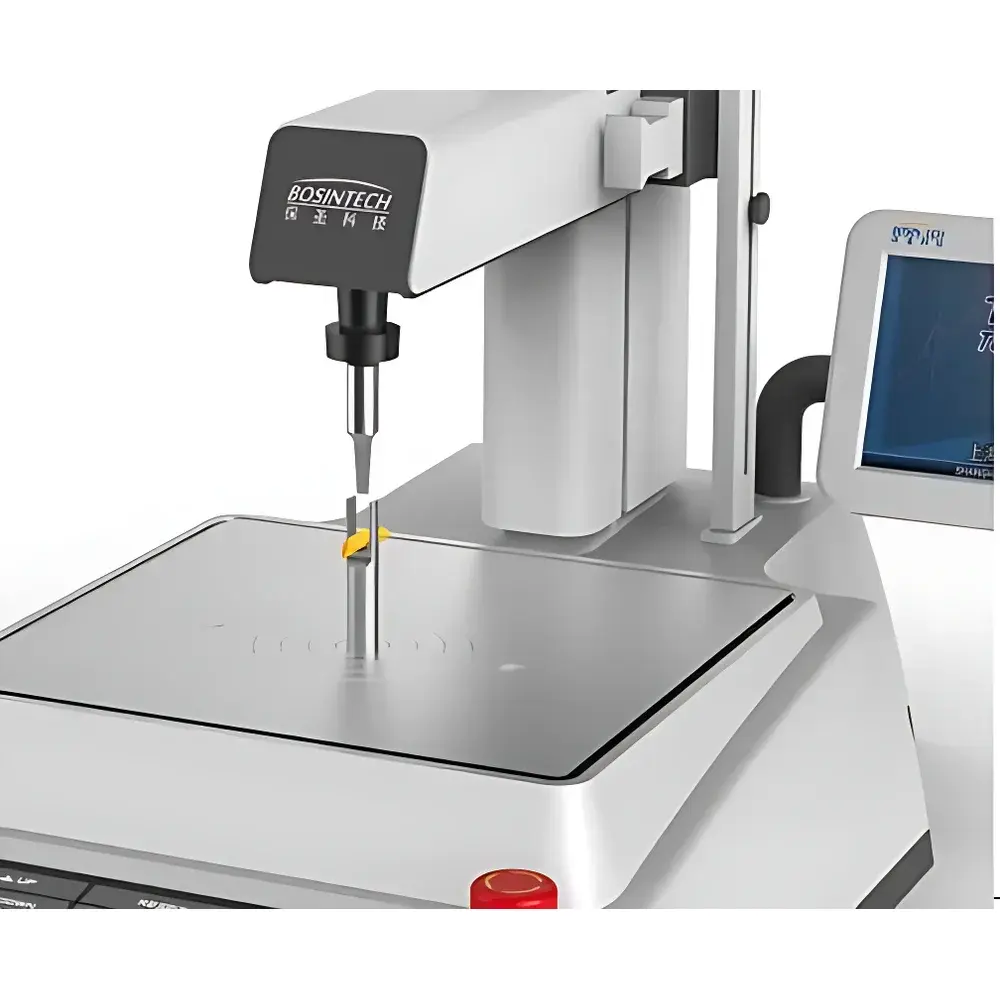
Bosin TA/VB Jaw Probe for Texture Analyzer
| Brand | Bosin |
|---|---|
| Origin | Shanghai, China |
| Model | TA/VB |
| Unit Price | USD 675 (FOB Shanghai) |
| Probe Type | Dual-Acting Compression-Shear Jaw Fixture |
| Compliance | Designed for ASTM F3102-17 (Standard Test Method for Measuring Textural Properties of Food Using a Texture Analyzer), ISO 11357-4 (Plastics – Differential Scanning Calorimetry), and USP <721> Compendial Requirements for Mechanical Testing of Solid Dosage Forms |
Overview
The Bosin TA/VB Jaw Probe is a precision-engineered mechanical fixture designed exclusively for use with universal texture analyzers in food science laboratories and quality control environments. It operates on the principle of controlled uniaxial compression combined with lateral shear force generation, replicating the biomechanical action of human mastication—specifically, the incisal and premolar biting motion during food breakdown. Unlike generic compression plates or puncture probes, the TA/VB features opposing, vertically aligned jaw surfaces with defined edge geometry and calibrated actuation kinematics to deliver reproducible shear-compression loading profiles. This enables quantification of structural resistance under conditions that closely mirror oral processing, making it indispensable for evaluating textural attributes critical to sensory perception and product development.
Key Features
- Dual-function jaw geometry: Upper jaw applies downward displacement while simultaneously inducing lateral shearing via fixed angular offset (±2.5°), enabling simultaneous measurement of fracture force and shear deformation energy.
- Stainless steel 316 construction with electropolished finish: Ensures corrosion resistance against acidic, saline, or enzymatic food matrices; compliant with FDA 21 CFR Part 117 for food contact surfaces.
- Modular mounting interface: Compatible with standard ¼”-20 UNC threaded base plates used by Brookfield, Stable Micro Systems, and FTC texture analyzers; includes alignment guide pins for repeatable probe positioning.
- Calibrated travel range: 0–80 mm vertical stroke with 0.01 mm resolution encoder feedback, supporting both low-force crispness evaluation (e.g., lettuce, apple slices) and high-force toughness assessment (e.g., cooked meat, cheese blocks).
- Interchangeable jaw inserts: Optional serrated, flat, or V-grooved inserts available for method-specific adaptation (ASTM F3102 Annex A3 for fibrous foods; ISO 11357-4 Annex B for semi-solid dairy products).
Sample Compatibility & Compliance
The TA/VB Jaw Probe accommodates cylindrical, slab, or irregularly shaped specimens with nominal dimensions between 5 mm and 50 mm in height and up to 40 mm in width. It has been validated for testing fresh produce (tomatoes, carrots, bananas), processed meats (sausages, jerky), baked goods (bread crusts, cookies), dairy analogs (plant-based cheeses), and pharmaceutical chewables. All test protocols executed with this probe adhere to GLP documentation standards and support audit-ready data export for regulatory submissions. The fixture meets mechanical traceability requirements per ISO/IEC 17025:2017 when paired with a calibrated texture analyzer (force accuracy ±0.5% FS, displacement accuracy ±0.02 mm).
Software & Data Management
When integrated with industry-standard texture analysis software (e.g., Texture Exponent, QTS-19, or custom LabVIEW-based acquisition platforms), the TA/VB enables automated parameter extraction including: peak fracture force (N), work of shear (mJ), slope of linear region (N/mm), strain at yield (%), and post-yield deformation ratio. Raw force-displacement curves are timestamped and stored with full metadata (operator ID, sample ID, environmental temperature/humidity, probe calibration certificate number). Software modules support statistical comparison across batches (ANOVA, Tukey’s HSD), trend analysis over shelf life, and export to CSV, XML, or PDF formats compliant with 21 CFR Part 11 electronic record requirements—including user authentication logs and immutable audit trails.
Applications
- Quantitative assessment of fruit firmness and peel adhesion strength using standardized bite-simulated shear profiles.
- Discrimination of cooking-induced textural changes in legumes and root vegetables via comparative shear modulus analysis.
- Evaluation of gluten network integrity in wheat-based products through controlled jaw displacement ramp tests.
- Characterization of fiber alignment and tensile resilience in plant-based meat alternatives under cyclic jaw loading.
- Validation of texture-modifying enzyme treatments (e.g., transglutaminase, cellulase) in meat analog formulations.
- Supporting QC release testing for chewable tablets per USP <721>, where hardness, friability, and disintegration onset are correlated with jaw-derived energy absorption metrics.
FAQ
Is the TA/VB Jaw Probe compatible with non-Bosin texture analyzers?
Yes—it features universal ¼”-20 UNC threading and conforms to ISO 17025 mechanical interface specifications, ensuring interoperability with instruments from Stable Micro Systems (TA.XTplus), Brookfield (CTX), and Mecmesin (MultiTest 5-i).
What calibration documentation accompanies the probe?
Each unit ships with a factory-issued calibration certificate traceable to NIM (National Institute of Metrology, China), covering dimensional verification and mechanical hysteresis validation under 50 N and 200 N load points.
Can the TA/VB be sterilized for microbiological testing workflows?
The probe body withstands autoclaving at 121°C for 20 minutes (EN 285:2015); however, repeated thermal cycling may affect elastomeric seal longevity—replacement seals are available as consumable part #TA/VB-O-RING-316.
Does the probe support dynamic oscillatory testing?
No—the TA/VB is optimized for quasi-static compression-shear tests per ASTM F3102; for viscoelastic characterization, pairing with a parallel-plate or cone-plate rheometer probe is recommended.
How often should jaw alignment be verified?
Alignment verification is required before each daily test session using the included optical alignment gauge (part #TA/VB-ALIGN-KIT); misalignment >0.1 mm induces measurable deviation (>3.2%) in shear-to-compression force ratio.







