
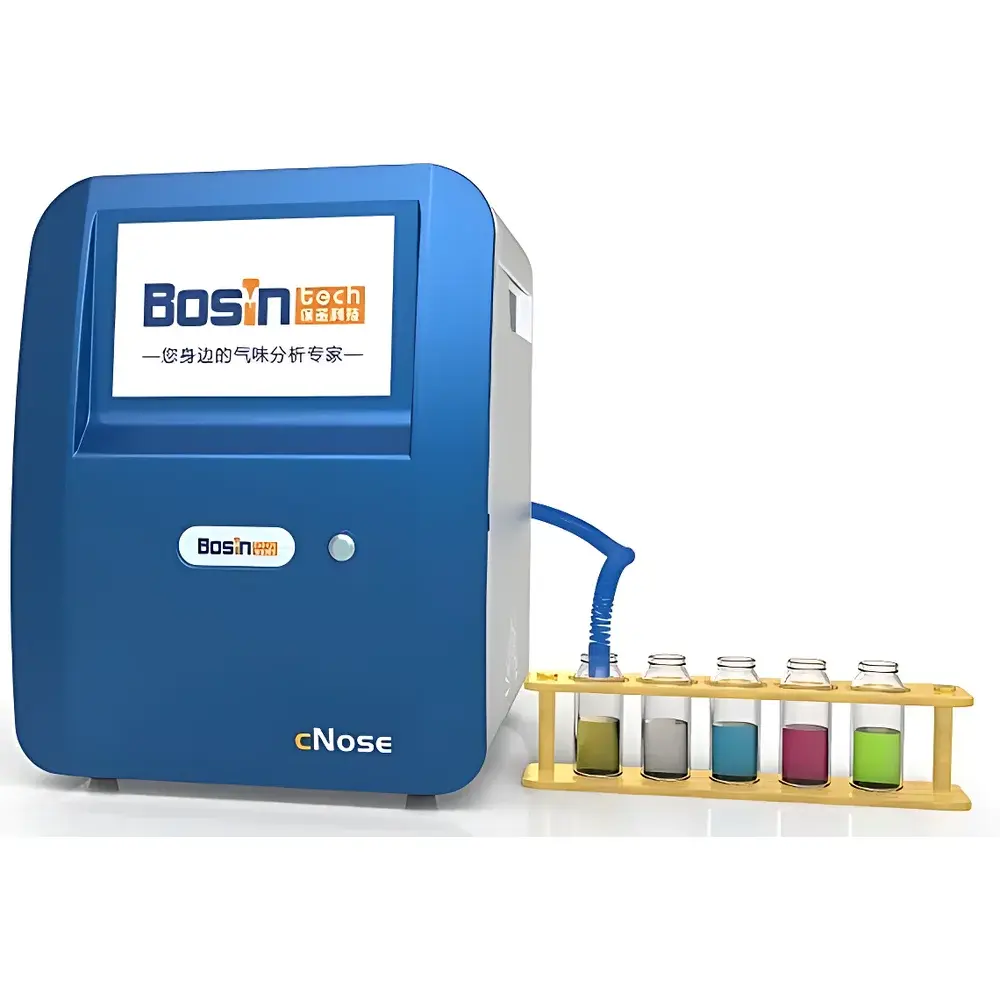
BosinTech C-Nose Electronic Nose for Odor Discrimination
| Brand | BosinTech |
|---|---|
| Model | C-Nose |
| Origin | Shanghai, China |
| Manufacturer | Shanghai Bosin Industrial Development Co., Ltd. |
| Product Type | Sensory Intelligent Analysis System – Electronic Olfaction Analyzer |
| Detection Principle | Metal Oxide Semiconductor (MOS) Sensor Array-Based Volatile Organic Compound (VOC) Profiling |
| Sensor Count | 14 Independent MOS Sensors with Differential Selectivity |
| Detection Limit | Sub-ppb (parts-per-quadrillion equivalent sensitivity in optimized matrix) |
| Sample Analysis Time | 60–120 s |
| Sensor Response Time | <1 s |
| Architecture | Modular Air Chamber Isolation per Sensor |
| Configuration Options | Desktop, Portable, and Online Integration Versions |
| Data Analysis Framework | PCA, SIMCA, PLS-DA, DFA, PLS, and Hierarchical Clustering |
| Compliance Readiness | Supports GLP/GMP-aligned audit trails, 21 CFR Part 11-compliant software modules (optional), ISO 19957 (electronic nose performance validation), ASTM E2813 (odor discrimination testing protocols) |
Overview
The BosinTech C-Nose is a high-fidelity electronic olfaction system engineered for objective, reproducible discrimination of complex volatile organic compound (VOC) profiles across diverse sample matrices. Operating on the principle of differential metal oxide semiconductor (MOS) sensor response kinetics, the C-Nose captures transient and equilibrium-phase signals from headspace vapors to generate multidimensional “odor fingerprints.” Unlike subjective sensory panels, this instrument delivers quantitative, operator-independent odor characterization—enabling rapid classification, similarity mapping, and trend analysis without reliance on human panel calibration or fatigue management. Its core architecture features 14 chemically heterogeneous MOS sensors housed in physically isolated micro-air chambers, minimizing cross-talk and ensuring long-term signal stability under repeated exposure cycles. Designed for integration into regulated laboratory and industrial environments, the C-Nose meets foundational requirements for method validation per ISO 19957 and supports protocol development aligned with ASTM E2813 for odor-based product differentiation.
Key Features
- 14-channel MOS sensor array with tailored surface chemistries for broad-spectrum VOC reactivity (aldehydes, esters, sulfur compounds, terpenes, alcohols, ketones)
- Sub-second sensor response latency and real-time analog-to-digital signal acquisition at 100 Hz sampling rate
- Modular air chamber design per sensor element—eliminates carryover and enables independent baseline stabilization
- Three deployment configurations: benchtop (C-Nose-DT), handheld field unit (C-Nose-PT), and process-integrated online module (C-Nose-OL) with 4–20 mA/Modbus RTU output
- Embedded environmental compensation for temperature (±0.1°C) and relative humidity (±1% RH) during acquisition
- Pre-calibrated sensor drift correction algorithm based on periodic zero-gas referencing (N₂ or synthetic air)
Sample Compatibility & Compliance
The C-Nose accepts liquid, solid, semi-solid, and gaseous samples via standardized headspace vial autosampling (20 mL crimp-top vials), direct probe insertion (for viscous or particulate-laden matrices), or continuous stream coupling (for exhaust ducts or bioreactor off-gas lines). It has been validated for use in food freshness assessment (ISO 22000-aligned QC workflows), pharmaceutical excipient odor profiling (ICH Q5C), polymer solvent residue screening (ASTM D7212), and environmental odor source identification (EPA Method TO-15 adjunct). All firmware and data handling modules support configurable audit trails, electronic signatures, and user role-based access control—facilitating compliance with GLP, GMP, and FDA 21 CFR Part 11 when deployed with optional secure software licensing.
Software & Data Management
BosinTech’s C-Nose Studio v4.2 provides a unified interface for acquisition, multivariate modeling, and reporting. Raw resistance-change time-series are automatically normalized and aligned using dynamic time warping (DTW). The platform natively implements PCA for exploratory pattern visualization, SIMCA for class membership verification (e.g., authentic vs. adulterated spice batches), PLS-DA for binary/multiclass discrimination (e.g., rancid vs. fresh oil), DFA for ordinal quality grading (e.g., coffee roast level scoring), and PLS regression for correlating odor fingerprints with physicochemical endpoints (peroxide value, TBARS, pH, ethanol content). All models are exportable as PMML 4.4 files; raw datasets comply with ASTM E1902 metadata standards. Data archives are stored in encrypted SQLite databases with SHA-256 hash integrity verification.
Applications
- Food & Beverage: Real-time monitoring of lipid oxidation in edible oils, shelf-life prediction of dairy products, varietal authentication of fruit juices, fermentation stage tracking in yogurt and kombucha, roast profile correlation in coffee and cocoa
- Pharmaceuticals: Excipient odor consistency screening, residual solvent detection in lyophilized powders, packaging leachate profiling, stability-indicating odor shift detection
- Materials Science: VOC emission profiling from adhesives, curing state verification in thermosets, degradation marker detection in recycled polymers
- Environmental Health: Odor source apportionment in wastewater treatment plants, landfill gas composition trending, indoor air quality event detection (e.g., mold bloom onset), biogas purity verification
- Agri-Tech: Grain storage condition assessment (moisture/mold index), harvest maturity estimation via volatile bouquet evolution, post-harvest handling impact quantification
FAQ
What sample preparation is required prior to analysis?
Minimal preparation is needed: liquids are equilibrated in sealed headspace vials (10–60 min, 40°C); solids are homogenized and placed directly in vials; gases are introduced via calibrated mass flow controller. No derivatization or extraction is necessary.
Can the C-Nose quantify individual compounds?
No—it is a pattern-recognition instrument, not a compositional analyzer. It identifies and discriminates mixtures based on holistic VOC profile similarity—not absolute concentration of single analytes. For compound-specific quantification, GC-MS or GC-FID coupling is recommended.
How often must sensors be recalibrated?
Factory calibration remains stable for ≥12 months under routine use. Annual verification against certified reference odor standards (e.g., ISO 8586 reference sets) is advised; drift correction is performed automatically during each run using internal zero-reference cycles.
Is remote monitoring supported?
Yes—C-Nose-OL and C-Nose-DT units support MQTT and OPC UA protocols for integration into SCADA and MES platforms. Live status dashboards and alerting (e.g., deviation from reference cluster) are configurable via web-based HMI.
Does the system support method transfer between instruments?
Yes—sensor response normalization and model portability are ensured through BosinTech’s Cross-Instrument Transfer Protocol (CITP), which standardizes feature scaling, baseline subtraction, and PCA loading vector alignment across device fleets.




