
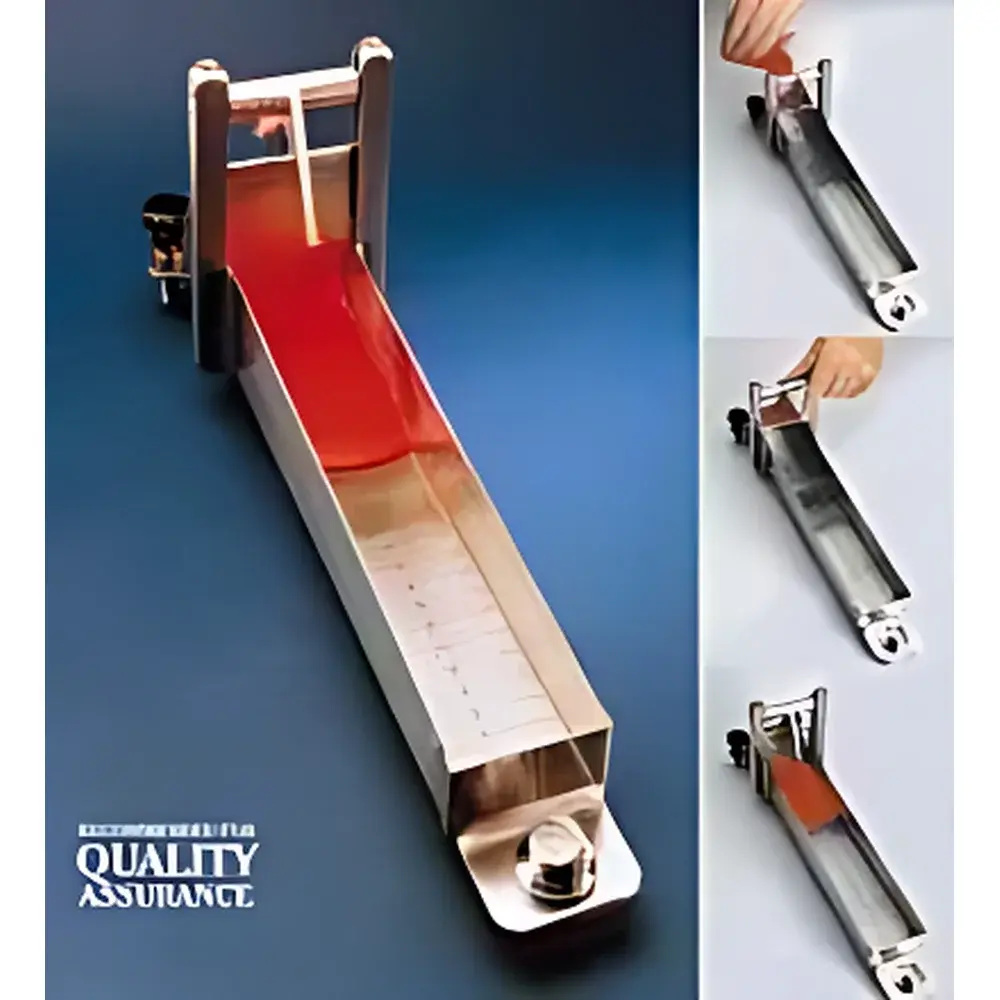
Bostwick Consistometer by Endecotts
| Brand | Endecotts |
|---|---|
| Origin | United Kingdom |
| Instrument Type | Flow-Off Viscometer (Bostwick Consistometer) |
| Construction | Stainless Steel Body |
| Sample Volume | 75 mL |
| Dimensions (L×W×H) | 14 in × 3.5 in × 5.5 in |
| Scale Graduation | 0.5 cm per division |
| Leveling | Dual adjustable leveling screws + bubble level |
| Gate Mechanism | Spring-loaded gate for instantaneous release |
| Compliance | Referenced in SN/T 1036–2002 (China Entry-Exit Inspection and Quarantine Industry Standard) |
Overview
The Bostwick Consistometer by Endecotts is a precision-engineered, gravity-driven flow-off viscometer designed specifically for rapid, repeatable assessment of consistency, flow behavior, and structural yield in semi-solid and highly viscous food products. Unlike rotational or capillary viscometers, the Bostwick method relies on controlled gravitational flow over a fixed incline—typically 6°—to quantify the distance (in centimeters) a sample travels under its own weight within a standardized time interval (commonly 30 seconds). This empirical yet highly reproducible measurement correlates directly with product texture, pumpability, spreadability, and thermal stability—making it indispensable for quality control in tomato paste, ketchup, fruit purées, yogurts, jams, sauces, and similar structured fluids. Its simplicity, mechanical robustness, and minimal calibration requirements render it ideal for both laboratory validation and high-frequency production-line testing.
Key Features
- Stainless steel construction ensures long-term corrosion resistance and compliance with food-grade hygiene standards (e.g., FDA 21 CFR Part 110, EC 1935/2004).
- Precision-machined 6° inclined flow channel with engraved 0.5 cm scale divisions enables direct, traceable reading of flow distance without interpolation.
- Spring-loaded gate mechanism delivers consistent, zero-delay release—critical for eliminating operator-induced variability in start timing.
- Dual leveling screws and integrated bubble level guarantee strict adherence to ISO 3219 and ASTM D1475-compliant test geometry across all installations.
- Compact footprint (14″ × 3.5″ × 5.5″) supports deployment in constrained lab benches or near-processing lines without dedicated infrastructure.
- Standardized 100 mL sample reservoir accommodates 75 mL test volume—optimized for representative sampling while minimizing material waste.
- Inter-instrument harmonization verified through Endecotts’ internal metrological protocol, ensuring cross-site comparability for multi-facility QC programs.
Sample Compatibility & Compliance
The Bostwick Consistometer is validated for use with non-Newtonian, shear-thinning, and yield-stress fluids exhibiting apparent viscosities ranging from ~102 to >106 mPa·s. It is routinely applied to tomato-based products (ketchup, paste, juice concentrate), dairy spreads (sour cream, Greek yogurt), fruit preparations (jellies, compotes), and industrial coatings where structural integrity upon rest and flow onset under low stress are critical performance indicators. The instrument conforms to multiple international standard methods, including SN/T 1036–2002 (China Customs inspection for exported tomato sauce), AOAC Official Method 981.12 (ketchup consistency), and referenced procedures in ISO 11357-6 (plastics rheology analogues). Its mechanical design meets GLP audit requirements for instrument qualification (IQ/OQ/PQ), with no software or electronic components requiring 21 CFR Part 11 validation.
Software & Data Management
The Bostwick Consistometer operates as a fully manual, analog measurement system—eliminating dependency on proprietary software, firmware updates, or digital data interfaces. All measurements are recorded directly onto paper log sheets or LIMS-compatible spreadsheets using standardized reporting templates. For laboratories requiring digital traceability, Endecotts provides optional companion documentation kits—including calibration verification logs, operator training checklists, and SOP templates aligned with ISO/IEC 17025 accreditation criteria. No electronic data capture or audit trail functionality is embedded; however, the device’s inherent mechanical determinism supports full compliance with GMP Annex 11 principles when integrated into documented paper-based QC workflows.
Applications
- Batch release testing of tomato ketchup against regulatory viscosity thresholds (e.g., USDA Grade A: 5–10 cm flow in 30 s).
- Monitoring thermal degradation during concentration or pasteurization—reduced flow distance indicates gel network strengthening or pectin hydrolysis.
- Formulation development for low-sugar or clean-label sauces where hydrocolloid interactions directly impact Bostwick flow.
- Supplier qualification for raw tomato pulp consistency prior to blending or seasoning.
- Stability assessment of emulsified dressings and mayonnaise analogues under ambient storage conditions.
- Cross-comparison of rheological behavior between pilot-scale and commercial production batches.
FAQ
What is the standard test duration for Bostwick measurements?
The internationally accepted duration is 30 seconds, measured from the moment the gate is released. Some applications (e.g., low-viscosity tomato juice concentrates) may specify 15 s or 60 s—always reference the governing standard or internal SOP.
Does the Bostwick Consistometer require calibration with reference fluids?
No. It is a geometrically defined, gravity-dependent instrument. Verification consists of physical checks: incline angle (6° ± 0.1°), scale linearity (certified via NIST-traceable calipers), and gate timing repeatability (±0.1 s).
Can results be converted to absolute viscosity units (e.g., Pa·s)?
Not directly. Bostwick flow distance is an empirical index correlated to yield stress and apparent viscosity under low-shear conditions. Conversion requires parallel rheometric testing (e.g., vane or plate-plate geometry) and regression modeling for each product matrix.
Is cleaning validated for allergen or residue control?
Yes. Full disassembly is possible; stainless steel surfaces are compatible with CIP/SIP protocols and validated cleaning agents per FDA Food Code Appendix I and EHEDG Guideline Doc. 17.
How does temperature affect Bostwick readings?
Temperature must be controlled per test method—typically 20 ± 0.5°C for tomato products. A 1°C deviation may alter flow distance by 2–4%, necessitating thermostatic sample conditioning before loading.



