
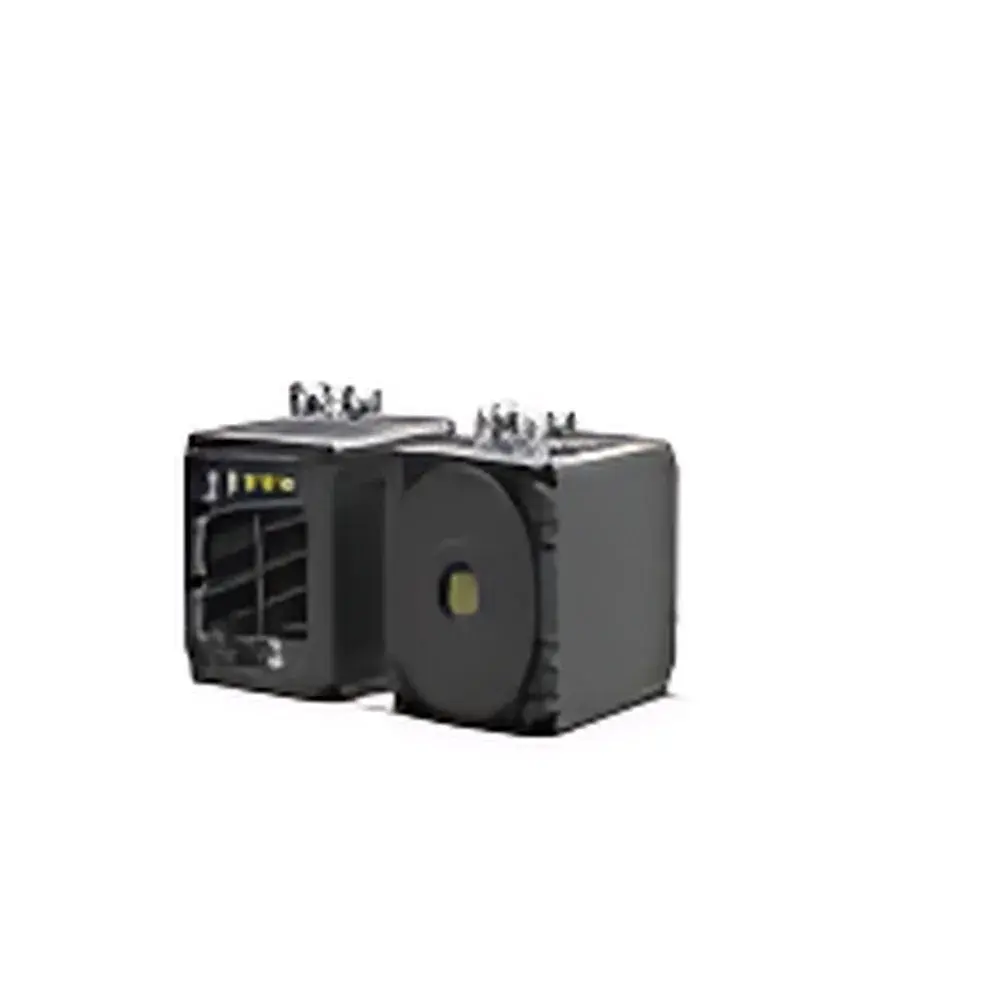
Bphoton Dhyana95V2 Back-Illuminated sCMOS Camera
| Brand | Bphoton |
|---|---|
| Origin | Shanghai, China |
| Model | Dhyana95V2 |
| Image Resolution | 2048(H) × 2048(V) |
| Pixel Size | 11 µm × 11 µm |
| Sensor Format | 2-inch G400BSI back-illuminated sCMOS |
| Quantum Efficiency | 95% @ 560 nm |
| Dynamic Range | 86 dB |
| Readout Speed | 24 fps @ 16-bit HDR / 48 fps @ 12-bit STD |
| Full Well Capacity | 100,000 e⁻ (STD), 80,000 e⁻ (HDR) |
| Read Noise | 1.6 e⁻ (median) / 1.7 e⁻ (RMS) in High Gain mode |
| Cooling | Air-cooled to −15°C @ 20°C ambient |
| Dark Current | 0.5 e⁻/pix/s (air), 0.25 e⁻/pix/s (water) |
| DSNU | 0.2 e⁻ |
| PRNU | 0.3% |
| Interface | USB 3.0 & Camera Link |
| Lens Mount | C-mount & F-mount |
| Power | 12 V / 8 A, 60 W |
| Dimensions (C-mount) | 100 mm × 118 mm × 127 mm |
| Weight | 1613 g |
Overview
The Bphoton Dhyana95V2 is a high-performance, back-illuminated scientific CMOS (sCMOS) camera engineered for quantitative low-light imaging across life sciences, synchrotron radiation, soft X-ray detection, and super-resolution microscopy. Built around the G400BSI 2-inch sensor, it leverages true back-thinning and advanced pixel architecture to achieve 95% quantum efficiency at 560 nm—among the highest in its class—while maintaining broad spectral sensitivity from 180 nm (deep UV) to 1100 nm (NIR). Its 11 µm pixel pitch enables both high spatial resolution and deep full-well capacity (up to 100,000 e⁻), supporting wide dynamic range imaging without sacrificing signal fidelity. The camera operates on a dual-gain HDR architecture that combines high- and low-gain readout paths in real time, preserving detail in both bright and dim regions of a single exposure—critical for applications such as STORM, SIM, and coherent diffraction imaging where photon-limited contrast and quantitative linearity are non-negotiable.
Key Features
- Back-illuminated 2-inch sCMOS sensor (G400BSI): Optimized for maximum QE across UV–VIS–NIR, with peak response at 560 nm (95%) and robust performance down to 180 nm and up to 1100 nm.
- Dual-readout modes: 24 fps at full resolution (4 MP) in 16-bit HDR mode for quantitative multi-intensity imaging; 48 fps in 12-bit STD mode for high-speed acquisition—doubling frame rate over prior-generation sCMOS variants.
- Ultra-low noise architecture: Median read noise of 1.6 e⁻ (High Gain), DSNU ≤ 0.2 e⁻, PRNU ≤ 0.3%, enabling pixel-level quantitative analysis compliant with GLP/GMP workflows.
- Active thermal stabilization: Dual cooling options—forced-air to −15°C or water-cooling to −25°C—ensuring stable dark current (< 0.25 e⁻/pix/s under water cooling) over extended acquisitions.
- Flexible sub-array and binning support: Configurable ROIs including 2048×1024, 1608×1608, 1024×1024, and down to 256×256; hardware binning (1×1, 2×2, 4×4) for SNR optimization without interpolation artifacts.
- Industrial-grade triggering & timing: Hardware-triggered exposure with <1 µs timestamp precision, programmable delay (0–10 s, 1 µs step), and multiple output signals (exposure, global reset, readout, TTL high/low) via SMA connectors.
- Multi-interface data transfer: Simultaneous USB 3.0 (for rapid setup and debugging) and Camera Link (Base/Medium configuration) for deterministic, high-throughput streaming in automated or synchronized beamline environments.
Sample Compatibility & Compliance
The Dhyana95V2 is compatible with standard optical platforms used in confocal, TIRF, light-sheet, and structured illumination microscopes. Its C-mount and F-mount options ensure seamless integration with commercial and custom optics—including objective-coupled lens systems, beam expanders, and vacuum-compatible X-ray optics. The camera meets electromagnetic compatibility (EMC) Class B requirements per EN 61326-1 and operates reliably within ambient conditions of 0–40°C and 10–85% RH (non-condensing). Firmware and SDK support full audit-trail logging for FDA 21 CFR Part 11–compliant environments when deployed with validated acquisition software (e.g., MetaMorph, Micro-Manager). Calibration metadata—including flat-field, dark-frame, and gain maps—is embedded in FITS and TIFF headers, facilitating traceable image processing per ISO 17025 and ASTM E2912 standards.
Software & Data Management
Bphoton provides a cross-platform SDK supporting C/C++ for custom application development, alongside native drivers for MATLAB, LabVIEW, Python (via PyCameraLink/NumPy), and open-source frameworks including Micro-Manager and OME-TIFF-compliant acquisition pipelines. The included Mosaic GUI supports real-time histogram analysis, live ROI statistics, non-uniformity correction (NUC), and export to HDF5, NRRD, or OME-Zarr formats. All acquired images retain embedded EXIF/FITS metadata—including exposure time, temperature, gain setting, trigger source, and calibration flags—enabling reproducible post-processing and FAIR (Findable, Accessible, Interoperable, Reusable) data management. Time-stamped frame headers (1 µs resolution) allow precise synchronization with external hardware clocks, pulse generators, or beam diagnostics in accelerator-based facilities.
Applications
- Super-resolution microscopy: Validated in STORM and PALM workflows, where high QE and low read noise directly improve localization precision and molecular counting accuracy—outperforming EMCCDs in photon budget efficiency above ~3 photons/pixel.
- Soft X-ray & EUV imaging: Deployed at SOLEIL Synchrotron for coherent scattering experiments; achieves >6th-order diffraction from 5 µm pinholes at 186 eV, with 10 s cumulative acquisition versus minutes required by legacy back-illuminated CCDs.
- Time-resolved fluorescence lifetime imaging (FLIM): Sub-millisecond shutter control (21 µs–10 s) and hardware-synchronized gating enable TCSPC-compatible acquisition when paired with pulsed lasers and time-correlated electronics.
- Quantitative cell biology: Used in high-content screening platforms requiring pixel-wise linearity, uniformity, and long-term stability—supported by factory-calibrated DSNU/PRNU values traceable to NIST-traceable photodiode standards.
- Adaptive optics wavefront sensing: High-speed STD mode (48 fps) enables closed-loop correction at Nyquist-limited temporal bandwidths in astronomical and ophthalmic AO systems.
FAQ
What cooling options does the Dhyana95V2 support, and how do they affect dark current?
The camera offers air-cooling (−15°C at 20°C ambient) and water-cooling (−25°C at 20°C coolant temperature). Water cooling reduces dark current to ≤0.25 e⁻/pix/s—critical for exposures >1 s in low-background applications such as synchrotron beamline detectors.
Is Camera Link interface mandatory for full-speed operation?
No. USB 3.0 supports full 48 fps @ 12-bit in STD mode. However, Camera Link is required for deterministic, jitter-free triggering in multi-camera or beam-synchronized setups, especially under real-time data streaming to RAID or GPU-accelerated processing nodes.
Can the Dhyana95V2 be used in vacuum or radiation-hardened environments?
The standard unit is rated for atmospheric operation only. For vacuum-compatible deployment (e.g., soft X-ray endstations), optional hermetically sealed housings with CF flanges and radiation-tolerant cabling must be specified at order—contact Bphoton Engineering Support for custom configurations.
How is non-uniformity correction handled during acquisition?
Factory-measured flat-field, dark-frame, and gain maps are applied in real time via FPGA-based LUTs. Users may also load custom calibration files via SDK, with all corrections logged in image metadata for auditability and reprocessing transparency.
Does the SDK support Linux ARM64 or real-time OS environments?
The official SDK targets x86_64 Linux (Ubuntu 20.04+, RHEL 8+) and Windows 10/11. ARM64 and RTOS ports are available under NDA for OEM integration; contact Bphoton Technical Sales for evaluation packages.




