
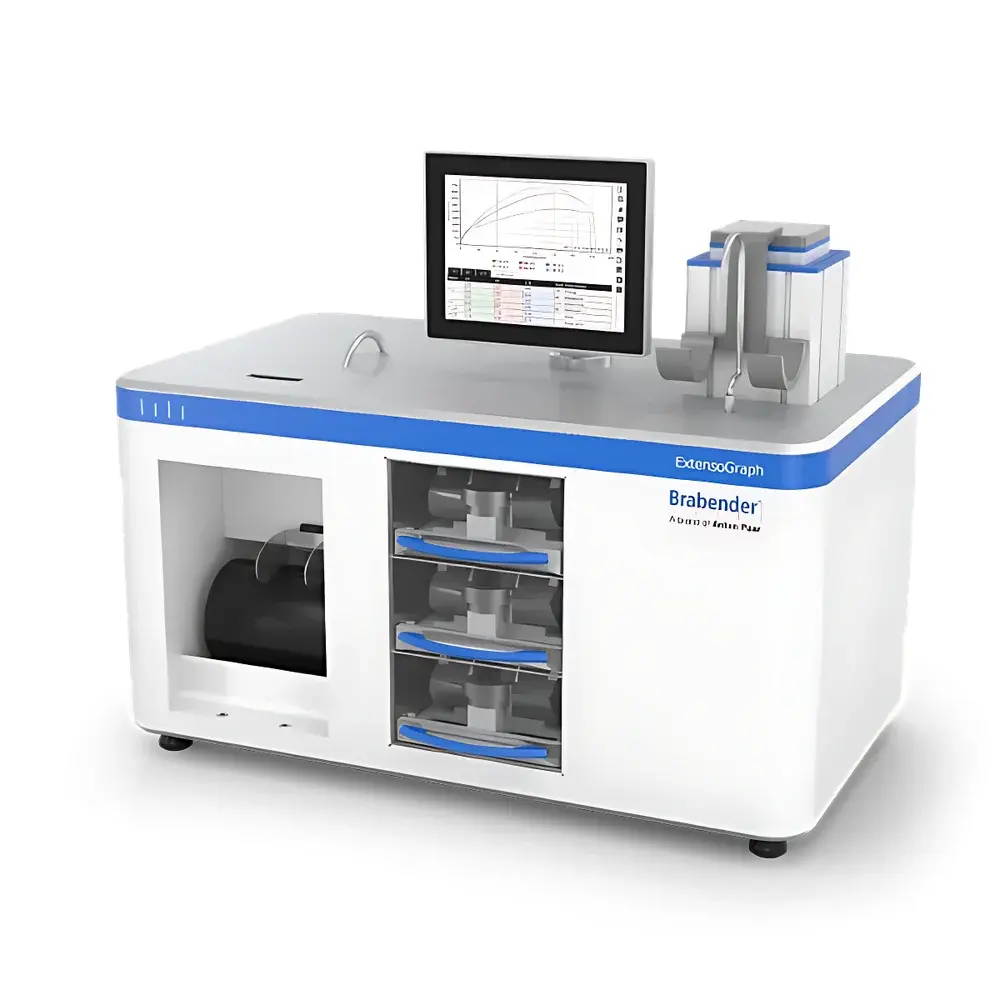
Brabender ExtensoGraph Dough Extensibility Tester
| Brand | Anton Paar Brabender |
|---|---|
| Origin | Germany |
| Model | ExtensoGraph |
| Compliance | ICC Standard No. 110, AACC Method 54-10, ISO 27971 |
| Temperature Control Range | 20–40 °C (±0.2 °C) |
| Humidity Control Range | 30–95% RH (±2% RH) |
| Measurement Resolution | 0.1 mm (extension), 0.01 N (force) |
| Sample Capacity | Up to 2 × 300 g dough pieces per test cycle |
| Data Export Formats | CSV, XML, PDF |
| Software Platform | MetaBridge v3.2 (FDA 21 CFR Part 11 compliant with audit trail, electronic signatures, and user role management) |
Overview
The Brabender ExtensoGraph is a precision-engineered dough extensibility tester designed for standardized rheological characterization of wheat-based doughs under controlled fermentation conditions. Based on the well-established Couette-type elongational deformation principle—where dough is stretched uniaxially at constant speed while force and extension are recorded in real time—the instrument delivers quantitative parameters essential for predicting processing behavior in industrial milling, mixing, sheeting, and baking operations. Unlike empirical texture analyzers or torsion-based mixers, the ExtensoGraph replicates the fundamental mechanical stress experienced by dough during extrusion, laminating, and pan flow. Its measurement output—expressed in Brabender Units (BU) for resistance-to-extension and millimeters (mm) for extensibility—aligns directly with internationally recognized specifications defined in ICC Standard No. 110 (Determination of dough extensibility), AACC Method 54-10 (Extensograph Test), and ISO 27971 (Cereal and cereal products — Determination of dough extensibility using the extensograph). This ensures traceable, inter-laboratory comparable data required for raw material qualification, process optimization, and quality assurance across global supply chains.
Key Features
- Modular architecture: Configurable as a fully integrated system (ExtensoBase + ExtensoPrep + ExtensoFerm) or deployed as standalone modules to match lab workflow demands and space constraints.
- Integrated climate-controlled fermentation chamber (ExtensoFerm): Equipped with ultrasonic humidification and Peltier-based temperature regulation, maintaining ±0.2 °C and ±2% RH stability over full 120-minute fermentation cycles.
- Automated mechanical sequence: Optical grating sensors trigger dough sheeting, cutting, and vertical stretching without manual intervention—minimizing operator variability and ensuring repeatability (RSD < 2.5% for Rmax across replicate tests).
- Self-contained instrumentation: Built-in touchscreen PC, refrigerated thermostat, vertically actuated stretching column, and vibration-damped base eliminate external peripherals and reduce footprint by up to 40% versus legacy setups.
- Real-time environmental monitoring: Onboard hygrothermograph continuously logs ambient temperature and humidity during testing, enabling correlation of dough behavior with environmental drift—a critical requirement for GLP-compliant laboratories.
Sample Compatibility & Compliance
The ExtensoGraph accommodates standard 300 g dough samples prepared according to AACC 54-10 or ICC 110 protocols, including hard red winter, soft white, durum, and spelt flours. It supports both straight-dough and sponge-dough systems, with programmable rest intervals between mixing and fermentation. All measurement outputs comply with mandatory reporting fields in ISO 27971 Annex A and are accepted by major grain inspection agencies (e.g., USDA FGIS, GAFTA, GCA). Instrument calibration is traceable to NIST-certified force transducers and encoder-based displacement standards. Full compliance with EU Machinery Directive 2006/42/EC and IEC 61000-6-3 EMC requirements is documented in the CE Declaration of Conformity supplied with each unit.
Software & Data Management
MetaBridge v3.2 serves as the unified control and analysis platform, supporting FDA 21 CFR Part 11 compliance through role-based access control, encrypted audit trails, electronic signature capture, and immutable data archiving. Test methods are stored as reusable templates with version-controlled parameters (fermentation time, temperature ramp profiles, stretching speed). Raw force–extension curves undergo automatic baseline correction and smoothing using Savitzky–Golay filtering (window size: 11 points, polynomial order: 2). Export functions generate ASTM E1482-compliant CSV files for LIMS integration and OPC UA-enabled connectivity for MES/ERP synchronization. Historical datasets can be cross-referenced with Brabender ViscoAmyloGraph or Farinograph results via shared metadata tagging.
Applications
- Flour mill quality control: Screening incoming wheat lots for gluten strength consistency and detecting enzymatic degradation (e.g., α-amylase overactivity).
- Bakery R&D: Quantifying dough tolerance to overmixing, evaluating enzyme additive efficacy (e.g., glucose oxidase, transglutaminase), and modeling oven spring potential.
- Ingredient supplier validation: Benchmarking hydrocolloids, vital wheat gluten, and malt flour against reference flours under identical fermentation kinetics.
- Academic research: Correlating extensibility indices (Rmax, Area, Extensibility Ratio) with SDS-PAGE glutenin subunit profiles and FTIR secondary structure analysis.
- Regulatory submissions: Generating dossier-ready data for EFSA novel food evaluations and USDA export certification packages.
FAQ
What international standards does the ExtensoGraph support?
ICC Standard No. 110, AACC Method 54-10, and ISO 27971 are natively implemented in MetaBridge test templates, with auto-calculated pass/fail flags based on declared specification limits.
Can the ExtensoGraph be integrated into an existing LIMS environment?
Yes—via configurable CSV export scheduling or native OPC UA server interface supporting DA and HDA data models for bidirectional synchronization with LabVantage, STARLIMS, or Thermo Fisher SampleManager.
Is operator training required for method validation?
Brabender provides IQ/OQ documentation kits and on-site PQ support aligned with ISO/IEC 17025 requirements; internal method verification typically requires ≤8 hours of hands-on technician training.
How is humidity uniformity maintained inside the fermentation chamber?
An integrated ultrasonic fogger generates micron-scale water droplets, while dual-axis fan circulation and condensate drainage channels prevent localized condensation and ensure ±2% RH homogeneity across the full 180 mm × 180 mm sample zone.
Does the system support multi-language user interfaces?
MetaBridge v3.2 offers English, German, French, Spanish, Chinese (Simplified), and Russian UI localizations, all accessible without software reinstallation or license key changes.





