
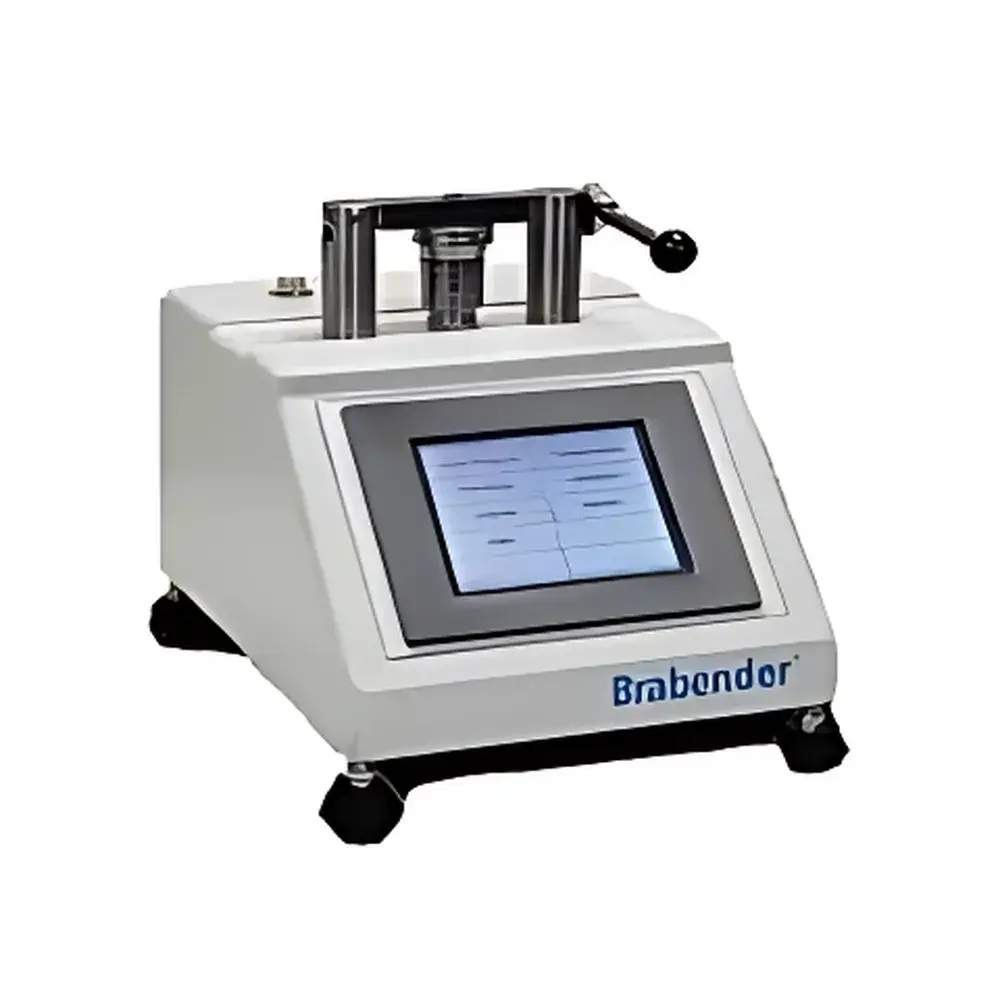
Brabender Glutograph-E Gluten Determinator
| Brand | Brabender |
|---|---|
| Origin | Germany |
| Model | Glutograph-E |
| Type | Electronic Gluten Extensibility and Elasticity Analyzer |
| Compliance | Designed for ISO 21415-1:2006, AACC Method 38-12A, ICC Standard No. 117/1 |
| Sample Mass | 2–3 g per test |
| Measurement Principle | Controlled-shear rotational deformation under constant torque |
| Output | Shear angle vs. time curve, elasticity index (EI), extensibility index (EX), breakdown time (t₆₀), recovery ratio (%) |
Overview
The Brabender Glutograph-E is a precision electronic instrument engineered for the quantitative characterization of gluten functionality in wheat flour and vital wheat gluten. It operates on the principle of controlled-shear rheometry: a fixed-volume gluten sample—typically 2–3 g—is compressed between two parallel, finely toothed stainless-steel discs with precisely defined geometry (fixed gap and diameter). While the upper disc remains stationary, the lower disc rotates under a constant applied torque. This generates a uniform shear stress across the sample, independent of its viscoelastic response. The resulting angular displacement (shear strain) is measured continuously as a function of time with high-resolution optical encoders. The instrument captures the full time-dependent deformation profile—including initial yield, steady-state flow, strain recovery upon unloading—and calculates standardized indices such as elasticity index (EI), extensibility index (EX), breakdown time (t₆₀), and recovery ratio (%). These parameters correlate directly with end-use performance in pasta extrusion, noodle sheeting, and baked goods processing. Unlike empirical tensile methods, the Glutograph-E provides reproducible, operator-independent data traceable to international standards including ISO 21415-1:2006, AACC Method 38-12A, and ICC Standard No. 117/1.
Key Features
- Constant-torque rotational shear system ensuring consistent stress application across variable gluten qualities
- Optical encoder-based angular displacement measurement with ±0.1° resolution and real-time digitization at 100 Hz sampling rate
- Integrated industrial-grade touchscreen interface (10.1″ capacitive display) with intuitive navigation and multilingual OS support
- Onboard embedded PC running deterministic real-time control firmware; no external computer required for operation
- Dual data export pathways: direct Ethernet (TCP/IP) connectivity for LIMS integration and USB 2.0 host port for flash storage backup
- Automatic calibration verification routine with traceable reference discs included in shipment
- Robust mechanical architecture compliant with IEC 61000-6-2 (EMC immunity) and IEC 61000-6-3 (EMC emissions)
Sample Compatibility & Compliance
The Glutograph-E accepts wet gluten isolates obtained via standard hand-washing or automated gluten washers (e.g., Brabender Glutomatic 2200), as well as rehydrated vital wheat gluten powders. Sample preparation follows AACC 38-12A protocols: gluten is manually kneaded to uniform consistency, formed into a cylindrical plug matching the disc gap volume (≈0.5 mL), and centrally placed between discs. The system is validated for use in GLP-compliant environments: audit trails, user access levels (admin/operator/guest), and electronic signature capability are enabled per FDA 21 CFR Part 11 requirements when paired with optional Brabender LabSoft v5.x software. All measurement outputs conform to ISO/IEC 17025 documentation standards for accredited testing laboratories.
Software & Data Management
Data acquisition, visualization, and reporting are managed through Brabender’s LabSoft v5.x platform (optional but recommended for regulated environments). The software supports batch-wise test sequencing, statistical process control (SPC) charting (X̄/R, Cpk), and automated report generation in PDF/A-1b format. Raw shear-angle-vs.-time datasets are stored in vendor-neutral CSV and HDF5 formats. Audit logs record operator ID, timestamp, instrument serial number, calibration status, and parameter modifications—fully searchable and exportable. Network deployment allows centralized data aggregation across multiple Glutograph-E units in multi-site QC networks, with TLS 1.2 encryption for secure Ethernet transmission.
Applications
- Assessment of gluten strength and tolerance in hard red spring (HRS) and durum wheat flours for pasta production
- Detection of heat damage or over-drying effects on gluten protein conformation via reduced elasticity index and shortened t₆₀
- Quality benchmarking of commercial vital wheat gluten batches prior to incorporation into meat analogs or seitan products
- Routine QC in flour mills to monitor seasonal variances in gluten network integrity
- Research applications in cereal chemistry investigating enzymatic modification (e.g., transglutaminase treatment) or oxidation effects on gluten cross-linking
- Validation of gluten-free ingredient substitutions by quantifying residual gluten elasticity in composite blends
FAQ
What sample preparation method is required before testing?
Wet gluten must be isolated using standardized washing (AACC 38-12A), then manually kneaded and shaped into a cylindrical plug matching the disc gap volume (0.5 mL). No drying or conditioning beyond ambient acclimation is permitted.
Can the Glutograph-E replace traditional extensograph testing?
It complements—not replaces—extensography. While extensographs measure uniaxial extension of dough ribbons, the Glutograph-E quantifies shear-dominated deformation of pure gluten mass, providing orthogonal rheological insight.
Is third-party calibration certification available?
Yes. Brabender offers annual NIST-traceable calibration services with ISO/IEC 17025-accredited certificates, including torque verification, angular encoder linearity, and thermal stability validation.
Does the instrument comply with food safety regulatory documentation requirements?
When operated with LabSoft v5.x and configured per SOPs, it meets FDA 21 CFR Part 11, EU Annex 11, and ISO 22000 traceability mandates for electronic records in food manufacturing QA/QC.
What maintenance is required for long-term accuracy?
Monthly cleaning of disc surfaces with ethanol and lint-free wipes; biannual inspection of drive belt tension and encoder alignment by authorized service engineers. No user-serviceable internal components exist.





