
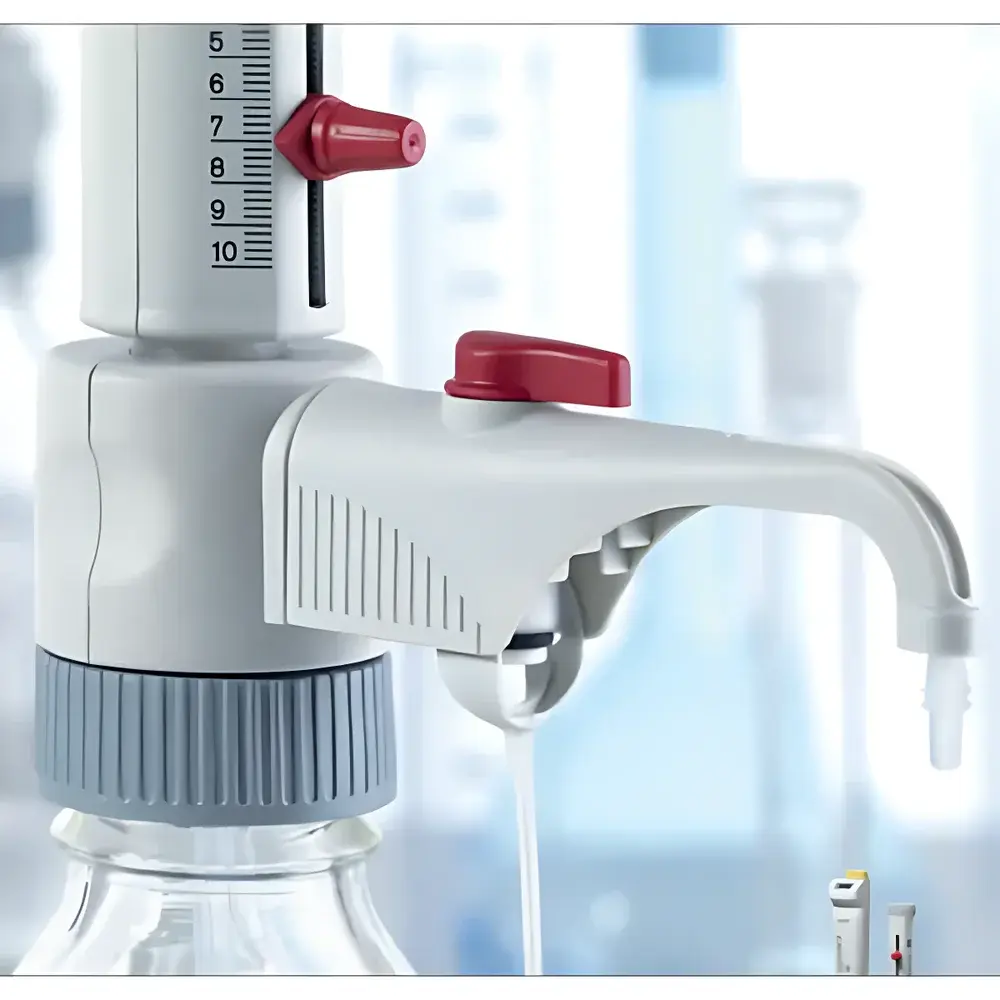
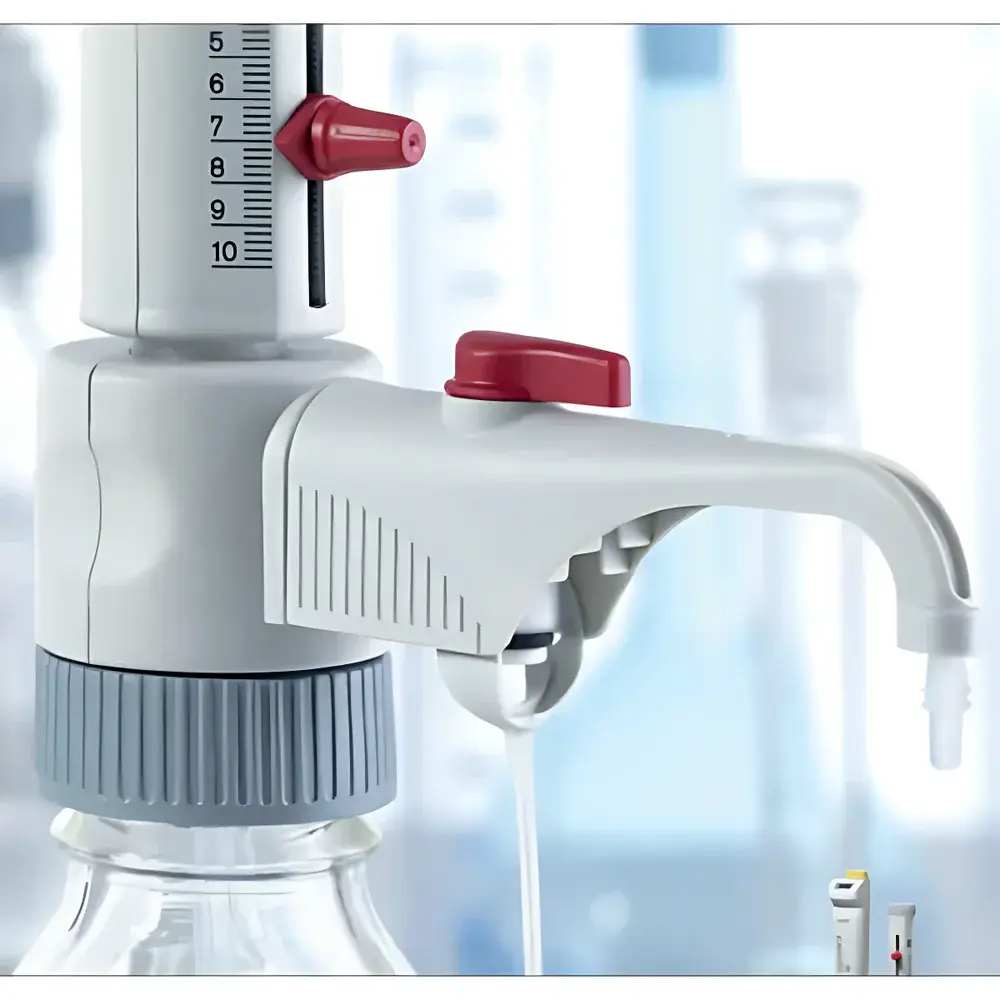
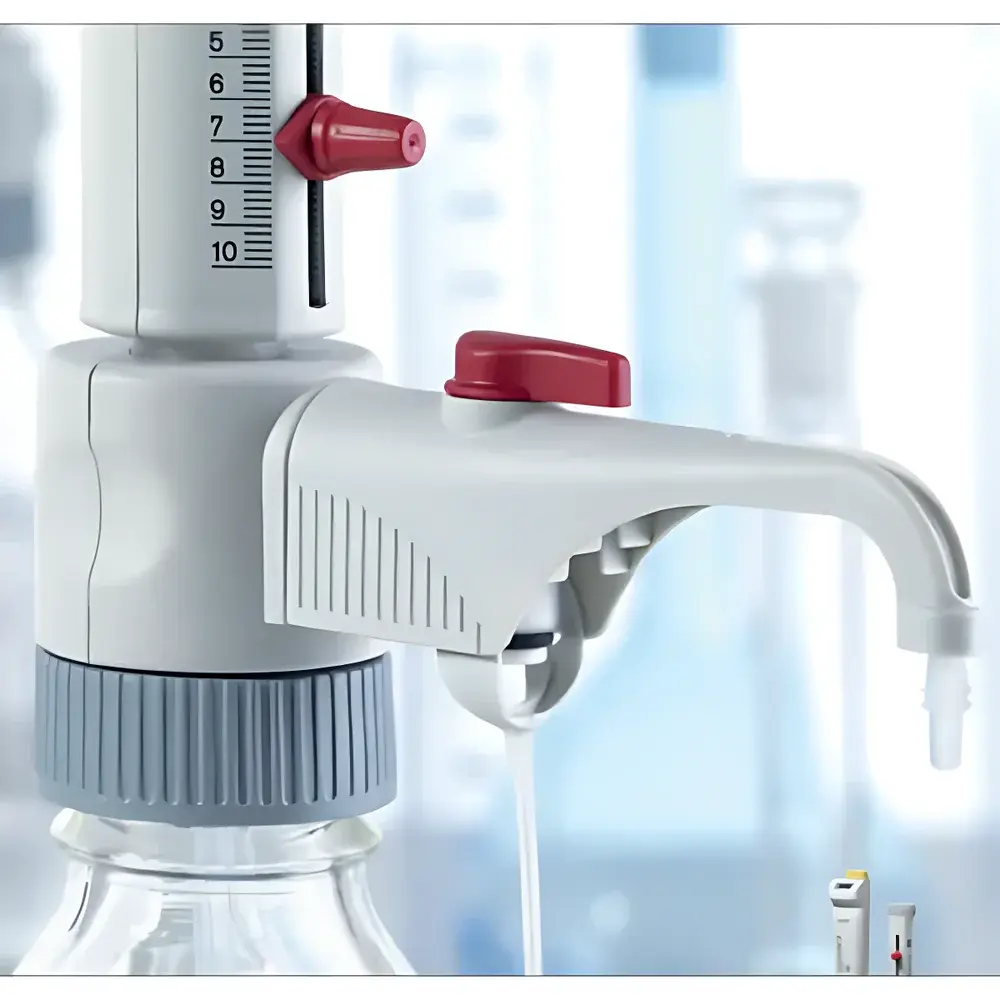
BRAND Dispensette S Bottle Top Dispenser
| Brand | BRAND® |
|---|---|
| Origin | Germany |
| Model | Dispensette S |
| Type | Manual Bottle Top Dispenser |
| Volume Range | 0.1–1 mL |
| Minimum Increment | 0.005 mL |
| Accuracy | ±0.5% |
| Precision (Repeatability) | ±0.1% |
| Max. Operating Pressure | 600 mbar |
| Max. Kinematic Viscosity | 500 mm²/s |
| Max. Liquid Density | 2.2 g/cm³ |
| Max. Temperature | 40 °C |
| Wetted Materials | Borosilicate glass, aluminum oxide ceramic, platinum-iridium alloy, ETFE, FEP, PFA, PTFE, PP |
Overview
The BRAND Dispensette S Bottle Top Dispenser is a precision-engineered manual liquid handling instrument designed for accurate, repeatable, and safe dispensing of aggressive and demanding reagents directly from laboratory reagent bottles. Based on positive displacement volumetric principle, the Dispensette S operates via a piston-driven mechanism housed within a chemically inert, modular body — eliminating reliance on air displacement or syringe-style plunger seals that degrade under corrosive conditions. Its core architecture enables direct bottle mounting without intermediate tubing or adapters, minimizing dead volume and cross-contamination risk while maintaining full operator control over aspiration and dispensing cycles. This design is especially critical in applications involving high-purity standards, trace-level analysis, or routine QC workflows where volumetric integrity must be preserved across hundreds of dispense cycles.
Key Features
- Chemically resistant wetted components including borosilicate glass cylinder, aluminum oxide ceramic piston seal, platinum-iridium alloy spring, and fluoropolymer valves (ETFE/FEP/PFA/PTFE) — validated for compatibility with concentrated mineral acids (e.g., H₂SO₄, H₃PO₄), strong alkalis, halogenated solvents, and high-density aqueous solutions.
- Integrated volume adjustment system featuring a precision-machined rack-and-pinion mechanism with engraved scale and tactile click-stop feedback — ensuring stable, reproducible setting retention even after repeated mechanical actuation.
- New-generation discharge tube assembly available with or without integrated safety reflux valve, preventing backflow during venting or pressure transients — essential for volatile or toxic liquids.
- Seal-free valve technology eliminates elastomeric O-rings susceptible to swelling or compression set, thereby extending service life and reducing maintenance frequency in continuous-use environments.
- Optimized fluidic path geometry enhances aspiration speed by up to 25% compared to prior-generation models, particularly beneficial when handling moderately viscous liquids (up to 500 mm²/s) at ambient temperatures up to 40 °C.
Sample Compatibility & Compliance
The Dispensette S meets stringent material compatibility requirements defined in ISO 8536-4 (glass containers for pharmaceutical use) and ASTM D1296 (standard test method for volatility of solvents). Its construction complies with EU Directive 2011/65/EU (RoHS) and carries CE marking per Machinery Directive 2006/42/EC. All fluoropolymer components are certified to USP Class VI and FDA 21 CFR 177.1550 for indirect food contact. The device supports GLP/GMP-aligned workflows through documented calibration traceability to national metrology institutes (e.g., PTB, NIST) and facilitates audit-ready records when used in conjunction with calibrated volumetric flasks and gravimetric verification protocols.
Software & Data Management
As a fully manual, non-electronic instrument, the Dispensette S does not incorporate onboard electronics, firmware, or digital connectivity. Consequently, it requires no software installation, network configuration, or cybersecurity validation — making it inherently compliant with environments governed by FDA 21 CFR Part 11 for systems where electronic records are not generated. Volume settings are mechanically recorded via engraved scales and verified using external calibration tools (e.g., certified analytical balances, Class A volumetric glassware). Users maintain calibration logs manually or integrate entries into LIMS platforms via standardized SOP templates aligned with ISO/IEC 17025 documentation practices.
Applications
The Dispensette S is routinely deployed in analytical chemistry laboratories for standardized titrant delivery (e.g., NaOH, HCl, EDTA), in clinical diagnostics for buffer and reagent preparation prior to ELISA or immunoassay plate loading, in food safety testing for acid hydrolysis step dosing, and in polymer research labs for controlled addition of catalysts or initiators into monomer systems. Its resistance to high-density electrolytes (up to 2.2 g/cm³) supports applications in battery electrolyte formulation and electroplating bath management. In environmental testing, it ensures consistent spiking of internal standards in EPA Method 525.3 (purge-and-trap GC/MS) sample preparation.
FAQ
Can the Dispensette S be autoclaved?
No — thermal exposure beyond 40 °C compromises fluoropolymer integrity and dimensional stability of the glass cylinder; sterilization must be performed using validated chemical methods (e.g., 70% ethanol, hydrogen peroxide vapor).
Is calibration required before first use?
Yes — users must perform initial volumetric verification per ISO 8655-3 using gravimetric methodology and document results against the stated accuracy specification (±0.5%) and repeatability (±0.1%).
What maintenance intervals are recommended?
Visual inspection and functional testing should occur daily; full disassembly, cleaning, and re-lubrication (with perfluorinated grease only) is advised every 3 months or after 500 dispense cycles, whichever occurs first.
Does BRAND provide certified calibration certificates?
Yes — optional factory calibration services include traceable certificates issued by BRAND’s accredited metrology lab (DAkkS ISO/IEC 17025), valid for 12 months from date of issue.
Can the same unit be used interchangeably for acids and organic solvents?
Only if equipped with the Dispensette S Organic variant — standard S models lack optimized valve geometry and wetted material selection for low-surface-tension solvents; cross-contamination risk increases significantly without dedicated units.



