
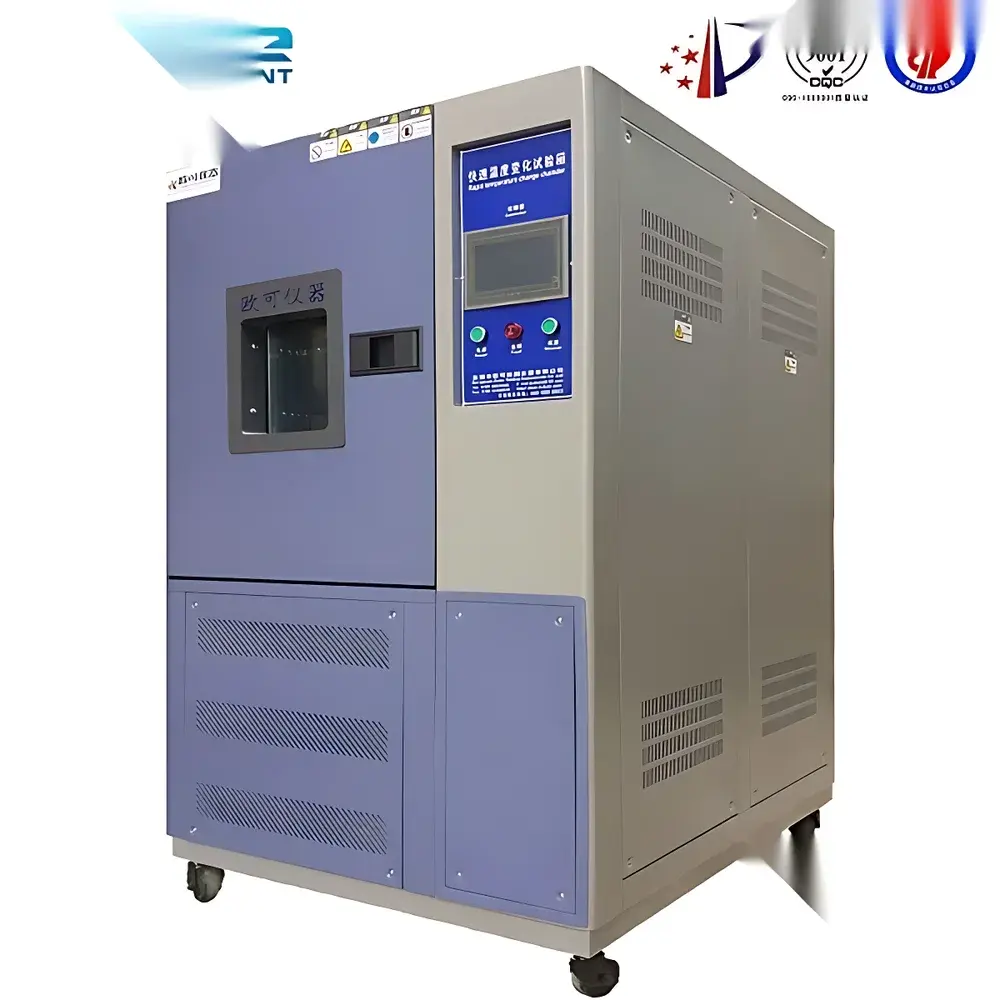
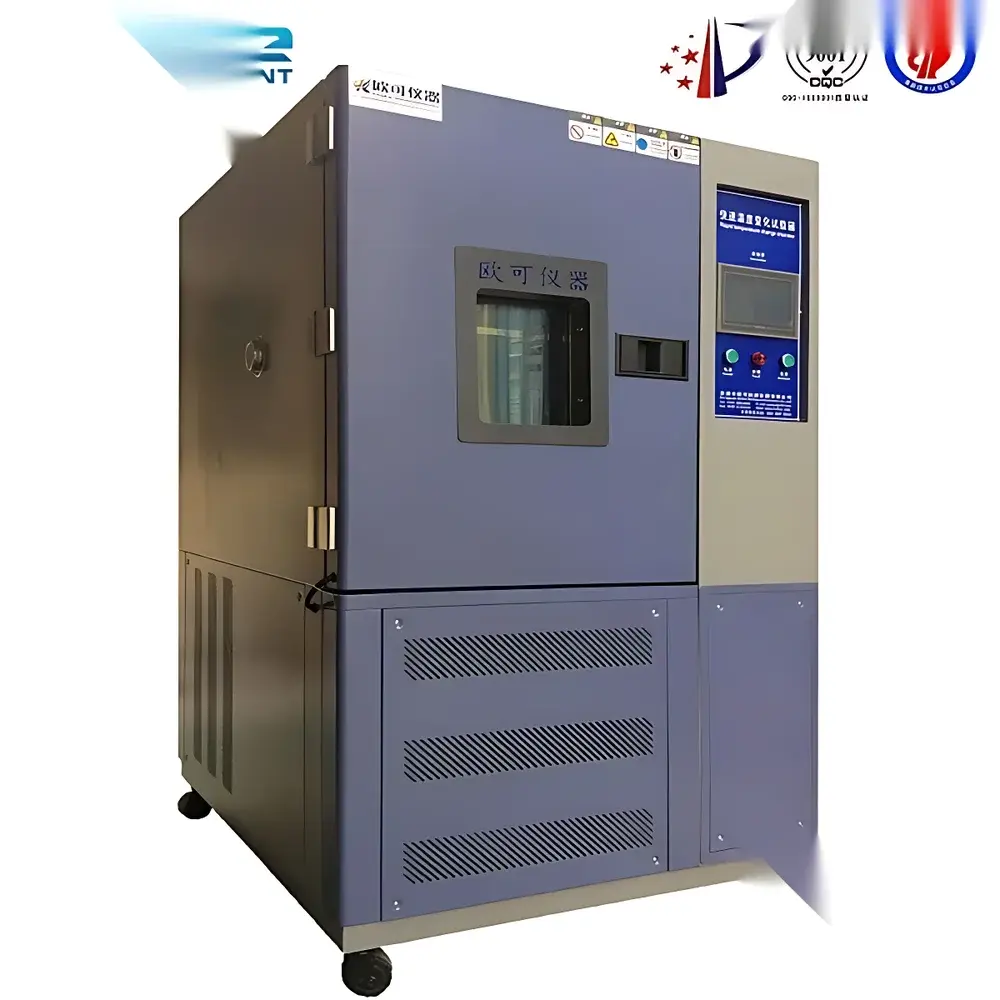
Other Brands KS-TH Series Rapid Temperature Change Chamber (RTC Chamber)
| Brand | Other Brands |
|---|---|
| Origin | Imported |
| Manufacturer Type | Authorized Distributor |
| Price | USD 2,650 (FOB) |
| Internal Dimensions (W×H×D, mm) | 500×600×500 to 1000×1000×1000 |
| External Dimensions (W×H×D, mm) | 1750×2250×2350 to 2350×2800×3000 |
| Temperature Range | −70 °C to +150 °C |
| Humidity Range (optional) | 20–98 % RH |
| Rapid Transition Range | −45 °C to +85 °C |
| Transition Rate Options | 5–30 °C/min (linear or non-linear mode selectable) |
| Temperature Uniformity | ±2.0 °C |
| Humidity Uniformity | ±3.0 % RH |
| Temperature Control Accuracy | ±0.5 °C |
| Humidity Control Accuracy | ±2.5 % RH |
| Temperature Resolution | 0.1 °C |
| Humidity Resolution | 0.1 % RH |
| Cooling System | Water-cooled |
| Compressor | Tecumseh (France) or Bitzer (Germany) |
| Power Supply | AC 380 V, 3-phase 5-wire, 50/60 Hz |
| Weight | 950–2300 kg |
| Compliance | GB/T 2423.1–2023, GB/T 2423.2–2023, GB/T 2423.4–2023 |
Overview
The KS-TH Series Rapid Temperature Change (RTC) Chamber is an engineered environmental test system designed for accelerated thermal stress evaluation of electronic components, automotive modules, aerospace subsystems, and industrial materials under dynamically varying temperature conditions. Based on forced-air convection with dual-stage refrigeration and precision PID-controlled heating, the chamber delivers reproducible linear or non-linear thermal transitions across a broad operational envelope—from −70 °C to +150 °C—with optional humidity control (20–98 % RH). Its core architecture supports high-fidelity simulation of real-world thermal shock profiles encountered during transportation, storage, and field operation—enabling early detection of solder joint fatigue, polymer delamination, seal integrity failure, and intermetallic compound growth in microelectronic packaging. The chamber meets fundamental requirements of IEC 60068-2-14 (Test N: Change of Temperature) and serves as a foundational platform for qualification per AEC-Q200, MIL-STD-810H Method 503.7, and JEDEC JESD22-A104.
Key Features
- Robust dual-wall construction: Outer shell of cold-rolled steel with epoxy-polyester coating; inner chamber fabricated from SUS304 stainless steel (2B finish) for corrosion resistance and cleanability.
- High-efficiency insulation: 100–150 mm thick polyurethane foam (CFC-free, density ≥40 kg/m³) with vacuum-sealed joints to minimize thermal bridging and ensure stable thermal gradients.
- Advanced control system: TEMI300 microprocessor-based controller with integrated temperature/humidity algorithm, real-time trend logging, and intuitive touch interface supporting programmable ramp-soak cycles, multi-segment profiles, and deviation alarms.
- Rapid transition capability: Selectable heating/cooling rates from 5 °C/min up to 30 °C/min (model-dependent), achieved via optimized refrigerant circuit design, oversized evaporator/condenser surfaces, and variable-speed axial fans.
- Double-seal door assembly: Dual-layer silicone rubber gasket (rated for −70 °C to +150 °C), heated glass observation window with anti-fog coating, and mechanical door lock with safety interlock.
- Comprehensive protection suite: Over-temperature, over-humidity, low-water-flow, compressor high/low-pressure, phase-loss, and ground-fault monitoring with automatic shutdown and event-triggered fault logging.
Sample Compatibility & Compliance
The KS-TH chamber accommodates standard test specimens up to 1000 L internal volume (KS-TH-1000 model), with two adjustable stainless-steel shelves, one Φ50 mm cable port with silicone plug, and optional accessories including glove ports, data logger interfaces, and dehumidification add-ons. All models are certified to national and international environmental testing standards, including GB/T 2423.1–2023 (Cold), GB/T 2423.2–2023 (Dry Heat), and GB/T 2423.4–2023 (Damp Heat, cyclic). While not pre-certified to ISO/IEC 17025, the system’s traceable calibration architecture—including NIST-traceable PT100 sensors and factory calibration reports—supports laboratory accreditation workflows. Humidity-equipped variants comply with ASTM E1820 for water activity correlation and support GLP-compliant validation protocols when paired with external data acquisition systems.
Software & Data Management
The TEMI300 controller provides local data storage (≥100 cycles, 10,000 data points) with USB export functionality. Optional PC-based software (KS-Link v4.x) enables remote monitoring, real-time graphing, alarm email/SMS notification, audit trail generation, and electronic signature support aligned with FDA 21 CFR Part 11 requirements. All logged parameters—including chamber setpoint, actual temperature/humidity, ramp rate, deviation status, and fault codes—are time-stamped with millisecond resolution and stored in CSV or XML format for integration into LIMS or QMS platforms. Calibration records, maintenance logs, and user access history are retained separately to support GMP/GLP documentation audits.
Applications
This RTC chamber is routinely deployed in reliability engineering labs for HALT (Highly Accelerated Life Testing), thermal cycling qualification (e.g., IPC-9701), PCB warpage analysis, battery cell thermal runaway screening, and elastomer compression set evaluation. It supports automotive Tier-1 suppliers performing climate endurance tests per VW 80101 and Ford CETP 00.00-L-467. In academic research, it facilitates studies on phase-change material behavior, polymer crystallinity kinetics, and MEMS device hysteresis under rapid thermal transients. The absence of internal heaters near sample zones ensures minimal radiant asymmetry—critical for optical component testing and photovoltaic module certification per IEC 61215.
FAQ
Is humidity control standard or optional?
Humidity functionality is an optional configuration. Base models operate in dry thermal cycling mode only; RH capability requires additional steam generator, humidifier reservoir, and dedicated sensor calibration.
What refrigerant is used in the cooling system?
All units employ R404A or R507A refrigerant—fully compliant with current EU F-Gas Regulation (EU) No 517/2014 and EPA SNAP-approved for industrial environmental chambers.
Can the chamber be validated for IQ/OQ/PQ protocols?
Yes. Standard documentation includes factory calibration certificates, installation drawings, and electrical schematics. Optional IQ/OQ packages include protocol templates, witness test reports, and uncertainty budgets per ISO/IEC 17025 Annex A.2.
What is the typical lead time for custom configurations?
Standard models ship within 6–8 weeks after order confirmation. Humidity-equipped or special voltage variants require 10–12 weeks due to extended component sourcing and integrated system validation.
Does the controller support Modbus RTU or Ethernet/IP communication?
The TEMI300 includes RS485 Modbus RTU as standard. Ethernet/IP and Profibus-DP are available via optional gateway module (KS-Comm-IP), enabling direct PLC integration in automated test cells.



