
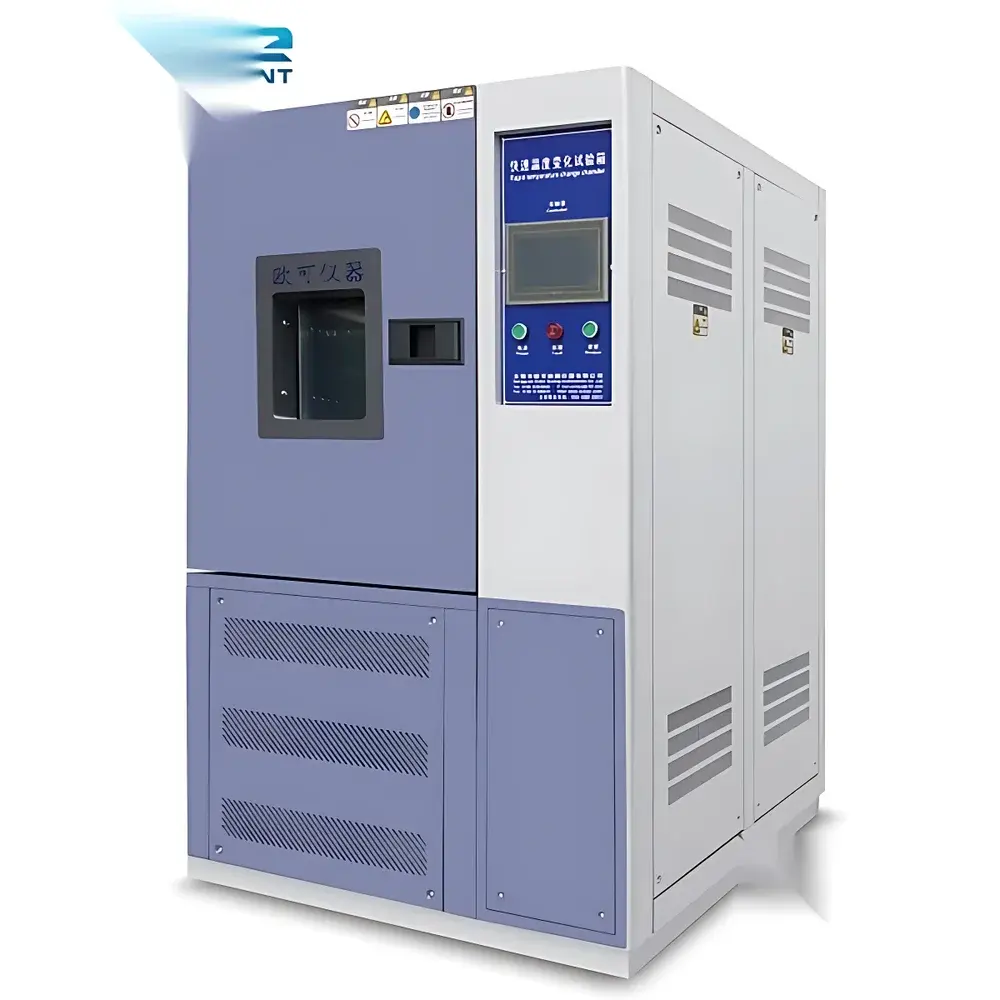
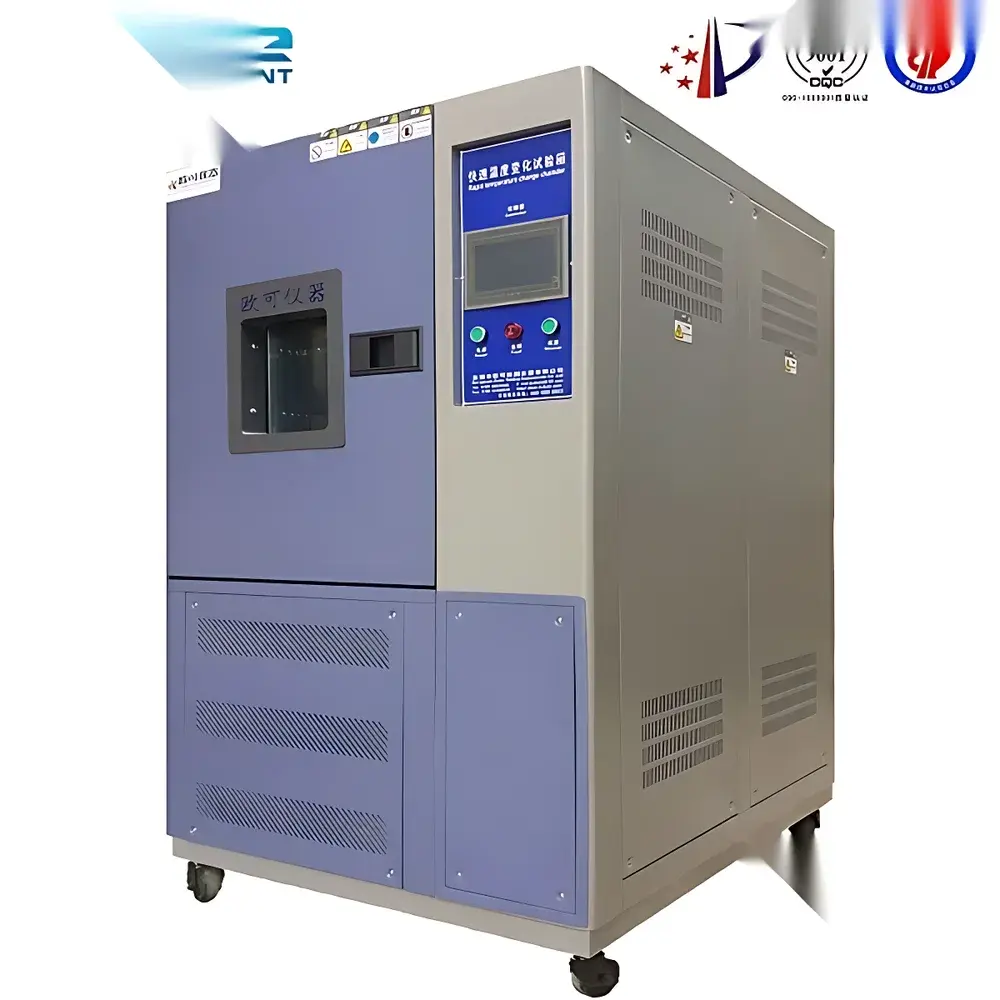
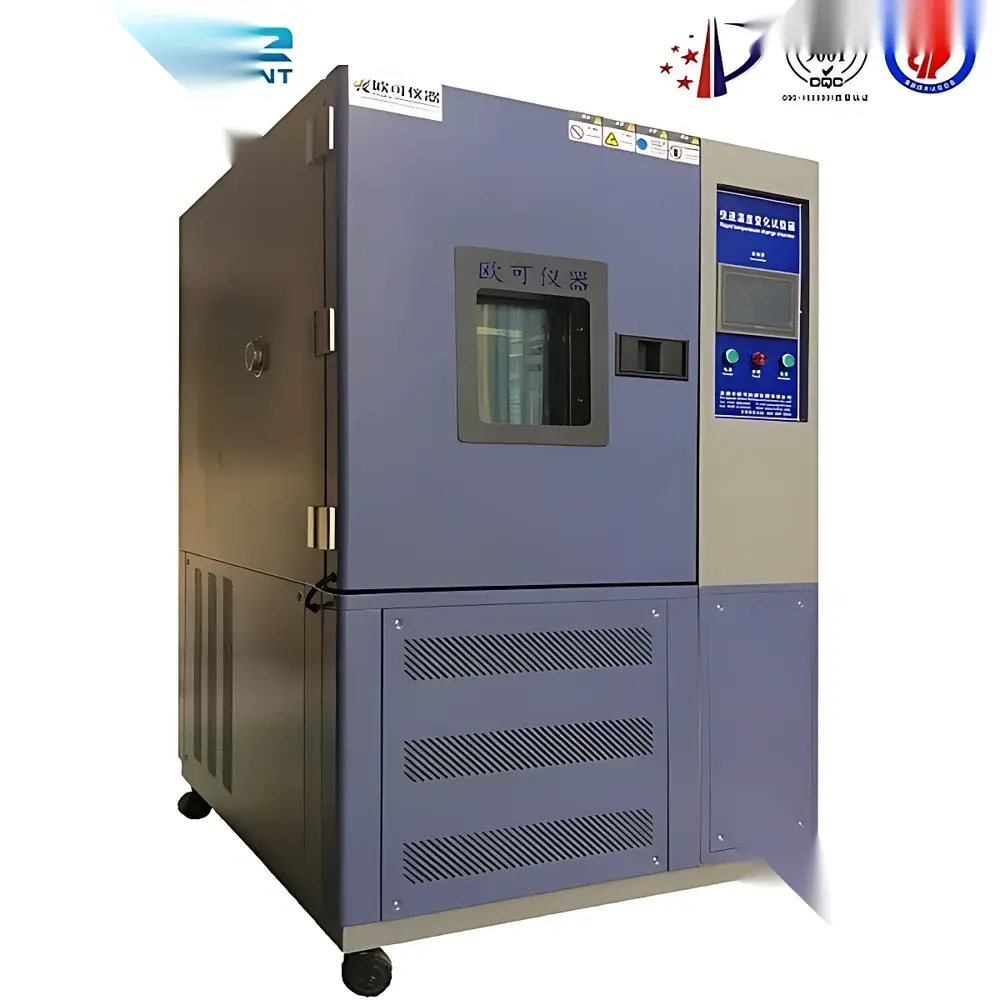
Other Brands Rapid Temperature Change Environmental Stress Screening Chamber (RTCS Chamber)
| Brand | Other Brands |
|---|---|
| Origin | Imported |
| Manufacturer Type | Authorized Distributor |
| Price | USD 2,650 (FOB) |
| Temperature Range | −70 °C to +150 °C |
| Rapid Thermal Transition Range | −45 °C to +85 °C |
| Max. Linear Ramp Rate | 15 °C/min |
| Humidity Range (Optional) | 20–98% RH (extendable to 5–98% RH on request) |
| Temp. Resolution/Accuracy | 0.1 °C / ±0.5 °C |
| Humidity Resolution/Accuracy | 0.1% RH / ±2.5% RH |
| Uniformity | ±2.0 °C / ±3.0% RH |
| Sample Load Capacity | ≥30 kg |
| Construction | Exterior – Powder-coated carbon steel |
| Cooling Method | Air-cooled or water-cooled |
| Viewing Window | 350 × 250 mm electrically heated, anti-fog, low-emissivity coated |
| Cable Port | Sliding conduit with sealing gasket |
| Illumination | Moisture-resistant LED chamber lighting |
| Sample Shelf Drive | Pneumatic dual-acting cylinder with German indirect-type position sensor |
Overview
The Rapid Temperature Change Environmental Stress Screening (RTCS) Chamber is an engineered thermal cycling test system designed for accelerated reliability assessment of electronic components, PCB assemblies, automotive modules, aerospace avionics, and packaging materials under extreme and dynamically varying thermal conditions. It operates on the principle of controlled, high-rate thermal ramping between defined low- and high-temperature setpoints—enabling precise simulation of operational thermal shock, storage temperature extremes, and environmental stress screening (ESS) per MIL-STD-810H, IEC 60068-2-14, and JEDEC JESD22-A104. Unlike conventional thermal chambers, this RTCS unit integrates independent high- and low-temperature zones with a shared sample compartment, allowing seamless transitions without mechanical door opening or ambient air intrusion. Its architecture supports both linear and non-linear ramp profiles, with programmable dwell times and up to 15 °C/min sustained ramp rates across the −45 °C to +85 °C operational envelope—critical for detecting latent defects such as solder joint fatigue, intermetallic delamination, and coefficient-of-thermal-expansion (CTE) mismatch failures.
Key Features
- Modular integrated structure: Upper high-temperature zone (+150 °C max), lower low-temperature zone (−70 °C min), rear-mounted refrigeration cabinet, and left-side control panel—optimized for floor space efficiency and service accessibility.
- Robust dual-wall construction: Exterior carbon steel with electrostatic color powder coating; interior chamber walls and shelves fabricated from mirror-finished SUS304 stainless steel for corrosion resistance and cleanroom-compatible maintenance.
- High-performance insulation: Composite thermal barrier combining high-density polyurethane foam (chlorinated ethyl ester-based, fire-retardant grade) and ultra-fine glass fiber棉—achieving thermal leakage <0.8 K/h at steady-state extremes.
- Precision motion-controlled sample carriage: Stainless steel shelf driven by dual-acting pneumatic cylinders with ISO 8502-certified smoothness; position feedback via contactless German-indirect capacitive sensors ensuring repeatable ±0.1 mm shelf positioning over 100,000 cycles.
- Heated, low-E anti-fog observation window: 350 × 250 mm electrically heated quartz-glass viewport with emissivity <0.15, enabling real-time visual monitoring without condensation or thermal distortion.
- Configurable cooling architecture: Selectable air-cooled or water-cooled condenser systems—validated for continuous operation at 40 °C ambient (air-cooled) or ≤32 °C inlet water (water-cooled), meeting ASHRAE 15 safety compliance.
Sample Compatibility & Compliance
This RTCS chamber accommodates samples up to 30 kg total mass on a single adjustable shelf, with vertical travel clearance supporting DUTs up to 600 mm in height. Standard cable ports feature sliding silicone-sealed conduits rated IP54, compatible with thermocouple leads, power feeds, and data acquisition cables. The chamber meets structural and operational requirements for ISO/IEC 17025-accredited laboratories conducting ESS validation. Optional humidity control (20–98% RH) complies with IEC 60068-2-78 for damp heat testing, while temperature uniformity (±2.0 °C) and stability (±0.5 °C) are verified per ASTM E741 and validated using NIST-traceable Class A PT100 sensors. Full audit trail logging—including setpoint history, actual chamber readings, alarm events, and user actions—is available to support GLP/GMP and FDA 21 CFR Part 11-compliant workflows when paired with optional software modules.
Software & Data Management
Built-in 10.1-inch capacitive touchscreen HMI provides intuitive profile programming, real-time multi-channel trending, and event-triggered data capture. Standard firmware supports up to 99 programmable test sequences, each with 99 segments (ramp/dwell/humidity coupling), and stores ≥10,000 hours of timestamped temperature/humidity logs internally. USB export and Ethernet TCP/IP communication enable integration with LabVIEW, MATLAB, or enterprise MES/QMS platforms. Optional PC-based software adds advanced features: automated report generation (PDF/CSV), statistical process control (SPC) charting, remote supervision via TLS-secured web interface, and electronic signature capability aligned with 21 CFR Part 11 Annex 11 requirements. All data files include embedded metadata—device ID, calibration expiry, operator login, and environmental context—for full traceability.
Applications
- Thermal cycling qualification of semiconductor packages (QFN, BGA, CSP) per JEDEC JESD22-A104D.
- Automotive electronics validation (ECUs, ADAS sensors) under ISO 16750-4 cold-hot shock protocols.
- Aerospace component screening per MIL-STD-810H Method 503.5 (Temperature Shock) and Method 502.6 (Low Temperature).
- Reliability growth testing of medical device PCBAs prior to ISO 13485 certification.
- Accelerated aging studies of polymer encapsulants, conformal coatings, and battery cell housings.
- Process validation of reflow soldering profiles and post-reflow thermal soak steps.
FAQ
What is the difference between linear and non-linear ramp modes?
Linear mode maintains constant temperature change rate (e.g., 10 °C/min) throughout the entire segment. Non-linear mode allows variable ramp rates within a single segment—typically used to emulate real-world thermal transients where acceleration/deceleration occurs near setpoints.
Can the chamber operate continuously at −70 °C and +150 °C simultaneously?
No. The chamber achieves its full temperature range through sequential zone activation—not simultaneous extreme operation. The −70 °C and +150 °C limits represent independent steady-state capabilities of the low- and high-temperature sections.
Is third-party calibration documentation included?
A factory calibration certificate (traceable to NIST or equivalent national metrology institute) is provided with shipment. On-site ISO/IEC 17025 calibration services are available upon request.
Does the system support humidity control out-of-the-box?
Humidity functionality is optional and requires separate humidifier/dehumidifier modules, steam generator, and RH sensor upgrade. Base configuration is dry-thermal only.
What safety certifications does the unit carry?
Standard units comply with CE (EMC Directive 2014/30/EU and LVD Directive 2014/35/EU), UL 61010-1, and RoHS 2011/65/EU. Additional country-specific certifications (e.g., KC, PSE, CCC) are available for OEM integration.



