
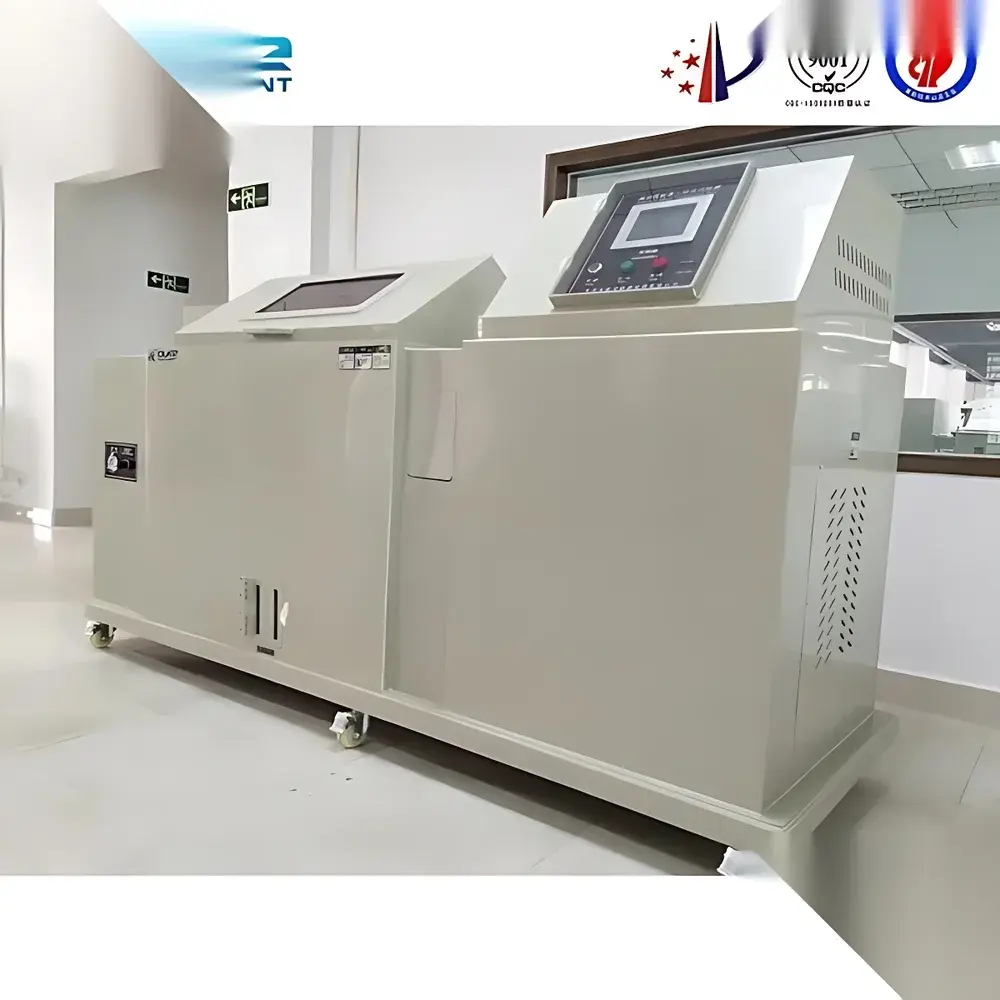
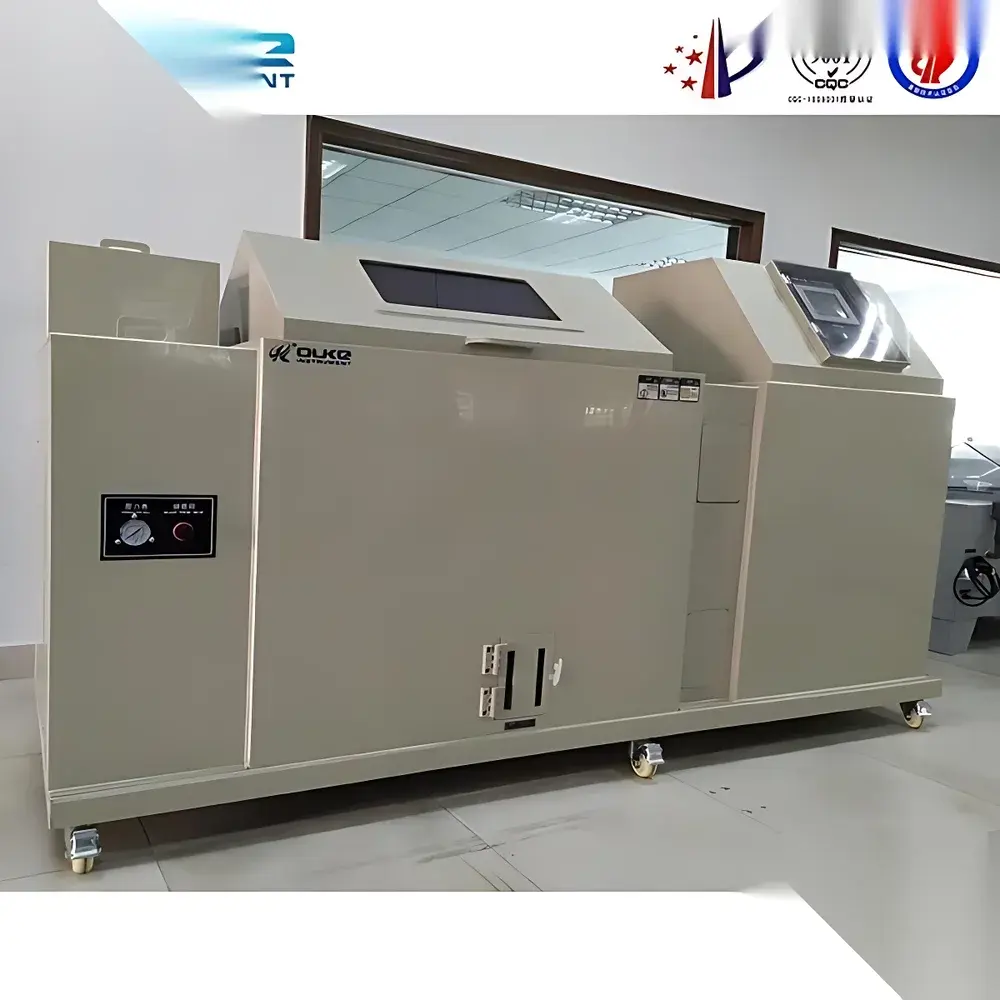
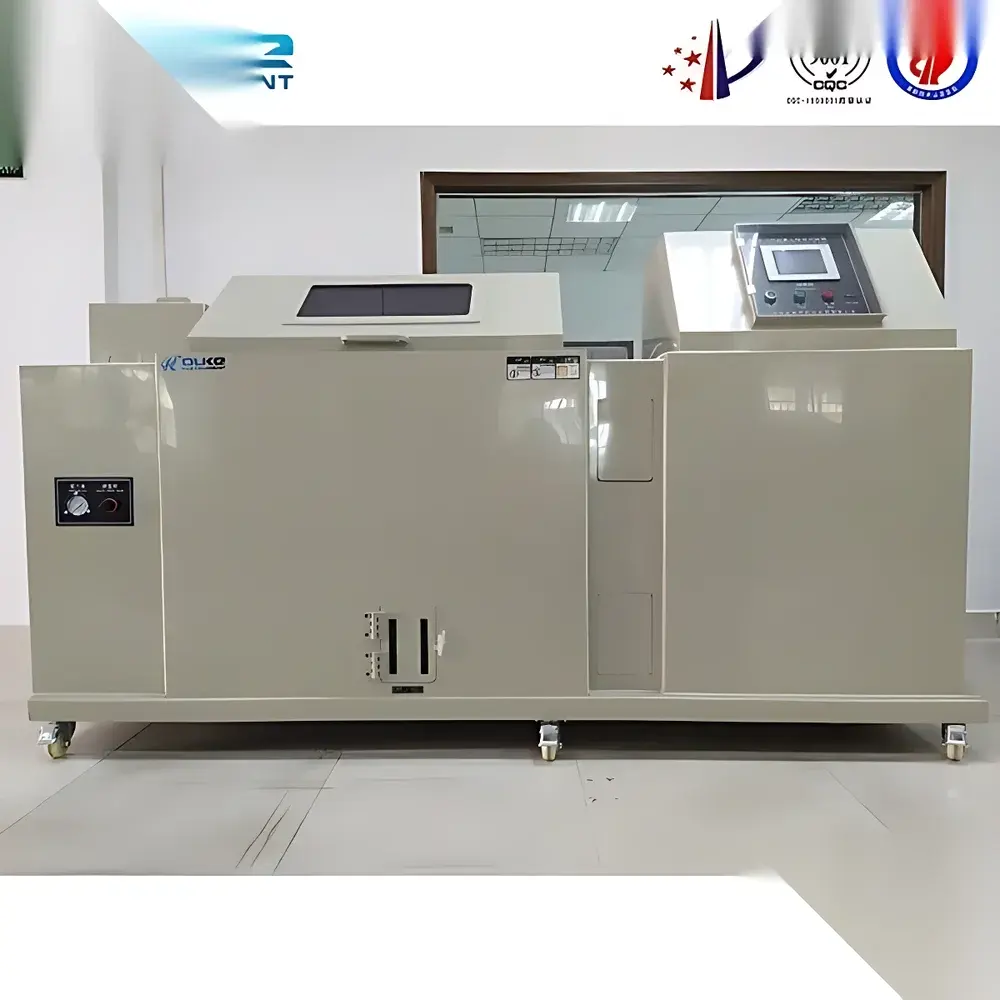
Other Brands Salt Spray Test Chamber for Electroplated Coating Thickness & Potential Difference Measurement
| Brand | Other Brands |
|---|---|
| Origin | Imported |
| Manufacturer Type | General Distributor |
| Price | USD 12,500 (approx.) |
| Thickness Range | 0.03–99 µm |
| Potential Difference Range | −100 to +400 mV |
| Thickness Accuracy | ±10% |
| Potential Difference Accuracy | ±5% |
| Reproducibility | <5% RSD |
| Display | 4-digit LED, two decimal places |
| Temperature Control (Chamber) | 0–99.9 °C, PID-controlled, resolution ±0.3 °C |
| Saturated Air Chamber Temp | 0–99.9 °C, PID-controlled, resolution ±0.3 °C |
| Heating Tank Safety Limit | 0–120 °C |
| Saturated Air Tank Safety Limit | 0–120 °C |
| Timer Range | 9.9 s–9990 h |
| Elapsed Time Meter | 0–9999.9 h |
| Air Pressure Regulator | Precision filter included |
| Pressure Gauge | 0–2.5 kg/cm², accuracy 0.01 kg/cm² |
| Toggle Switch | Illuminated, rated for ≥20,000 actuations |
Overview
The Other Brands Salt Spray Test Chamber is a specialized electrochemical testing system engineered for quantitative evaluation of metallic coating integrity and corrosion resistance in industrial electroplating applications. Unlike conventional salt fog chambers that solely assess time-to-failure under accelerated corrosive conditions, this integrated instrument combines ASTM B117-compliant salt spray exposure with real-time, non-destructive electrochemical thickness and potential difference measurement—enabling simultaneous assessment of both environmental durability and metallurgical quality. The system operates on the principle of anodic dissolution coulometry, where controlled electrolytic etching of layered metal deposits (e.g., Cu/Ni/Cr, Ni/Cu/Ni, Zn-Ni) yields quantifiable charge transfer correlated to layer thickness via Faraday’s law. Concurrently, open-circuit potential measurements between successive layers provide interfacial electrochemical stability data critical for predicting galvanic corrosion behavior under service conditions.
Key Features
- Integrated dual-function architecture: Combines ISO 9227 / ASTM B117 salt spray exposure chamber with embedded electrochemical microprobe measurement unit
- Multi-layer coating analysis capability: Supports single-layer (e.g., Cr, Ni, Zn, Sn, Ag, Au) and complex multi-layer systems (2- or 3-layer stacks), including functional gradient and duplex nickel architectures
- Precision temperature regulation: Dual independent PID controllers for chamber air (0–99.9 °C, ±0.3 °C resolution) and saturated air reservoir (0–99.9 °C, ±0.3 °C resolution), ensuring strict compliance with test standard thermal profiles
- High-stability pressure control system: Includes calibrated pressure gauge (0–2.5 kg/cm², 0.01 kg/cm² precision), inline particulate/condensate filtration, and regulated air delivery for uniform fog generation
- Digital timing infrastructure: Programmable exposure timer (9.9 s–9990 h) and elapsed time meter (0–9999.9 h) support long-term cyclic corrosion testing per ISO 14993 or GMW 14872
- Onboard data acquisition: 4-digit LED display (two decimal places), built-in thermal printer for immediate hardcopy output of thickness (µm) and potential difference (mV), and optional PC connectivity via RS-232/USB interface
Sample Compatibility & Compliance
The chamber accommodates standard test specimens up to 600 × 450 × 400 mm (W × D × H), with dedicated fixtures for flat panels, fasteners, and small machined components. It supports all common electroplated substrates—including steel, brass, aluminum alloys, and zinc die-cast—and is validated for use with ASTM B504 (Ni), B456 (Cu/Ni/Cr), B764 (multi-layer Ni), and ISO 1463 (metallic coating thickness by coulometric method). All operational parameters meet requirements for GLP-compliant laboratories; audit trails, user access logs, and calibration history storage are supported via optional software modules compliant with FDA 21 CFR Part 11 electronic record provisions.
Software & Data Management
The system includes Windows-compatible analytical software for instrument control, data logging, and report generation. Raw measurement files store timestamped thickness values, potential differentials, temperature/pressure setpoints, and exposure duration. Graphical output includes orthogonal X-Y plots (potential difference vs. thickness) with auto-scaled axes and exportable CSV/PDF formats. Software features include statistical process control (SPC) charting, batch comparison tools, and customizable pass/fail thresholds aligned with internal QC specifications or customer-defined AQL limits.
Applications
This chamber serves quality assurance labs in automotive component manufacturing (e.g., brake calipers, fuel rails), electronics plating (connector pins, PCB edge fingers), aerospace fastener suppliers, and contract electroplaters. Typical use cases include incoming inspection of supplier-plated parts, R&D validation of new alloy plating baths, failure analysis of field-corroded hardware, and qualification of alternative RoHS-compliant coatings (e.g., trivalent chromium replacing hexavalent Cr). Its ability to quantify interlayer potential differences makes it indispensable for evaluating sacrificial protection mechanisms in Zn–Ni or Sn–Cu systems.
FAQ
Does this chamber comply with ASTM B117 and ISO 9227?
Yes—the chamber design, fog collection rate (1.0–2.0 mL/80 cm²/h), pH (6.5–7.2), and temperature uniformity meet both standards’ physical and procedural requirements.
Can it measure thickness of non-conductive topcoats such as chromate conversion layers?
No—this system is limited to electrically conductive metallic layers; chromate or polymer topcoats require complementary techniques like XRF or ellipsometry.
Is calibration traceable to NIST or equivalent national metrology institutes?
Standard calibration uses certified reference samples traceable to PTB (Germany) or NPL (UK); full NIST-traceable certification is available as an optional service.
What maintenance intervals are recommended for the electrolyte circulation system?
The electrolyte pump and electrode assembly require cleaning every 200 hours of operation; full system descaling is advised quarterly using manufacturer-specified citric acid solution.
Can test data be exported to LIMS or SAP QM modules?
Yes—via configurable ASCII/CSV output or OPC UA interface, supporting integration into enterprise quality management platforms.



