
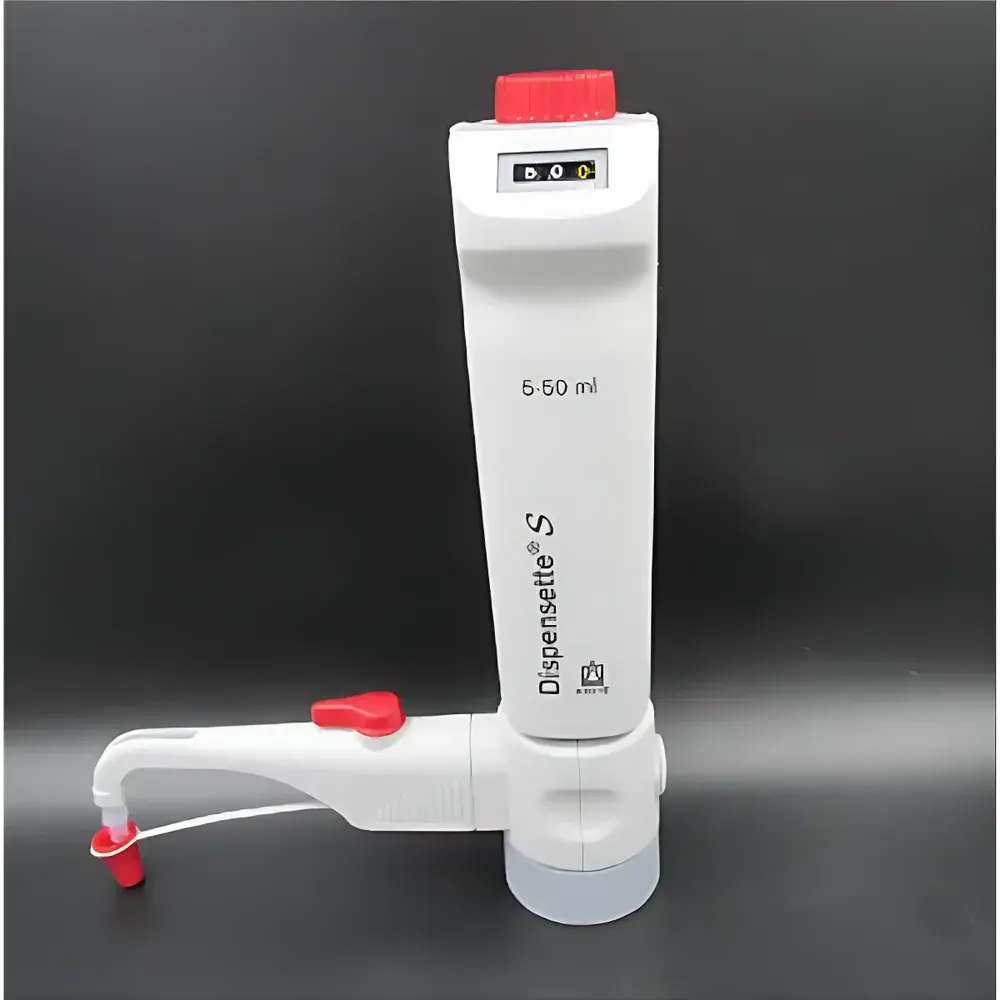
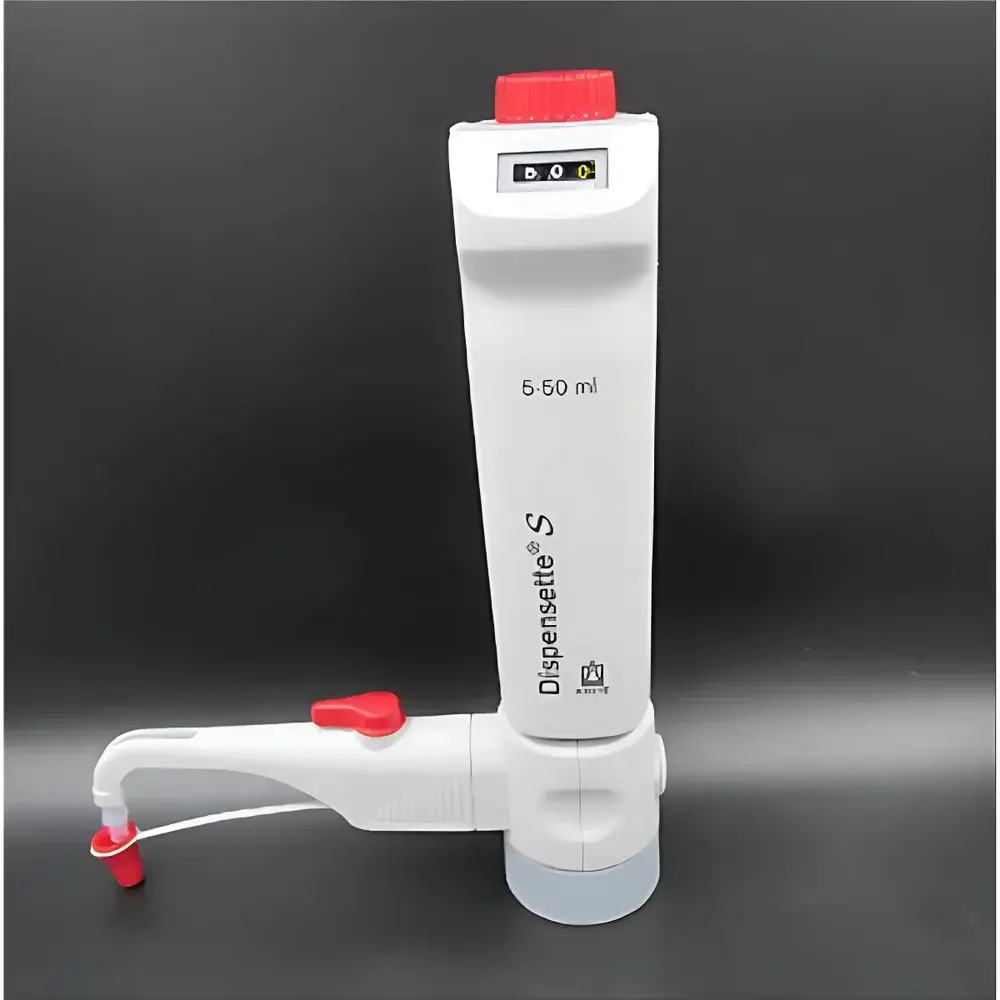
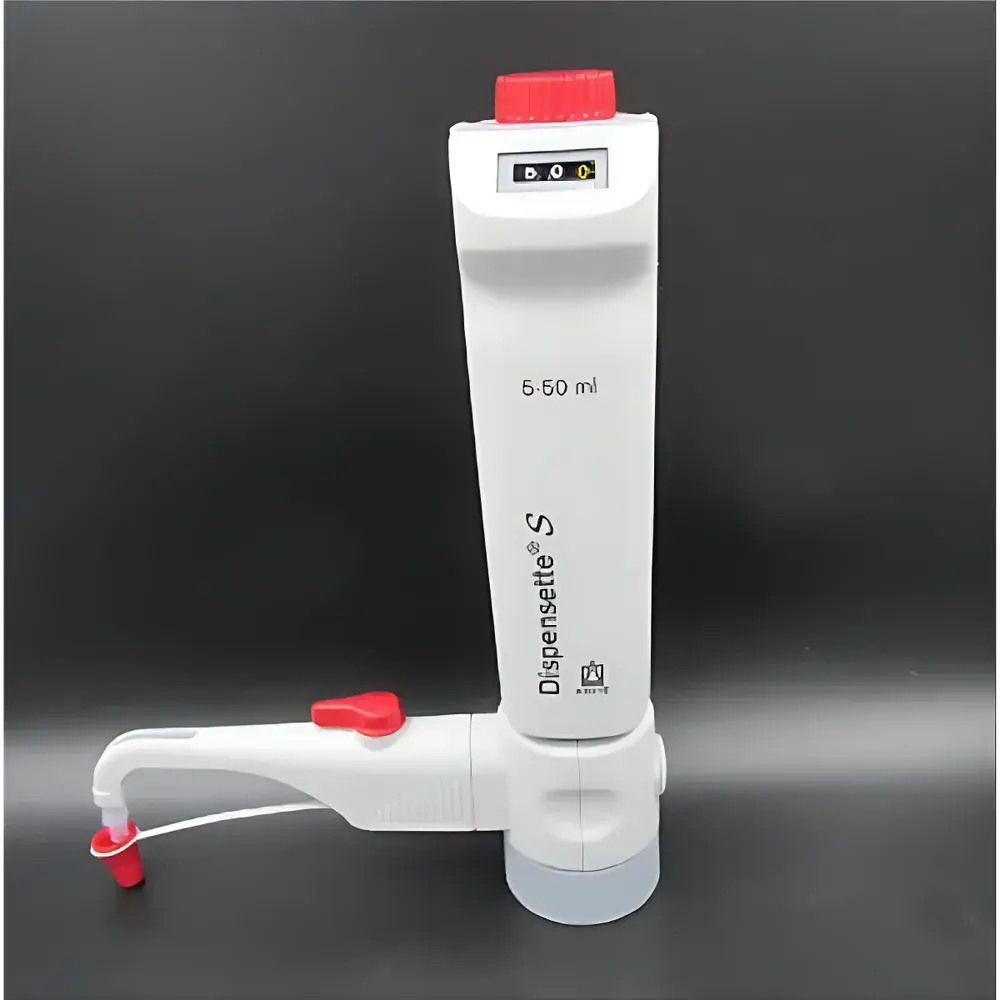
Brandtech Dispensette® S Bottle Top Dispenser Model 4600351
| Brand | Brandtech (Branded as BRAND®) |
|---|---|
| Origin | Germany |
| Type | Electronic Bottle Top Dispenser |
| Volume Range | 2.5–25 mL |
| Minimum Increment | 0.1 mL |
| Accuracy | ≤ ±0.5% (relative error) |
| Precision | ≤ 0.1% (relative standard deviation) |
| Sterilization | Autoclavable at 121 °C, saturated steam |
| Compliance | GLP, ISO 9001 |
| Dispensing Valve | Sealing-ring-free valve system with integrated ball valves |
| Delivery Tube | Adjustable length, 360° rotatable dispensing module |
| Thread Compatibility | Standard 45 mm GL45 neck |
| Safety Feature | Integrated safety reseal valve (optional configuration) |
| Certification | DE-M mark (German Metrology Institute) |
Overview
The Brandtech Dispensette® S Bottle Top Dispenser Model 4600351 is a high-precision, autoclavable electronic liquid handling instrument engineered for reproducible, contamination-controlled delivery of aggressive and sensitive reagents directly from standard laboratory reagent bottles. Designed according to the principles of positive displacement metering—where volume is defined by mechanical displacement of a calibrated piston within a sealed chamber—the Dispensette® S eliminates reliance on gravity or air displacement, ensuring consistent volumetric accuracy across varying liquid densities, viscosities, and vapor pressures. Its application scope spans quality control laboratories, pharmaceutical R&D, chemical synthesis, and academic research environments where traceability, operator safety, and regulatory compliance are non-negotiable. The device operates without elastomeric sealing rings—a key innovation that removes a primary source of adsorption, swelling, and cross-contamination—enabling reliable dispensing of corrosive inorganic acids (e.g., H₃PO₄, H₂SO₄), alkaline solutions, saline media, and broad-spectrum organic solvents (excluding HF, concentrated HCl, and HNO₃ per manufacturer specifications).
Key Features
- Ring-free valve architecture with chemically resistant PTFE-coated glass piston and sapphire-hardened ball valves—designed for >100,000 actuation cycles under routine use
- Full autoclaving capability at 121 °C / 20 min (DIN EN 285), validated for repeated sterilization without performance drift or dimensional change
- Integrated red calibration indicator plate: provides immediate visual confirmation when factory-set calibration has been altered—supporting audit-ready GLP workflows
- 360° rotatable dispensing head ensures ergonomic alignment with bottle labeling, reducing user fatigue and misorientation errors during high-throughput dispensing
- Adjustable suction tube length (range: 120–380 mm) accommodates bottles from 30 mL vials to 5 L carboys; supplied with GL45 (45 mm) thread and universal adapter set (GL32, GL25, ST24)
- Electronic control module with tactile feedback buttons, backlit LCD display, and programmable dispensing modes (single-shot, repeat, continuous)
Sample Compatibility & Compliance
The Dispensette® S 4600351 is validated for direct dispensing from commercially available reagent containers without intermediate transfer steps—minimizing exposure risk and sample degradation. It complies with ISO 8655-3 (volumetric piston-operated instruments), meets requirements for Good Laboratory Practice (GLP) documentation, and supports full traceability under ISO/IEC 17025-accredited calibration protocols. Its construction materials (borosilicate glass, PTFE, ETFE, FEP, and 316 stainless steel) conform to USP Class VI biocompatibility standards and resist corrosion from pH 0–14 solutions (excluding hydrofluoric acid and oxidizing mixtures above 65 °C). The DE-M metrological certification confirms conformity with German national measurement legislation (Eichgesetz), ensuring legally recognized volume accuracy in regulated EU markets.
Software & Data Management
While the 4600351 operates as a standalone instrument, its electronic module logs dispensing events—including volume, timestamp, and actuation count—in non-volatile memory (10,000-event capacity). Data export via USB-C interface enables integration into LIMS or ELN platforms using CSV-formatted reports compliant with FDA 21 CFR Part 11 requirements (electronic signatures, audit trails, and data integrity controls). Calibration history—including date, technician ID, reference standard used (e.g., certified Class A volumetric flask), and post-adjustment verification results—is stored separately and exportable. Firmware updates maintain alignment with evolving ISO/IEC 17025 clause 6.4.10 (software validation) and ICH Q9 risk-based calibration intervals.
Applications
- Precise preparation of calibration standards and QC samples in environmental testing (e.g., EPA Method 200.7, ISO 11885)
- Reagent addition in titration workflows requiring sub-0.1 mL repeatability (ASTM D97, ISO 3675)
- Controlled dispensing of cytotoxic compounds in oncology research labs operating under ISO 15190 biosafety guidelines
- High-integrity dilution series generation for ELISA, PCR master mix preparation, and cell culture media formulation
- Automated solvent transfer in HPLC mobile phase preparation where water content and particulate ingress must be minimized
FAQ
Is the Dispensette® S 4600351 compatible with hydrofluoric acid (HF)?
No. HF is explicitly excluded due to irreversible etching of borosilicate glass components and degradation of fluoropolymer seals. Use only with acids listed in the technical datasheet (H₃PO₄, H₂SO₄, diluted HCl/HNO₃ up to specified concentrations).
Can the device be calibrated in-house without external service?
Yes—calibration follows ISO 8655-6 procedures using certified Class A glassware and gravimetric verification. The red indicator plate activates automatically upon adjustment, documenting calibration events for internal QA review.
What maintenance intervals are recommended for GLP-compliant operation?
Valve modules should be inspected every 6 months or after 5,000 dispenses; full cleaning and visual inspection of piston surface and ball seats is required prior to autoclaving. Logbook entries must include date, operator ID, and observation notes per ISO/IEC 17025 clause 7.7.
Does the electronic module support network connectivity (e.g., Ethernet or Wi-Fi)?
No—data transfer is limited to USB-C for security and electromagnetic compatibility reasons. Network interfaces are omitted to prevent unintended remote access and ensure compliance with IEC 61326-1 for laboratory EMC environments.



