
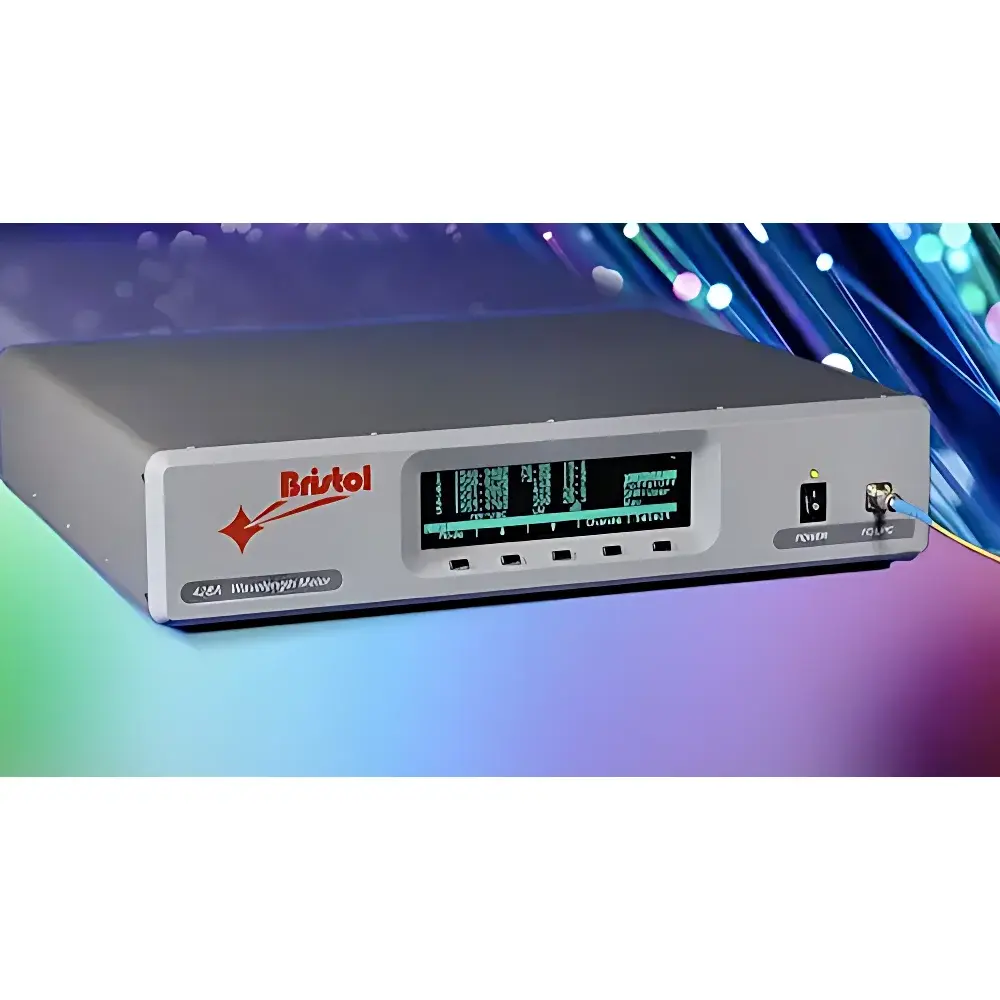
Bristol 428 Series Optical Communication Laser Wavelength Meter
| Brand | Bristol |
|---|---|
| Origin | USA |
| Model | 428 Series |
| Wavelength Range | 1270–1650 nm (182–236 THz) |
| Absolute Accuracy | ±0.2 ppm |
| Calibration Source | Stabilized HeNe Laser |
| Max Channels Simultaneous Measurement | 1000 |
| Update Rate | 4 Hz |
| Power Measurement Accuracy | ±0.5 dB (±30 nm from 1310/1550 nm) |
| Minimum Input Power | −40 dBm (1270–1600 nm) |
| Maximum Input Power | +10 dBm |
| Display Resolution | 0.0001 nm |
| Output Interfaces | USB 2.0, Ethernet (GPIB optional) |
| Dimensions (H×W×L) | 89 mm × 432 mm × 381 mm |
Overview
The Bristol 428 Series Optical Communication Laser Wavelength Meter is a high-precision interferometric instrument engineered for metrology-grade wavelength and optical power characterization of continuous-wave (CW) and modulated lasers in dense wavelength division multiplexing (DWDM) systems. Operating on the principle of high-finesse Michelson interferometry with real-time phase tracking, the 428 Series delivers traceable, absolute wavelength measurements across the full telecommunications C-, L-, S-, and extended U-bands (1270–1650 nm / 182–236 THz). Its design centers on long-term stability and autonomous calibration integrity—enabled by an integrated, thermally stabilized, frequency-stabilized HeNe laser reference source that continuously validates measurement accuracy without manual intervention or external recalibration. This architecture ensures compliance with industry requirements for unbroken metrological traceability, supporting ISO/IEC 17025-compliant laboratory workflows and GLP/GMP-aligned production testing environments.
Key Features
- Interferometric wavelength measurement with ±0.2 ppm absolute accuracy (e.g., ±0.3 pm at 1550 nm), verified against NIST-traceable HeNe reference
- Simultaneous acquisition of up to 1000 DWDM channels at 4 Hz update rate—enabling real-time spectral monitoring of multi-channel transceivers and ROADMs
- Integrated dual-function capability: concurrent wavelength and optical power measurement per channel, with ±0.5 dB linearity over ±30 nm windows centered at 1310 nm and 1550 nm
- Self-calibrating architecture featuring a permanently sealed, long-life stabilized HeNe laser—eliminating drift-induced recalibration cycles and reducing total cost of ownership
- Flexible input dynamic range: −40 dBm minimum detectable power (1270–1600 nm), +10 dBm maximum input (display-limited), compatible with amplified spontaneous emission (ASE) sources and low-power DFBs
- Standard digital interfaces include USB 2.0 and 10/100/1000BASE-T Ethernet; IEEE-488 (GPIB) available as factory-installed option for integration into ATE and automated test benches
Sample Compatibility & Compliance
The 428 Series accepts free-space collimated beams or fiber-coupled inputs via FC/APC or FC/PC adapters (optional). It supports both single-frequency CW lasers (e.g., DFB, DBR, external cavity diodes) and externally modulated sources (e.g., NRZ, PAM4, QPSK carriers) without requiring demodulation preprocessing. The instrument meets IEC 61326-1:2013 for electromagnetic compatibility in industrial environments and conforms to laser safety Class 1 per IEC 60825-1:2014 when used with appropriate fiber interconnects. Its measurement uncertainty budget is documented per ISO/IEC Guide 98-3 (GUM), and raw data export supports audit-ready reporting for FDA 21 CFR Part 11-compliant systems when paired with validated software configurations.
Software & Data Management
Bristol’s proprietary Wavemeter Control Software (v5.x) provides real-time visualization of wavelength, power, and channel ID in nm, cm⁻¹, or THz units—with user-selectable display resolution down to 0.0001 nm. The software enables time-stamped batch logging (CSV, HDF5), statistical trend analysis (mean, std dev, min/max over user-defined intervals), and alarm-triggered event capture. Remote operation is supported via TCP/IP socket commands or SCPI over Ethernet/USB, allowing seamless integration with LabVIEW, Python (PyVISA), MATLAB, or custom C/C++ test sequencers. All firmware and configuration changes are logged with timestamped audit trails, satisfying GLP documentation requirements.
Applications
- DWDM transmitter qualification and drift monitoring during burn-in and lifetime testing
- Fiber-optic component characterization—including tunable lasers, AWGs, and interleavers—under thermal and current sweep conditions
- Calibration of optical spectrum analyzers (OSAs) and wavemeters in metrology labs
- In-line wavelength verification in coherent optical module assembly lines
- Research on narrow-linewidth lasers, optical frequency combs, and quantum communication sources
- Verification of ITU-T G.694.1 channel grid alignment in reconfigurable optical add-drop multiplexers (ROADMs)
FAQ
Does the 428 Series require periodic external recalibration?
No. The built-in stabilized HeNe laser serves as a permanent primary reference; the system performs continuous self-validation and requires no scheduled external recalibration.
Can it measure lasers with linewidths broader than 1 MHz?
Yes—the instrument is optimized for single-longitudinal-mode (SLM) sources but maintains specified accuracy for lasers with linewidths up to 10 MHz under standard operating conditions.
Is power measurement performed simultaneously with wavelength acquisition?
Yes. Each detected channel’s optical power is measured concurrently with its wavelength, using a calibrated photodiode path synchronized to the interferometer readout.
What is the typical measurement uncertainty contribution from temperature fluctuations?
The instrument’s internal thermal management maintains interferometer path stability within ±0.02 °C; combined with active HeNe referencing, ambient temperature variations from 15–30 °C introduce <±0.05 ppm additional uncertainty.
Can the 428 Series be rack-mounted?
Yes—its 19-inch rack-mount kit (optional accessory) accommodates standard 2U vertical space and includes front-panel cable management and ventilation ducting.






