
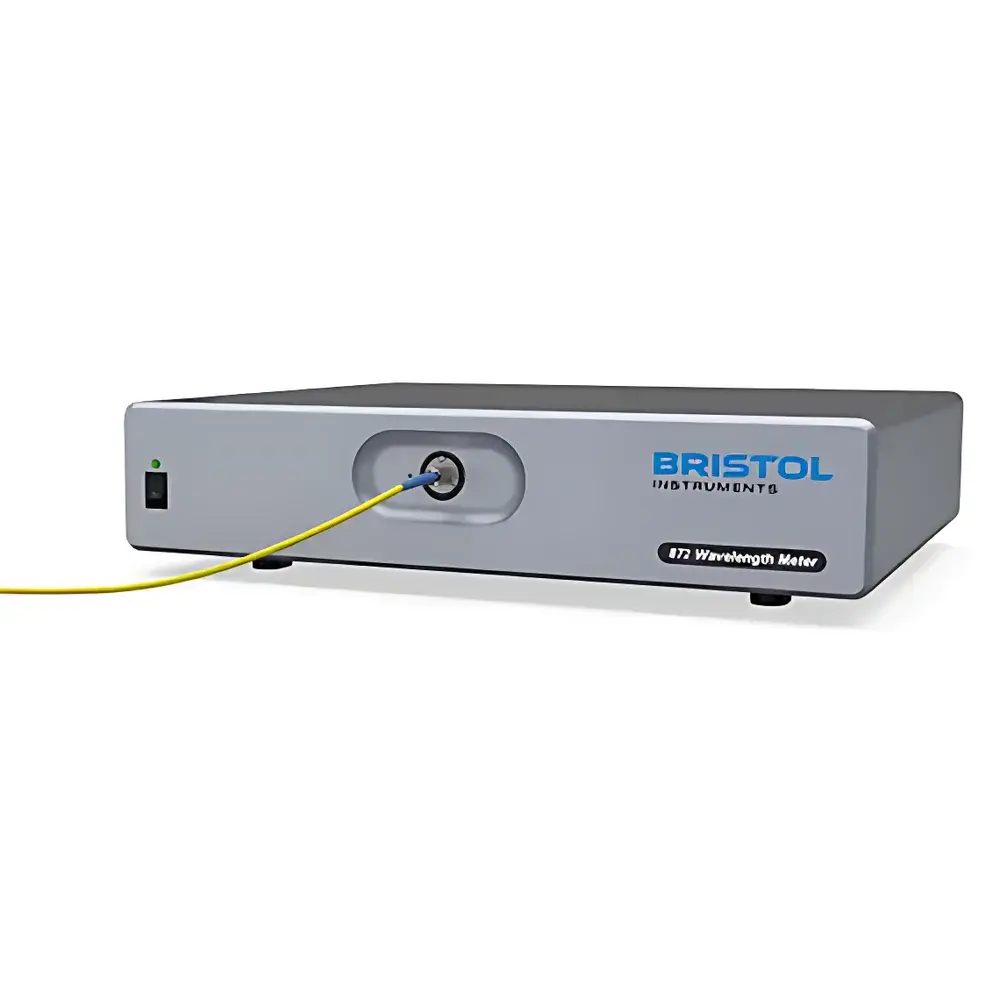
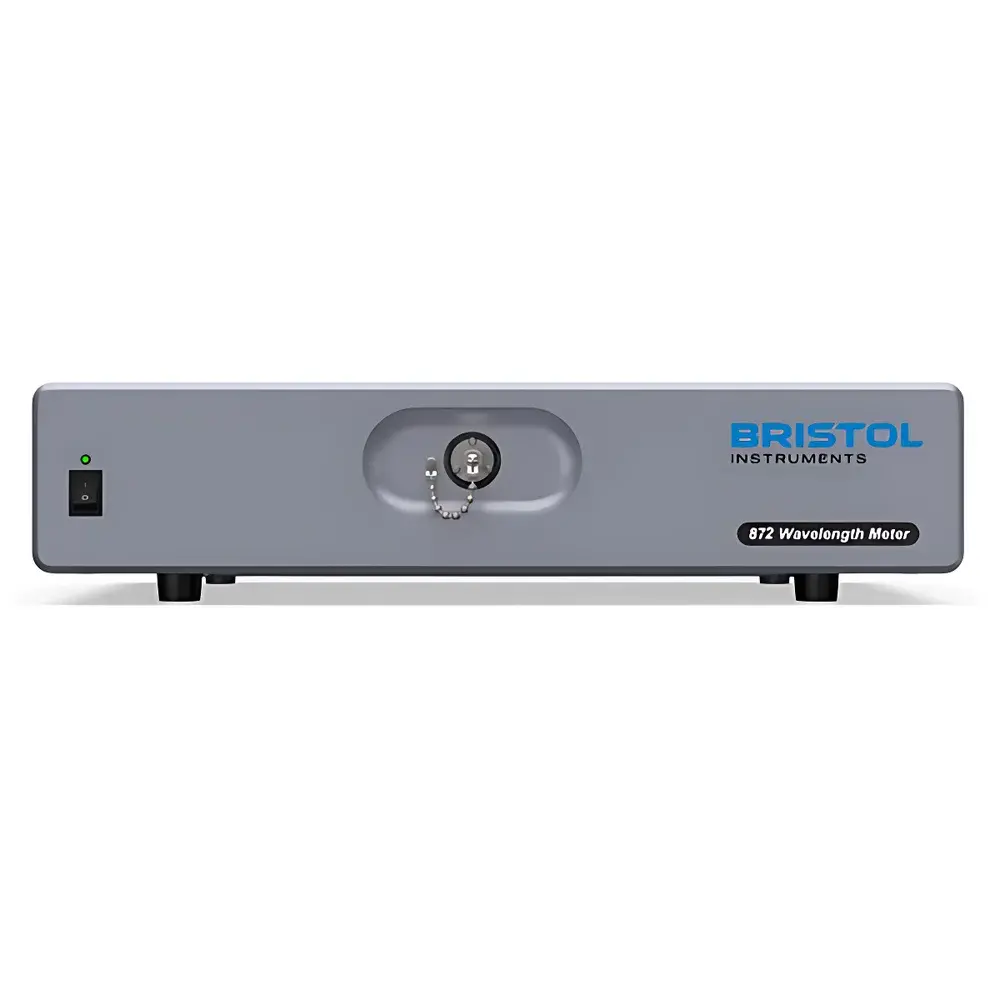
Bristol Instruments 872 Series Pulsed Laser Wavelength Meter
| Brand | Bristol |
|---|---|
| Origin | USA |
| Model | 872 Series |
| Wavelength Range (VIS) | 375–1100 nm |
| Wavelength Range (NIR) | 630–1700 nm |
| Absolute Accuracy | ±0.2 ppm (±0.0002 nm @ 1000 nm) |
| Resolution | 0.001 ppm (300 kHz @ 300,000 GHz) |
| Measurement Rate | 1 kHz |
| Input | Fiber-coupled (free-space option available) |
| Calibration | Internal wavelength reference standard |
| PID Control | Integrated |
| Warm-up Time | <15 min |
| Dimensions (H×W×L) | 89 mm × 432 mm × 381 mm |
| Minimum Pulse Energy | 3–300 nJ (VIS), 50–600 nJ (NIR) |
Overview
The Bristol Instruments 872 Series Pulsed Laser Wavelength Meter is a high-precision, self-calibrating optical metrology instrument engineered for demanding applications in quantum optics, atomic physics, and laser development laboratories. Based on a stabilized Michelson interferometer architecture with active path-length control, the 872 Series delivers traceable wavelength measurements of both pulsed and continuous-wave (CW) lasers across two optimized spectral bands: visible (375–1100 nm) and near-infrared (630–1700 nm). Its core measurement principle relies on high-fidelity interferometric fringe analysis, where optical path difference is precisely monitored and corrected in real time using an internal HeNe-based wavelength reference. This architecture enables sub-picometer resolution and long-term stability without reliance on external calibration sources—making it suitable for environments requiring compliance with ISO/IEC 17025 traceability frameworks.
Key Features
- Internal wavelength reference standard ensures automatic, drift-free calibration—no periodic recalibration or external standards required.
- Dual-band configuration: 872A-VIS (375–1100 nm) and 872A-NIR (630–1700 nm) models share identical metrological performance and firmware architecture.
- Measurement resolution of 0.001 ppm (equivalent to 300 kHz at 300 THz or 0.001 pm at 1000 nm), supporting ultra-narrow linewidth characterization of mode-locked and frequency-doubled lasers.
- Real-time 1 kHz measurement rate enables dynamic tracking of wavelength drift, mode hops, and thermal transients in actively stabilized systems.
- Integrated PID controller provides closed-loop feedback for external laser current or temperature actuators—enabling direct implementation of frequency lock loops for atomic spectroscopy (e.g., Rb, Cs, Yb transitions) and cavity stabilization.
- Fiber-coupled input with factory pre-alignment minimizes alignment overhead; optional free-space input module supports collimated beam coupling with adjustable kinematic mounts.
- Nine-digit display with selectable units (nm, µm, cm⁻¹, GHz, THz) facilitates cross-domain interpretation in spectroscopic and photonic integration workflows.
Sample Compatibility & Compliance
The 872 Series accepts nanosecond- to microsecond-duration pulses with minimum energies of 3 nJ (VIS) and 50 nJ (NIR), accommodating common Q-switched, gain-switched, and OPO-pumped sources. It is compatible with single-mode fiber inputs (SMF-28, HI1060, etc.) and supports polarization-maintaining configurations via optional adapters. The instrument meets electromagnetic compatibility requirements per FCC Part 15 Class A and CE directives. Its internal calibration source is traceable to NIST-certified HeNe laser standards, supporting laboratory quality assurance protocols aligned with ISO 17025 and GLP documentation practices. While not FDA-certified as a medical device, its metrological rigor aligns with requirements for laser safety validation (IEC 60825-1) and photonics R&D reporting under DoD and NSF grant guidelines.
Software & Data Management
The 872 Series operates via the vendor-supplied Wavemeter Control Software (v5.x), which provides remote operation over USB 2.0 or Ethernet (TCP/IP). The software supports full data logging with timestamping, CSV export, and programmable trigger synchronization with external pulse generators or DAQ systems. Audit-trail functionality records all user-initiated calibrations, parameter changes, and measurement sessions—meeting basic ALCOA+ principles for research integrity. API support (LabVIEW, MATLAB, Python) enables integration into automated test benches and custom feedback control architectures. Raw interferogram data can be exported for offline Fourier analysis, supporting advanced uncertainty quantification per GUM (Guide to the Expression of Uncertainty in Measurement).
Applications
- Stabilization and characterization of diode lasers used in magneto-optical traps (MOTs) and optical lattices.
- Verification of wavelength accuracy in tunable external-cavity diode lasers (ECDLs) and distributed feedback (DFB) sources.
- Monitoring center-wavelength drift in fiber lasers and solid-state amplifiers during thermal load testing.
- Validation of optical parametric oscillator (OPO) output tuning curves across broad spectral ranges.
- Supporting metrology workflows in national labs and university quantum engineering centers requiring traceable λ-measurement at sub-MHz uncertainty levels.
- Integration into industrial laser manufacturing lines for final QC of telecom-grade DFBs and pump diodes (C-band, L-band).
FAQ
Does the 872 Series require external calibration during routine operation?
No—the built-in HeNe-referenced calibration system performs autonomous verification before each measurement cycle, eliminating scheduled recalibration intervals.
Can the instrument measure multi-longitudinal-mode (MLM) lasers?
Yes, but resolution is limited to the instrument’s free spectral range (~1 GHz); individual modes within that bandwidth are resolvable only if spectrally separated by ≥300 kHz.
Is the PID controller compatible with third-party laser drivers?
Yes—output signals (0–10 V analog, ±10 V differential) are fully configurable and electrically isolated to interface with commercial TEC controllers and laser current sources.
What is the typical measurement uncertainty budget for a 1064 nm Nd:YAG laser?
At 1064 nm, combined standard uncertainty is ≤±0.00022 nm (k=2), derived from resolution, linearity, thermal drift, and reference stability contributions.
How does the 872 Series handle low-repetition-rate pulsed lasers (e.g., 10 Hz)?
It buffers and processes each pulse individually; measurement rate remains 1 kHz, but effective sampling follows the laser’s PRF—data points are time-stamped and interpolated for drift analysis.




