
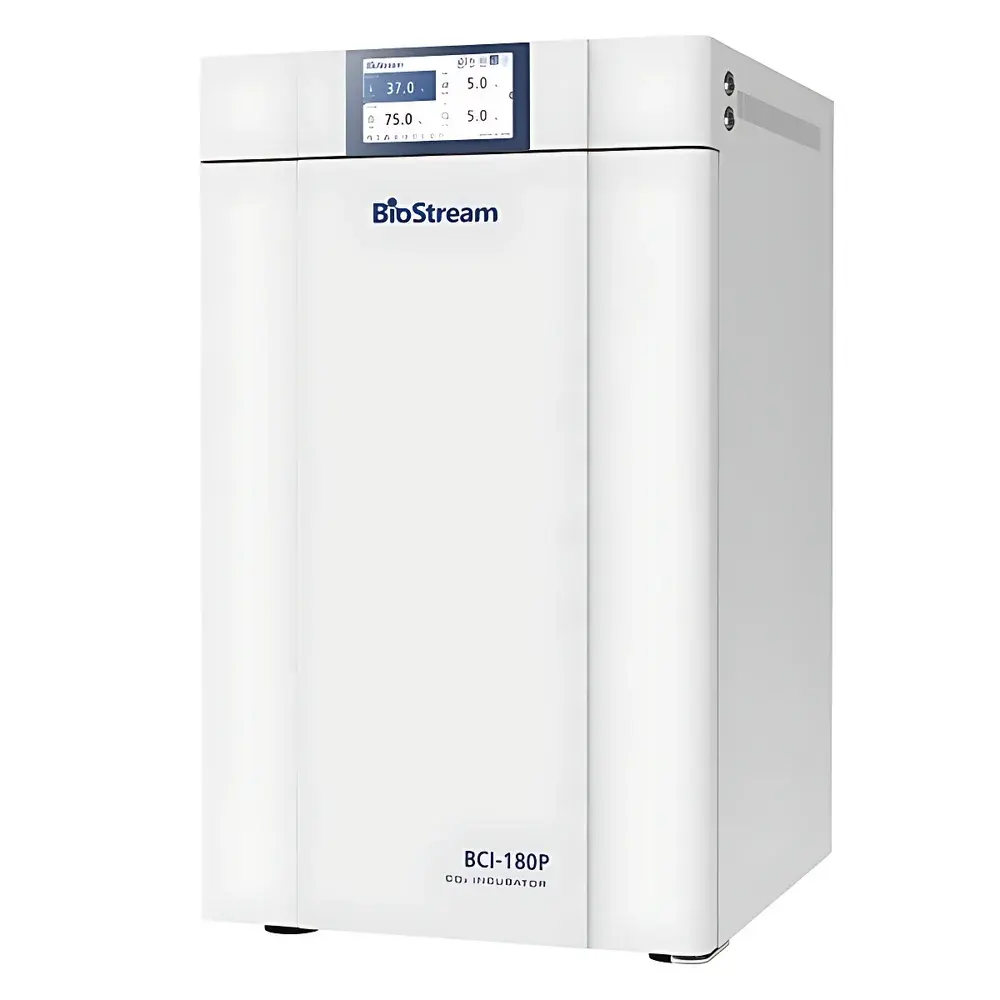
Brookfield BCI-180P Low-Temperature CO₂ Incubator
| Brand | Brookfield |
|---|---|
| Origin | Netherlands |
| Model | BCI-180P |
| Capacity | 180 L |
| Temperature Uniformity | ±0.3 °C (at 37 °C / RT 20 °C) |
| Temperature Range | +20 to +60 °C |
| Temperature Resolution | 0.1 °C |
| CO₂ Range | 0–20 % |
| CO₂ Accuracy | ±0.1 % (at 5 %, 37 °C) |
| CO₂ Resolution | 0.1 % |
| CO₂ Sensor | Dual-beam infrared sensor |
| Sterilization | Dry-heat up to ≤125 °C |
| Heating Power | 320 W |
| CO₂ Inlet Pressure | 0.3–0.5 bar |
| Shelf Capacity | 3 standard / up to 8 optional |
| Internal Dimensions (W×D×H) | 473 × 528 × 710 mm |
| External Dimensions (W×D×H) | 560 × 620 × 945 mm |
| Net Weight | 85 kg |
| Jacket Type | Air-jacketed (6-sided gradient heating) |
| Chamber Material | AISI 304 stainless steel |
| Display | TFT touch screen |
| Control System | Digital PID |
Overview
The Brookfield BCI-180P Low-Temperature CO₂ Incubator is a precision-engineered life science instrument designed for stable, contamination-resistant cell culture under tightly controlled atmospheric and thermal conditions. Unlike conventional compressor-based incubators, the BCI-180P employs solid-state Peltier thermoelectric cooling technology—enabling precise sub-ambient temperature regulation down to +20 °C without mechanical vibration, refrigerant use, or acoustic disturbance. This architecture supports sensitive applications such as primary neuronal culture, stem cell expansion, and low-temperature co-culture assays where thermal stability and environmental integrity are non-negotiable. The air-jacketed chamber features six-sided gradient heating with independent PID control per zone, minimizing thermal gradients across the 180 L working volume. Dual-beam infrared CO₂ sensing ensures long-term drift-free gas concentration monitoring, while the AISI 304 stainless-steel interior provides corrosion resistance and facilitates routine decontamination.
Key Features
- Peltier-based cooling system enabling stable operation from +20 °C to +60 °C with no moving parts, zero refrigerant emissions, and <10 dB(A) operational noise
- Air-jacketed design with six-sided independent heating zones and real-time thermal mapping for ±0.3 °C uniformity at 37 °C and ambient (20 °C)
- Dual-beam NDIR CO₂ sensor with automatic baseline correction, delivering ±0.1 % accuracy at 5 % CO₂ setpoint and 37 °C
- Integrated dry-heat sterilization mode (≤125 °C, 12 h), validated for microbial reduction ≥6 log₁₀ (ISO 14644-1 Class 5 compatible environments)
- TFT capacitive touch interface with multilingual support (EN/DE/FR/ES), configurable alarm thresholds, and event-logged parameter history
- Modular construction allowing field-replaceable Peltier modules, CO₂ sensor cartridges, and fan assemblies—reducing mean time to repair (MTTR) to <30 minutes
Sample Compatibility & Compliance
The BCI-180P accommodates standard tissue culture vessels—including T-flasks (up to T225), multiwell plates (6–96-well), Petri dishes, and roller bottles—across three standard stainless-steel shelves (load capacity: 15 kg/shelf). Optional shelf configurations support up to eight levels for high-density screening workflows. All internal surfaces meet ISO 13485-certified biocompatibility requirements; chamber materials comply with USP <88> Class VI cytotoxicity testing. The incubator satisfies essential regulatory prerequisites for GLP and GMP environments: full audit trail logging (user actions, parameter changes, alarms), password-protected access tiers (operator/admin/supervisor), and electronic signature support aligned with FDA 21 CFR Part 11 Annex 11 expectations. CO₂ control performance adheres to ASTM E1910-21 (Standard Practice for Performance Testing of CO₂ Incubators) and ISO 13738:2017 (Biotechnology — Requirements for CO₂ Incubators).
Software & Data Management
Embedded firmware supports continuous data acquisition at 10-second intervals for temperature, CO₂, and relative humidity (optional RH probe). Raw logs export via USB-C in CSV format with ISO 8601 timestamps and UTC synchronization. Optional Ethernet connectivity enables integration into LabVantage, Thermo Fisher SampleManager, or custom LIMS platforms using Modbus TCP or RESTful API endpoints. All configuration changes trigger immutable entries in the internal event log—including operator ID, timestamp, pre-change/post-change values, and reason-for-change annotation fields. Firmware updates are digitally signed and validated prior to installation, preserving data integrity during version transitions.
Applications
- Long-term maintenance of temperature-sensitive primary cells (e.g., hepatocytes, chondrocytes) requiring stable +25–32 °C operation
- Low-oxygen preconditioning studies using programmable CO₂ ramping (0–20 % in 0.1 % increments) combined with thermal gradients
- Pre-incubation of CRISPR-Cas9 electroporation samples prior to transfection, minimizing metabolic stress
- Quality control of monoclonal antibody-producing CHO cell lines under ICH Q5D-compliant conditions
- Regulatory submission support for biologics manufacturing, including traceable calibration records and IQ/OQ documentation packages
FAQ
Does the BCI-180P support external CO₂ gas blending (e.g., with N₂ or O₂)?
Yes—the unit accepts mixed gas inputs via calibrated mass flow controllers (MFCs); optional factory-installed tri-gas module enables independent control of CO₂, O₂, and N₂.
Is the dry-heat sterilization cycle validated for mycoplasma eradication?
Yes—validation reports confirm ≥6 log₁₀ reduction of Mycoplasma hominis and Acholeplasma laidlawii following the 125 °C/12 h protocol per ISO 11138-3.
Can the incubator be integrated into a central building management system (BMS)?
Yes—BACnet MS/TP and Modbus RTU interfaces are available as field-installable options for HVAC and alarm integration.
What is the recalibration interval for the CO₂ sensor?
The dual-beam IR sensor requires no routine recalibration; annual verification against NIST-traceable gas standards is recommended per ISO/IEC 17025 guidelines.
Are third-party humidity probes supported?
Only Brookfield-certified capacitive RH sensors (model RH-BCI-01) are supported to maintain measurement uncertainty <±2 % RH (20–80 % RH range).





