
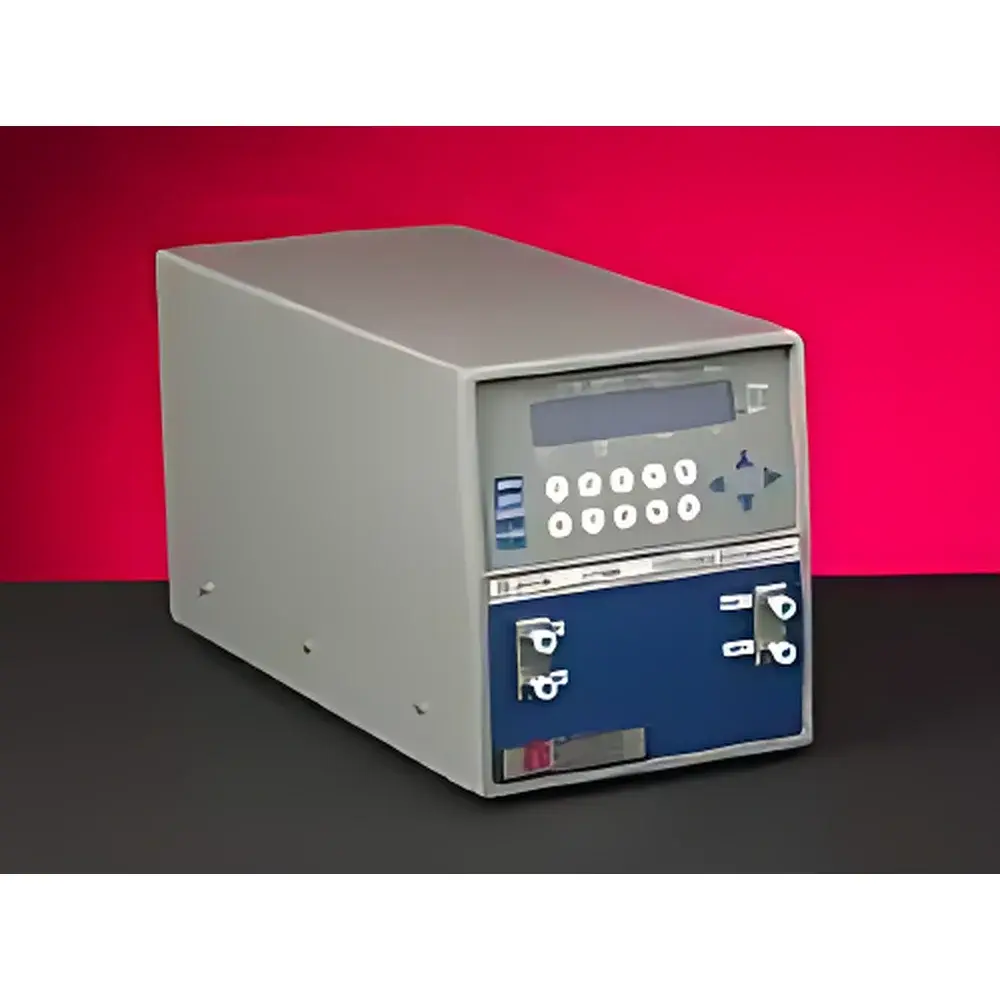
Brookfield BI-DNDC Differential Refractometer
| Origin | USA |
|---|---|
| Manufacturer Type | Authorized Distributor |
| Origin Category | Imported Instrument |
| Model | BI-DNDC |
| Pricing | Available Upon Request |
Overview
The Brookfield BI-DNDC Differential Refractometer is a precision optical instrument engineered for the quantitative measurement of refractive index increments (dn/dc) in polymer solutions and for real-time, concentration-sensitive detection in liquid chromatography systems. It operates on the principle of differential interference detection—comparing the refractive index of a sample stream against a matched reference solvent stream using a dual-beam, wavelength-stabilized LED optical path. This design ensures high baseline stability and low thermal drift, critical for both static dn/dc determination and dynamic online coupling with size-exclusion chromatography (SEC), gel permeation chromatography (GPC), or field-flow fractionation (FFF) platforms. The instrument supports two operational modes: static batch analysis (via syringe injection into a microflow cell) and continuous flow detection (integrated via HPLC-compatible 6-port injection valve and pump-driven eluent delivery). Its core architecture complies with fundamental requirements for trace-level solute quantification in polymer characterization, pharmaceutical excipient analysis, and biopolymer solution thermodynamics.
Key Features
- Optimized 45° flow-cell geometry enabling minimal band broadening and rapid equilibration (<60 s typical)
- Ultra-low dead volume configuration: 25 µL from injection port to flow cell, 240 µL from flow cell to outlet—critical for preserving chromatographic resolution
- Multi-wavelength LED source (620 nm, 535 nm, 470 nm) supporting solvent-specific optimization and minimizing UV-sensitive sample degradation
- Nine selectable full-scale ΔRIU ranges—from 6 × 10⁻⁴ down to 2.3 × 10⁻⁶ RIU—enabling seamless transition between concentrated polymer solutions and dilute macromolecular dispersions
- Thermostatically controlled cell compartment with ±0.01 °C short-term stability and ±0.5 °C absolute accuracy over 15–45 °C operating range
- Integrated user-programmable I/O interface (TTL/RS-232) for synchronization with external triggers, fraction collectors, or third-party data acquisition systems
- Front-panel keypad navigation combined with comprehensive PC-based control via BI-DNDCW software
Sample Compatibility & Compliance
The BI-DNDC accommodates aqueous and organic solvent systems compatible with standard HPLC-grade materials—including THF, DMF, chloroform, DMSO, and buffered aqueous media—within its specified n₀ range of 1.0–1.75 RIU. Sample introduction is supported via 2–2.5 mL glass syringes (static mode) or standard 10–100 µL loop injectors (dynamic mode), with concentration linearity validated across 0.1–10 mg/mL for typical synthetic polymers (e.g., polystyrene, PMMA, PEG). The instrument meets essential metrological requirements for GLP-compliant laboratories: temperature calibration traceable to NIST standards, electronic audit trail support in BI-DNDCW software, and compatibility with FDA 21 CFR Part 11–enabled environments when deployed with validated system configurations. It aligns with ASTM D5296 (SEC molecular weight determination) and ISO 16014-4 (polymer characterization by SEC) for refractive index detection performance.
Software & Data Management
BI-DNDCW is a Windows-native application providing full instrument control, real-time signal monitoring, baseline correction algorithms (including solvent gradient compensation), and export-ready data formatting (ASCII, CSV, AIA/ANDI). The software implements automated zeroing routines, multi-point sensitivity calibration workflows, and time-stamped event logging—including injection events, range switches, and temperature setpoint changes. All acquired signals are stored with metadata (instrument ID, operator, date/time, method name), satisfying basic data integrity requirements for internal QA/QC and regulatory submissions. Optional integration with third-party chromatography data systems (e.g., Empower, Chromeleon, OpenLab CDS) is supported through standardized ASCII output and configurable trigger protocols.
Applications
- Determination of dn/dc values for absolute molar mass calculation in SEC/GPC analysis
- Quantitative detection of non-UV-absorbing analytes—e.g., polysaccharides, polyols, surfactants, and unmodified proteins—in separation workflows
- Monitoring polymerization kinetics via real-time refractive index change in reaction mixtures
- Characterization of colloidal stability and solvation behavior in nanocellulose or lignin dispersions
- Quality control of excipients in parenteral formulations where UV transparency precludes UV-Vis detection
- Validation of mobile phase composition consistency in gradient HPLC methods
FAQ
What is the minimum detectable mass for sucrose in water under standard operating conditions?
The instrument achieves a sensitivity of 1.5 ng of fructose in water; for sucrose, comparable detection limits (~2–3 ng) are observed under identical flow and temperature conditions.
Can the BI-DNDC be used with aggressive solvents such as concentrated sulfuric acid or HF?
No—the flow cell and wetted components are constructed from fused silica, stainless steel (316), and PEEK; they are not chemically resistant to strong mineral acids, halogens, or fluorinated solvents beyond manufacturer-specified compatibility charts.
Is temperature ramping supported during data acquisition?
The instrument maintains a fixed setpoint temperature during acquisition; programmable temperature ramps require external oven integration and are not natively supported by BI-DNDCW firmware.
Does the system provide native support for GMP audit trails?
BI-DNDCW includes operator login, method versioning, and electronic signature prompts; full 21 CFR Part 11 compliance requires deployment on a validated Windows domain environment with time-synced servers and documented system qualification.
How is baseline drift corrected during long-duration SEC runs?
BI-DNDCW offers real-time solvent subtraction, adaptive baseline rolling average (user-defined window), and post-acquisition polynomial fitting—methods routinely applied to mitigate thermal and pressure-induced drift in multi-hour separations.



