
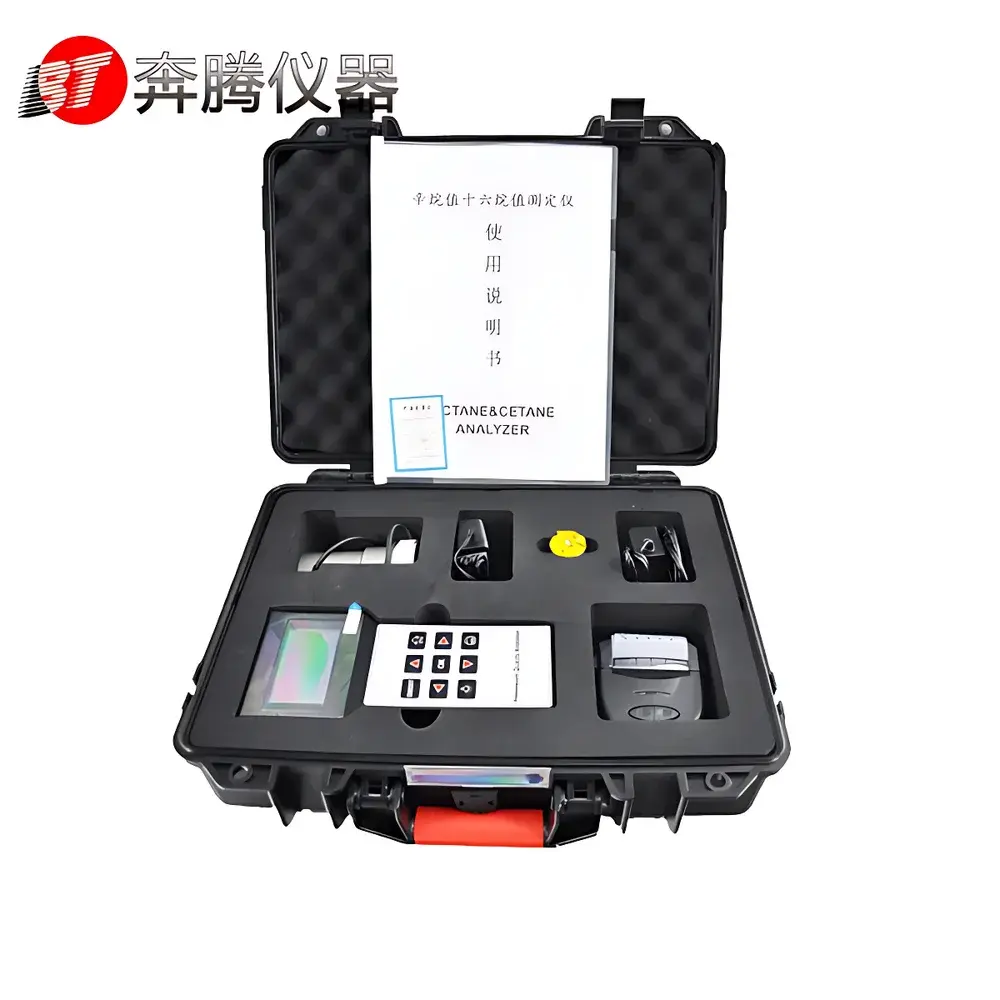
Brookfield BT-2020 Dielectric Constant-Based Octane & Cetane Number Analyzer
| Brand | Benteng |
|---|---|
| Origin | Jilin, China |
| Manufacturer Type | OEM Manufacturer |
| Region of Manufacture | Domestic (China) |
| Model | BT-2020 |
| Pricing | Upon Request |
| Octane Range | 40–120 |
| Octane Accuracy | ±0.5 ON |
| Octane Repeatability | ±0.2 ON |
| Cetane Accuracy | ±1 CN |
| Cetane Repeatability | ±0.5 CN |
| Measurement Time | 1–5 s |
| Operating Temperature Compensation | Yes |
| Atmospheric Pressure Compensation | Yes |
| Display | 4-line backlit LCD |
| Power Supply | Internal rechargeable battery (Low-voltage cutoff at 5.4 V) |
| Dimensions (Main Unit) | 100 mm × 210 mm × 40 mm |
| Sensor Dimensions | 60 mm × 100 mm |
| Weight | 0.7 kg |
| Battery Life | ≥1000 h (typical field use) |
Overview
The Brookfield BT-2020 Dielectric Constant-Based Octane & Cetane Number Analyzer is a portable, field-deployable instrument engineered for rapid, non-destructive assessment of gasoline octane number (ON) and diesel cetane number (CN) using dielectric permittivity and electromagnetic induction principles. Unlike combustion-based reference methods—such as ASTM D2699 (Research Octane Number, RON), ASTM D2700 (Motor Octane Number, MON), or ASTM D613 (Cetane Number)—the BT-2020 relies on the correlation between hydrocarbon composition, polarizability, and bulk dielectric response under controlled electromagnetic excitation. This physics-based approach enables real-time estimation of anti-knock performance without fuel consumption, ignition systems, or high-pressure test engines. The analyzer is calibrated against primary reference fuels and traceably aligned to international standards including ASTM D2699, ASTM D2700, ASTM D4737, ASTM D613, EN ISO 5165, and GB/T 18339. Its compact architecture supports deployment in refinery off-gas lines, terminal laboratories, fuel distribution hubs, and mobile quality assurance units.
Key Features
- Dielectric constant measurement platform optimized for hydrocarbon polarity differentiation—capable of resolving subtle compositional shifts induced by oxygenates (e.g., ethanol, MTBE), aromatics, branched alkanes, and olefins.
- Integrated atmospheric pressure and ambient temperature compensation algorithms—ensuring metrological consistency across elevation gradients and seasonal operating conditions (−20 °C to +50 °C).
- Simultaneous RON, MON, and Anti-Knock Index (AKI = (RON + MON)/2) calculation with dual-fuel mode switching (gasoline/diesel) via intuitive interface.
- Robust sensor head with solvent-resistant, hermetically sealed housing and shock-dampened mechanical design—validated for transport in ISO-certified instrument cases.
- Low-power ARM-based processing core with Windows-compatible USB-C data export—supports batch logging, timestamped measurements, and CSV/Excel-ready output.
- Four-line backlit LCD display with dynamic contrast enhancement—operational down to −30 °C without condensation-induced readout degradation.
- No consumables, no calibration gases, no moving parts—reducing total cost of ownership and eliminating routine maintenance intervals typical of CFR engine-based analyzers.
Sample Compatibility & Compliance
The BT-2020 accepts undiluted liquid hydrocarbon samples directly from sampling valves, drums, or inline flow cells. It accommodates gasoline blends containing up to 15% v/v ethanol (E15), reformulated gasoline (RFG), alkylate-rich streams, and low-sulfur diesel (ULSD) with cetane improvers (e.g., 2-ethylhexyl nitrate). The instrument complies with regulatory frameworks requiring documented traceability: measurement uncertainty budgets are internally archived per ISO/IEC 17025:2017 Annex A.2 guidelines; data integrity meets FDA 21 CFR Part 11 requirements when used with optional audit-trail-enabled firmware (v3.2+). Calibration verification is performed quarterly using NIST-traceable reference fuels (e.g., Chevron RON/MON standards, PTB CN Reference Diesel).
Software & Data Management
Embedded firmware supports local storage of ≥5,000 measurement records with embedded GPS coordinates (optional module), operator ID tagging, and QC flagging (e.g., “low signal-to-noise”, “temperature out-of-spec”). PC-side software (BT-DataLink v4.1) provides statistical process control (SPC) charting, trend analysis across batches, and automated report generation compliant with ASTM D6299 precision statements. Export formats include .csv, .xlsx, and PDF with embedded digital signatures. All firmware updates are cryptographically signed and delivered via secure HTTPS endpoint—no third-party cloud dependency.
Applications
- Real-time blending optimization at refinery rack loading terminals—enabling immediate adjustment of naphtha/isomerate ratios based on predicted RON.
- Field verification of gasoline compliance with regional specifications (e.g., EU Directive 98/70/EC, EPA Tier 3, China VI B).
- Monitoring cetane drift in hydrotreated diesel during catalyst deactivation cycles—correlating dielectric shift with aromatic saturation loss.
- Quality gate screening prior to tank farm transfer—reducing reliance on off-site lab turnaround (typically >24 h for ASTM D2699).
- Educational use in petroleum engineering labs—demonstrating structure-property relationships between molecular branching and dielectric relaxation behavior.
FAQ
Does the BT-2020 replace ASTM D2699/D2700 testing for regulatory submission?
No—it serves as a rapid screening tool aligned to those standards; final certification requires primary method testing per jurisdictional requirements.
Can it measure biofuels such as FAME or HVO?
Yes, with model-specific calibration curves available for EN 14214 biodiesel and ASTM D975 hydrotreated vegetable oil (HVO) blends.
Is sensor immersion required?
No—the sensor operates via contact-mode dielectric coupling; full submersion is unnecessary and not recommended.
What is the recalibration interval under GLP conditions?
Every 90 days or after 500 measurements—whichever occurs first—using certified reference materials traceable to NIST SRM 2720a.
Does it support remote diagnostics?
Yes, via optional Bluetooth 5.0 module enabling firmware health checks, error log retrieval, and predictive sensor drift alerts.





