
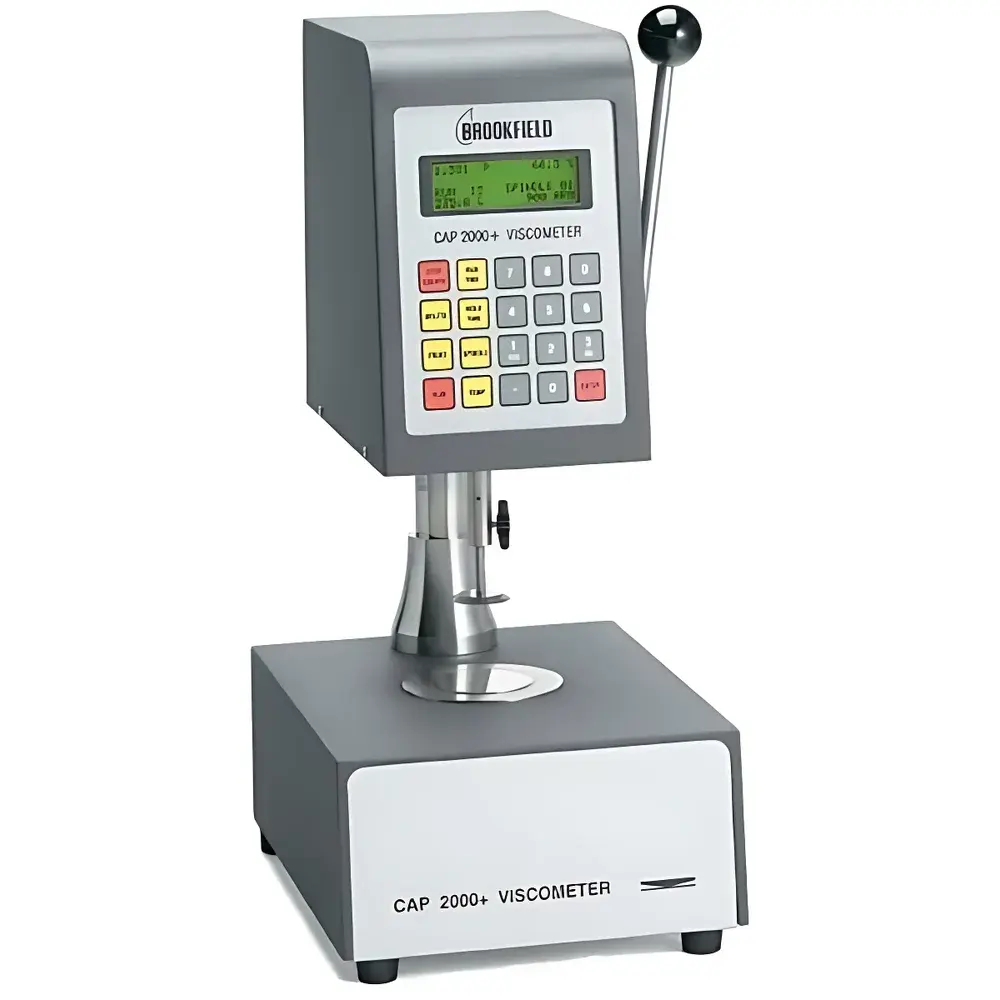
Brookfield CAP 2000+ Cone-Plate Viscometer
| Brand | Brookfield |
|---|---|
| Origin | USA |
| Model | CAP 2000+ |
| Temperature Control Options | L-Series (5–75°C), H-Series (50–235°C) |
| Shear Rate Range | Up to 10,000 s⁻¹ |
| Sample Volume | < 1 mL |
| Speed Range | 5–1000 rpm |
| Compliance | ASTM D4287, ISO 2884, BS 3900, GB/T 9751 |
| Software Integration | CAPCALC32 (optional PC-based control and data analysis) |
| Gap Setting | Automatic cone-plate gap determination |
| Torque Range | User-configurable |
Overview
The Brookfield CAP 2000+ Cone-Plate Viscometer is an engineered solution for high-shear rheological characterization of low-to-medium viscosity fluids—particularly formulated for R&D laboratories and quality control environments in the coatings, inks, adhesives, and polymer dispersion industries. It operates on the fundamental principle of cone-and-plate geometry, where a precisely angled conical spindle rotates over a flat, temperature-controlled plate, generating a uniform shear field across the sample gap. This configuration ensures well-defined, constant shear rate conditions—critical for evaluating non-Newtonian behavior under industrially relevant high-shear regimes (up to 10,000 s⁻¹), as specified in ASTM D4287 and ISO 2884. Unlike coaxial cylinder systems, the cone-plate design minimizes edge effects and delivers superior reproducibility for viscosity and yield stress estimation at elevated shear rates, making it indispensable for correlating lab-scale measurements with application processes such as spray atomization, roller coating, or high-speed mixing.
Key Features
- Automated cone-plate gap setting ensures repeatable measurement geometry without manual calibration or micrometer adjustment.
- Dual temperature control configurations: L-Series (5–75°C) for ambient-to-moderate thermal testing; H-Series (50–235°C) for high-temperature curing studies and hot-melt formulation evaluation.
- Minimal sample requirement (< 1 mL) reduces material consumption and enables rapid screening of precious or hazardous formulations.
- Speed range of 5–1000 rpm supports both low-shear stability assessment and high-shear thinning analysis within a single instrument platform.
- User-definable torque range allows optimization of measurement sensitivity across diverse viscosity spans—from water-like solvents to viscous resin blends—without hardware modification.
- Robust mechanical architecture with precision-ground stainless-steel cones and hardened aluminum plates ensures long-term dimensional stability and resistance to chemical exposure.
Sample Compatibility & Compliance
The CAP 2000+ accommodates Newtonian and shear-thinning fluids typical of solvent-borne and water-borne coatings, UV-curable resins, pigment dispersions, and functional inks. Its cone-plate geometry is especially suited for samples that exhibit minimal sedimentation or phase separation during testing—provided appropriate pre-conditioning (e.g., gentle agitation, degassing) is performed prior to loading. The instrument meets the geometric and operational requirements of ASTM D4287 (Standard Test Method for Viscosity of Paints, Varnishes, Lacquers, and Related Products by Cone-and-Plate Viscometer), ISO 2884-1 (Paints and varnishes — Determination of viscosity using a cone-and-plate viscometer), BS 3900-A9, and GB/T 9751 (Chinese national standard for high-shear viscosity of coatings). These standards mandate specific cone angles (typically 1° or 2°), rotational speed protocols, and temperature control tolerances—all inherently satisfied by the CAP 2000+’s certified mechanical and thermal subsystems.
Software & Data Management
When paired with the optional CAPCALC32 software, the CAP 2000+ transforms into a fully automated data acquisition and analysis workstation. CAPCALC32 provides real-time torque and viscosity display, programmable multi-speed ramps, automatic calculation of apparent viscosity at defined shear rates, and export-ready data formatting (CSV, Excel-compatible). The software supports audit-trail generation—including operator ID, timestamp, instrument configuration, and environmental parameters—facilitating compliance with GLP and GMP documentation requirements. While not natively 21 CFR Part 11 compliant, CAPCALC32 output files can be integrated into validated LIMS or ELN platforms where electronic signature and data integrity controls are centrally managed.
Applications
- Rapid screening of dispersant efficiency and pigment stabilization in architectural and industrial coatings.
- Correlation of high-shear viscosity with sprayability, leveling, and sag resistance in formulation development.
- Monitoring viscosity drift during thermal aging or UV exposure studies.
- Quality release testing of batch-consistency for solvent-based clearcoats and automotive basecoats.
- Yield stress approximation via controlled shear ramp tests for thixotropic ink systems.
- Supporting DOE (Design of Experiments) workflows in polymer synthesis labs where viscosity serves as a proxy for molecular weight distribution trends.
FAQ
What is the minimum required sample volume for accurate measurement?
Less than 1 mL is sufficient due to the shallow, fixed-gap geometry of the cone-plate system.
Can the CAP 2000+ measure yield stress?
It does not directly report yield stress, but controlled shear-rate ramps combined with Herschel-Bulkley curve fitting in CAPCALC32 enable empirical yield point estimation.
Is external cooling or heating circulator integration supported?
No—the L-Series and H-Series models feature fully self-contained Peltier-based temperature control; no auxiliary chiller or heater bath is required.
How is calibration verified?
Brookfield recommends annual verification using NIST-traceable silicone oil standards at multiple shear rates and temperatures, documented per internal SOP or ISO/IEC 17025 guidelines.
Does the instrument support continuous data logging during production line QC?
Yes—via CAPCALC32’s batch-mode scripting, users can define pass/fail thresholds and auto-generate compliance reports for each test sequence.



