
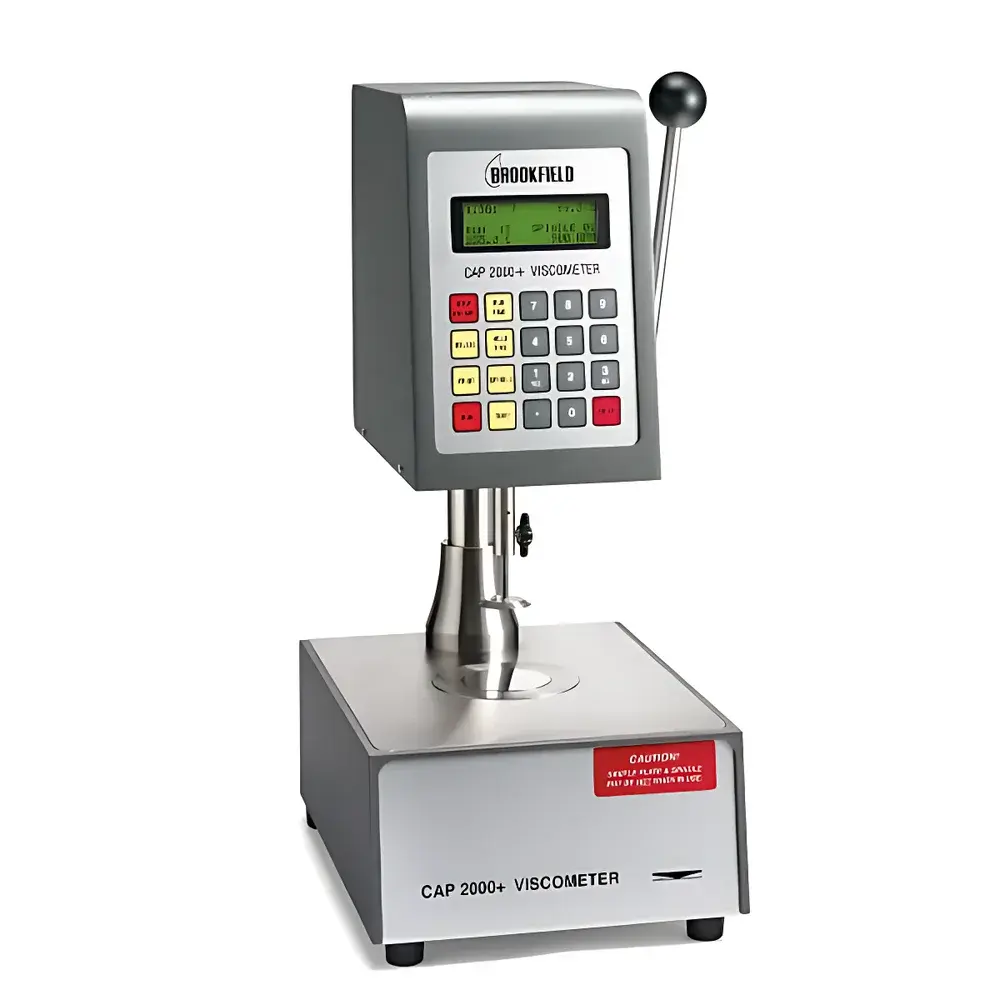
Brookfield CAP-2000+ High-Temperature Cone-and-Plate Rheometer
| Brand | Brookfield |
|---|---|
| Origin | USA |
| Model | CAP-2000+ |
| Temperature Range (L-Series) | 5–75°C |
| Temperature Range (H-Series) | 50–235°C |
| Shear Rate Range | 10–13,300 s⁻¹ |
| Sample Volume | 24–1700 µL (depending on cone geometry) |
| Cone Angles | 1°, 2°, 4° (standard), custom options available |
| Torque Range | High-torque mode up to 2000+ dyne·cm |
| Compliance | ASTM D4287, ISO 2884, BS 3900, GB/T 9751 |
| Control Interface | Built-in touchscreen + PC via CAPCALC™ software |
| Cone/Plate Gap Adjustment | Motorized auto-gap calibration |
Overview
The Brookfield CAP-2000+ is a precision-engineered high-temperature cone-and-plate rheometer designed for controlled-shear viscometry and rheological characterization of thermally sensitive, non-Newtonian fluids under elevated temperature conditions. Operating on the fundamental principle of Couette flow between a rotating conical spindle and a stationary flat plate, the instrument delivers highly reproducible shear stress and viscosity data across a wide shear rate spectrum (10–13,300 s⁻¹). Its architecture is optimized for applications demanding strict thermal stability and minimal sample volume—particularly critical in R&D and QC environments where material scarcity, thermal degradation, or process-relevant temperature profiles (e.g., hot-melt adhesives, asphalt binders, polymer melts, and high-solid coatings) govern measurement validity. Unlike capillary or rotational cylinder geometries, the cone-and-plate configuration ensures uniform shear rate distribution across the entire sample gap—a prerequisite for accurate yield stress estimation, power-law modeling, and time-dependent thixotropic analysis.
Key Features
- Integrated Peltier (L-series) or heated aluminum block (H-series) temperature control with ±0.1°C stability over the full operating range (5–75°C or 50–235°C)
- Motorized auto-gap adjustment with real-time gap verification—eliminating manual micrometer errors and ensuring repeatable sample thickness (typically 50–100 µm)
- Large-format backlit LCD touchscreen interface enabling direct parameter entry, real-time curve plotting, and on-device data review without external hardware
- Dual torque sensor configurations: high-torque mode (up to 2000+ dyne·cm) for viscous melts and low-torque mode (as low as 797 dyne·cm) for low-to-medium viscosity fluids at low shear rates
- Ten interchangeable cone geometries (CAP-01 through CAP-10), each calibrated with traceable standard oils per ASTM D2196 and ISO 3219, supporting viscosity ranges from 10⁶ mPa·s
- Sample volume requirement as low as 24 µL (CAP-03, 4° cone), minimizing material consumption and reducing thermal equilibration time
Sample Compatibility & Compliance
The CAP-2000+ is validated for use with thermoplastic adhesives, bituminous binders, solvent-based and waterborne coatings, UV-curable resins, and molten polymers. Its cone-and-plate geometry conforms to standardized test methods including ASTM D4287 (high-shear viscosity of paints and related materials), ISO 2884-1 (determination of viscosity using cone-and-plate viscometers), BS 3900-P1, and GB/T 9751 (Chinese national standard for high-shear viscosity of coatings). All cone spindles are manufactured to ISO 3219 tolerances (cone angle deviation ≤ ±0.02°), and gap calibration adheres to ISO 16520 requirements for rotational rheometers. The system supports GLP-compliant workflows when operated with CAPCALC™ software, including electronic signatures, audit trails, and instrument qualification documentation templates aligned with FDA 21 CFR Part 11 expectations.
Software & Data Management
CAPCALC™ is the native Windows-based control and analysis platform for the CAP-2000+. It enables full remote operation—including ramped shear rate sweeps, oscillatory frequency sweeps, time-sweep thixotropy recovery tests, and temperature ramping protocols. Data export formats include CSV, Excel (.xlsx), and universal .txt for integration into LIMS or statistical process control (SPC) systems. CAPCALC™ maintains a complete metadata log for every test: timestamp, operator ID, environmental temperature/humidity (if connected to optional sensors), cone ID, gap value, thermal history, and raw torque/speed readings. Version-controlled method templates ensure inter-laboratory reproducibility, while password-protected user roles support multi-tier access (operator, supervisor, administrator) in regulated environments.
Applications
- Quality control of hot-melt adhesives across automotive, packaging, and medical device assembly lines
- Rheological profiling of asphalt binders for Superpave PG grading and rutting resistance prediction
- Formulation development of high-solids architectural coatings, where high-shear viscosity directly correlates with spray atomization and sag resistance
- Thermal stability assessment of thermoplastic elastomers during extrusion and injection molding process simulation
- Yield stress quantification of structured gels and filled pastes used in electronics encapsulation and battery electrode slurries
- Accelerated aging studies of polymer melts under isothermal and dynamic temperature profiles
FAQ
What temperature accuracy and stability does the CAP-2000+ achieve?
The H-series achieves ±0.1°C stability at setpoints between 50°C and 235°C, verified by integrated Pt100 RTD and calibrated against NIST-traceable reference thermometers.
Can the CAP-2000+ perform oscillatory measurements?
No—the CAP-2000+ is a steady-shear viscometer optimized for rotational viscosity and apparent viscosity profiling; for amplitude sweeps, frequency sweeps, or viscoelastic moduli (G’, G”), consider the Brookfield DVNext or Rheo3000 series.
Is CAPCALC™ compliant with FDA 21 CFR Part 11?
Yes—when configured with electronic signatures, audit trail logging, and role-based access control, CAPCALC™ meets core technical requirements for electronic records and signatures in regulated pharmaceutical and medical device manufacturing.
How often must cone spindles be recalibrated?
Annual recalibration is recommended per ISO/IEC 17025 guidelines; each cone includes a certificate of conformance with angular tolerance and calibration oil verification data.
Does the system support automated cleaning protocols?
While no built-in solvent purge is included, the open-access measurement chamber and removable cone/plate assembly allow rapid manual cleaning with compatible solvents (e.g., xylene, THF, or ethanol), followed by nitrogen drying—critical for residue-sensitive applications like optical coatings.



