
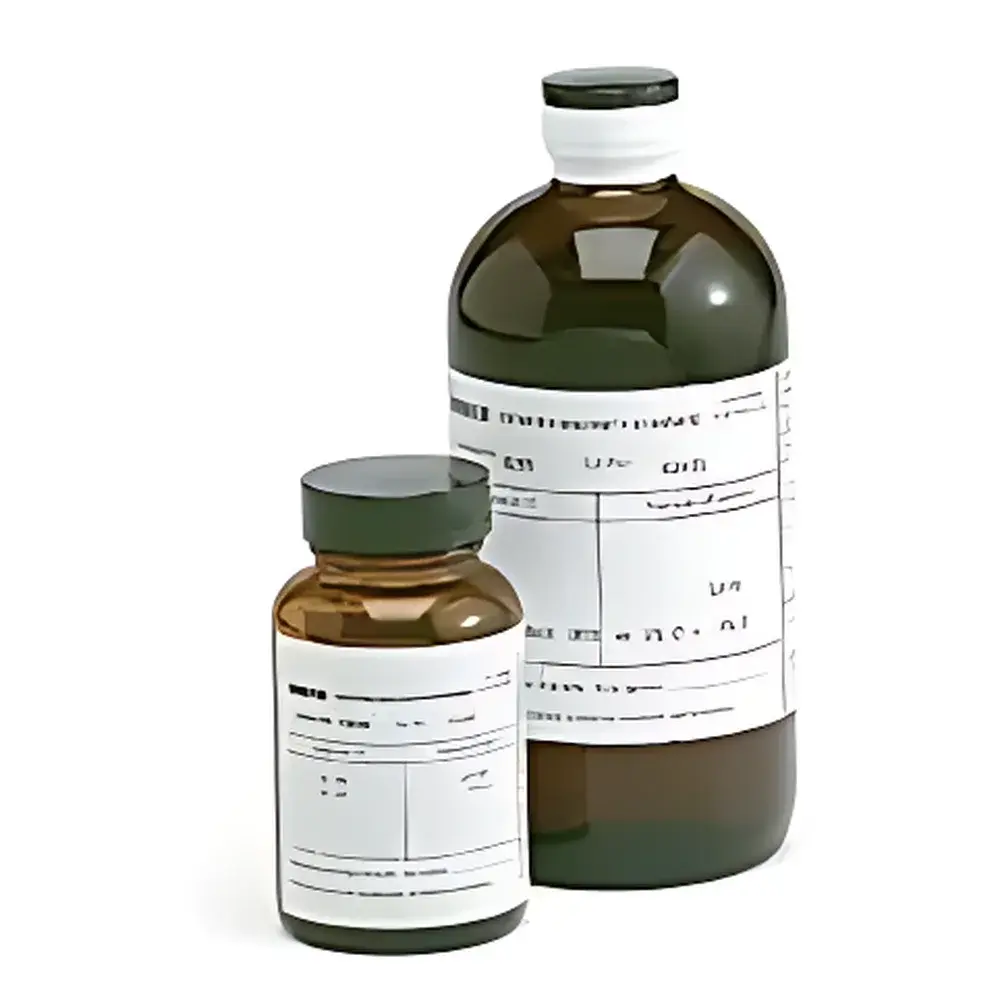
Brookfield CAP Viscometer Oil Standards
| Brand | Brookfield |
|---|---|
| Origin | USA |
| Model | CAP Viscometer Oil Standards |
| Viscosity Range | 57–21,250 cP (mPa·s) |
| Temperature Range | 25 °C (low-temp) and 60 °C (high-temp) |
| Accuracy | ±1% of nominal value |
| Packaging | 150 mL (4 fl oz) per vial |
| Shear Rate Suitability | >500 s⁻¹ |
| Base Fluids | Mineral oil and polybutene (hydrocarbon-based) |
Overview
Brookfield CAP Viscometer Oil Standards are certified reference materials engineered for precision calibration and performance verification of rotational viscometers—particularly cone/plate (CP) systems operating under high-shear conditions. These standards are formulated from hydrocarbon-based fluids (mineral oil and polybutene), selected for their thermal stability, low volatility, and Newtonian behavior across defined temperature and shear-rate regimes. Each oil is characterized at two controlled temperatures—25 °C (low-temperature reference) and 60 °C (high-temperature reference)—to support viscosity calibration across typical laboratory operating ranges. Designed specifically for use with Brookfield CAP-series viscometers and compatible CP geometries, these oils enable traceable verification of instrument response in shear rates exceeding 500 s⁻¹, a critical requirement for rheological validation in QC/QA and GLP-compliant environments.
Key Features
- NIST-traceable viscosity certification: Each vial includes a manufacturer-issued certificate of calibration, documenting nominal viscosity values and uncertainty (±1% of nominal) at both 25 °C and 60 °C.
- Optimized for cone/plate geometry: Formulated to deliver reliable, repeatable readings in CP configurations where gap control and edge effects demand Newtonian, low-volatility reference fluids.
- Two-tier torque compatibility: Low-torque (CAP0L–CAP5L) and high-torque (CAP0H–CAP10H) variants cover a continuous viscosity range from 57 cP to 21,250 cP—encompassing common industrial lubricants, adhesives, and polymer melts.
- Consistent packaging: Supplied in 150 mL (4 fl oz) amber glass vials with inert caps to minimize oxidation and evaporation during storage and repeated use.
- Hydrocarbon composition: Free of silicones, esters, or polar additives—ensuring compatibility with standard stainless-steel and tungsten-carbide spindle surfaces and eliminating risk of residue buildup or cross-contamination.
Sample Compatibility & Compliance
These standards are intended for use with rotational viscometers employing cone/plate sensor systems, especially where shear rate independence and thermal stability are essential. They comply with ASTM D2196 (Standard Test Methods for Rheological Properties of Non-Newtonian Materials) and align with ISO 2555 (Plastics — Determination of Apparent Viscosity of Transparent Liquids Using a Rotational Viscometer). While not pharmaceutical-grade, they meet general laboratory requirements for instrument qualification under FDA 21 CFR Part 11–aligned workflows when paired with audit-trail-capable software. All batches undergo batch-specific characterization against primary NIST SRM 2360 series reference oils, and certificates include date of certification, lot number, and measurement uncertainty budget.
Software & Data Management
When used with Brookfield’s PC-based Rheo3000 or ViscoQC software, CAP oil standards support automated calibration routines—including multi-point verification, drift assessment, and torque-linearity checks. The software logs all calibration events with timestamp, operator ID, ambient conditions, and measured deviation from certified values—generating PDF reports compliant with internal QA documentation protocols. For laboratories operating under GLP or GMP frameworks, the system supports electronic signature capture and full audit-trail retention for ≥15 years, satisfying data integrity requirements per ALCOA+ principles.
Applications
- Periodic verification of cone/plate viscometer accuracy prior to routine sample testing.
- Validation of temperature control stability across the 25–60 °C operating envelope.
- Performance qualification (PQ) of new instruments during installation and commissioning.
- Root-cause analysis during out-of-specification (OOS) viscosity measurements—distinguishing instrument drift from sample variability.
- Training and competency assessment for lab personnel performing rheological measurements per SOPs.
- Supporting regulatory submissions requiring documented instrument calibration history (e.g., ISO 17025 accredited labs).
FAQ
What is the shelf life of CAP viscometer oil standards?
Unopened vials retain certified viscosity accuracy for 24 months from date of manufacture when stored at 15–25 °C, away from direct sunlight and humidity.
Can I use CAP oils with spindle-based (e.g., LV/Ul adapter) geometries?
No—CAP oils are optimized for cone/plate systems operating above 500 s⁻¹. Spindle-based measurements at low shear may yield non-representative results due to fluid elasticity and wall-slip effects.
Are certificates provided with every vial?
Yes—each 150 mL vial includes a unique, lot-specific certificate listing certified values at both 25 °C and 60 °C, expanded uncertainty, and NIST traceability statement.
How many calibration points do I need for routine verification?
Most labs select two oils spanning the operational range (e.g., CAP2H and CAP7H) to verify linearity and sensitivity; full-range verification requires three or more points per ISO/IEC 17025 guidance.
Do CAP oils require temperature equilibration before use?
Yes—allow ≥30 minutes in a thermostatically controlled bath at target temperature (25 °C or 60 °C) prior to loading into the CP geometry to ensure thermal homogeneity and minimize density-driven convection errors.



