
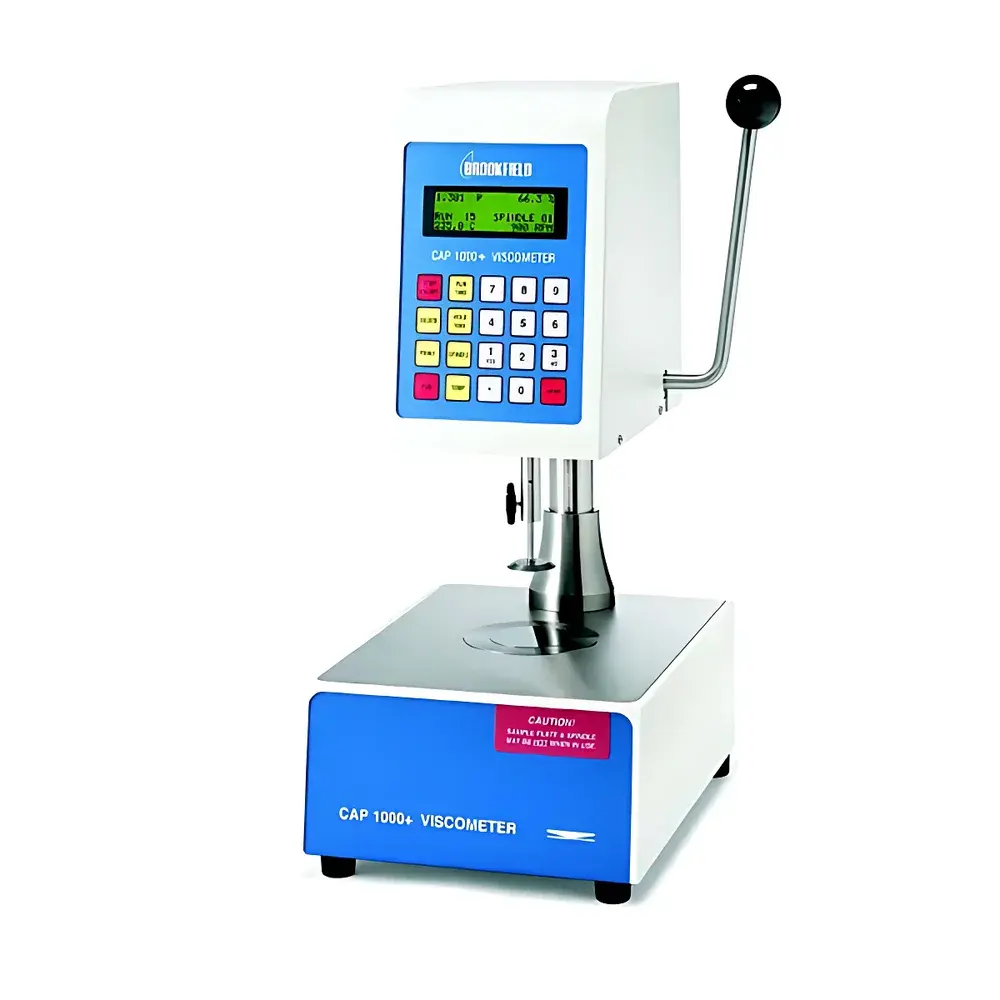
Brookfield CAP1000+ & CAP2000+ Cone Plate Viscometers
| Brand | Brookfield |
|---|---|
| Origin | USA |
| Model | CAP1000+, CAP2000+ |
| Instrument Type | Rotational Viscometer (Cone-Plate Geometry) |
| Torque Range | High Torque (181,000 dyne·cm) / Low Torque (7,970 dyne·cm) |
| Shear Rate Range | 0.2–15,000 s⁻¹ (dependent on cone spindle and speed selection) |
| Sample Volume | 24–1700 µL |
| Temperature Control | L-Series (5–75°C), H-Series (50–235°C) |
| Display | 4-line LCD |
| Compliance | ASTM D4287, ISO 2884, BS 3900, GB/T 9751 |
| Software | CapCalc32 (PC-based control, data acquisition, rheological modeling) |
Overview
The Brookfield CAP1000+ and CAP2000+ Cone Plate Viscometers are precision-engineered instruments designed for high-shear, controlled-gap rheological characterization of fluids under defined thermal conditions. Based on the fundamental principle of cone-and-plate geometry, these viscometers generate a uniform shear field across the sample—enabling accurate determination of apparent viscosity, yield stress, and plastic viscosity at shear rates up to 15,000 s⁻¹. Unlike coaxial cylinder (Couette) systems, the cone-plate configuration ensures constant shear rate throughout the measurement gap, eliminating velocity gradient artifacts and delivering high reproducibility in quality control and R&D environments. The CAP series is particularly suited for materials exhibiting non-Newtonian behavior—including thixotropic paints, thermosetting resins, hot-melt adhesives, and polymer melts—where high-shear performance and minimal sample volume are critical operational constraints.
Key Features
- Integrated Peltier temperature control system with two configurations: L-Series (5–75°C) for ambient-to-moderate thermal testing; H-Series (50–235°C) for high-temperature applications such as asphalt, epoxy curing, or molten polymer evaluation.
- Ergonomic positioning handle enables rapid, repeatable cone alignment with automatic gap calibration—reducing operator variability and ensuring consistent measurement geometry.
- Modular cone spindle selection (CAP-01 through CAP-10) allows optimization of shear rate range and sample volume requirements—from 24 µL (CAP-03) to 1700 µL (CAP-07)—while maintaining geometric fidelity and torque resolution.
- CAP1000+ offers fixed-speed operation at 100, 400, 750, or 900 rpm, making it ideal for standardized QC protocols requiring rapid pass/fail assessment per ASTM D4287 or ISO 2884.
- CAP2000+ provides continuously variable speed control from 5 to 1000 rpm, supporting multi-point flow curves, time-dependent measurements (e.g., recovery after shear), and extended rheological profiling.
- High-torque (181,000 dyne·cm) and low-torque (7,970 dyne·cm) variants accommodate both highly viscous systems (e.g., bitumen, plastisols) and low-viscosity Newtonian liquids (e.g., solvents, thin coatings) without hardware modification.
Sample Compatibility & Compliance
The CAP platform is validated for use with medium-to-high viscosity fluids across industrial sectors including coatings, adhesives, food processing, pharmaceuticals, and polymer manufacturing. Its design conforms to internationally recognized test methods for high-shear viscosity: ASTM D4287 (high-shear viscosity of paints and related materials), ISO 2884-1 (paints and varnishes—determination of viscosity using rotational viscometers), BS 3900-A6, and GB/T 9751 (Chinese national standard for coating viscosity). All models support GLP-compliant operation when used with CapCalc32 software configured for audit-trail logging, user authentication, and electronic signature—meeting foundational requirements of FDA 21 CFR Part 11 for regulated laboratories.
Software & Data Management
CapCalc32 is a dedicated Windows-based application that transforms the CAP2000+ into a fully functional rheometer. It supports automated test sequencing, real-time data streaming, and post-acquisition analysis including Bingham, Casson, and Herschel-Bulkley model fitting for yield stress and flow index derivation. The software features script annotation for SOP documentation, looped repetition for statistical robustness, and overlay plotting for comparative analysis of up to five datasets. Raw data exports to CSV or Excel formats ensure compatibility with LIMS and enterprise analytics platforms. Audit trail functionality records all parameter changes, user actions, and instrument events—facilitating internal audits and regulatory inspections under GMP/GLP frameworks.
Applications
These instruments serve critical functions in formulation development, process validation, and incoming material inspection. Typical use cases include: viscosity profiling of architectural and automotive coatings under simulated spray or roll-coating shear conditions; rheological screening of UV-curable inks and screen printing pastes; thermal stability assessment of hot-melt adhesives during extrusion; yield stress quantification in gels and personal care emulsions; and consistency evaluation of food-grade starch slurries, chocolate masses, and confectionery syrups. In polymer processing, the CAP2000+ supports melt index correlation studies and crosslinking kinetics monitoring in thermosets. Its small sample requirement (<1 mL) also enables efficient testing of expensive or limited-availability R&D batches.
FAQ
What is the minimum sample volume required for CAP-series measurements?
Sample volume ranges from 24 µL (with CAP-03 spindle) to 1700 µL (with CAP-07), depending on cone angle and diameter. All spindles maintain a defined gap tolerance of ±1 µm for metrological traceability.
Can the CAP1000+ perform yield stress analysis?
Yield stress determination requires variable shear rate data; therefore, only the CAP2000+—when paired with CapCalc32 and appropriate mathematical models (e.g., Herschel-Bulkley)—supports quantitative yield stress calculation.
Is temperature calibration traceable to NIST standards?
Yes. The integrated Peltier system includes factory-calibrated RTD sensors with documented uncertainty budgets traceable to NIST SRM 1968 (thermistor calibration standard) and ISO/IEC 17025-accredited calibration procedures.
How does cone-plate geometry improve measurement accuracy compared to spindle-based viscometers?
Cone-plate geometry delivers uniform shear rate distribution across the entire sample volume, eliminating wall-slip effects and end-effects inherent in cylindrical geometries—resulting in higher sensitivity to structural breakdown and improved inter-laboratory reproducibility.
Are CAP-series instruments compatible with automated production line integration?
While standalone units, both CAP1000+ and CAP2000+ support RS-232 and USB communication protocols. With CapCalc32’s COM interface and scripting API, they can be embedded into SCADA or MES workflows for automated batch release testing.



