
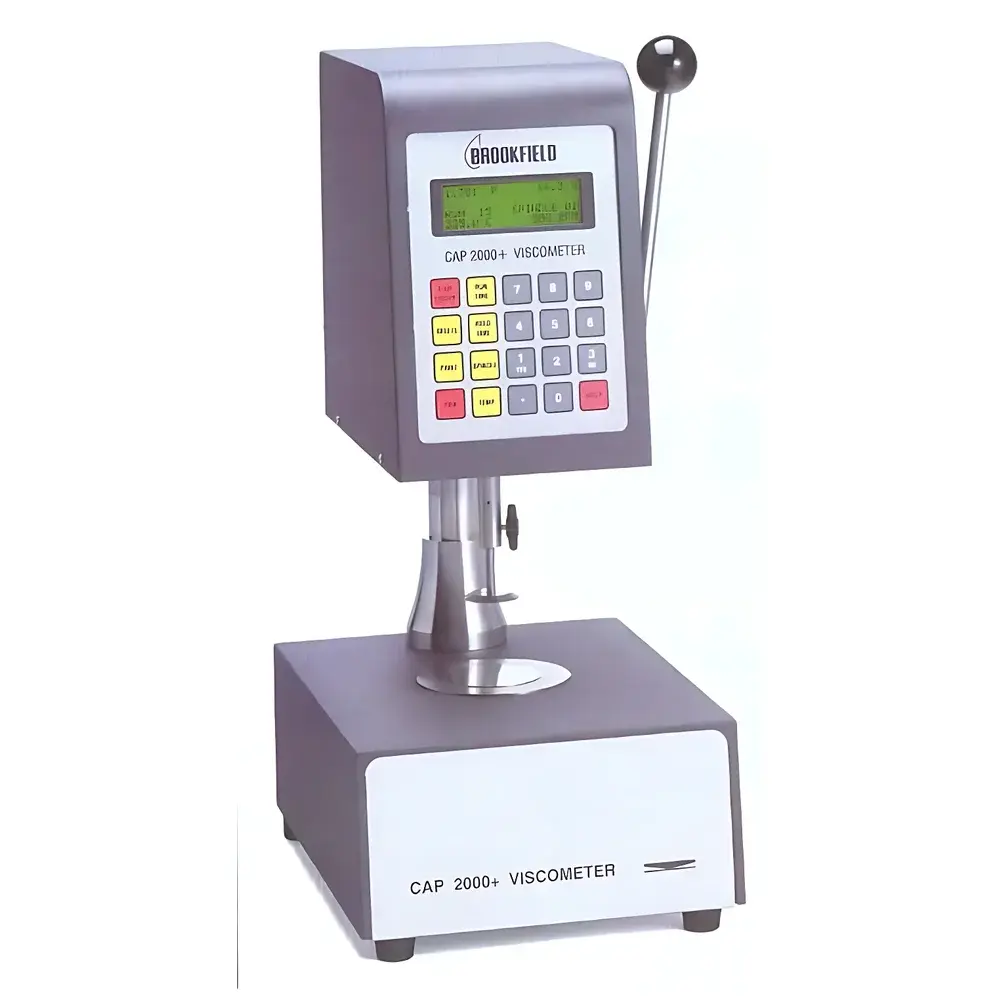
Brookfield CAP2000+ Cone and Plate Viscometer
| Brand | Brookfield |
|---|---|
| Origin | USA |
| Model | CAP2000+ |
| Shear Rate Range | up to 12,000 s⁻¹ |
| Viscosity Range | 0.025–10 cP (with 6 spindles) |
| Sample Volume | < 1 mL |
| Temperature Control | Dual integrated systems |
| Display | Digital LCD |
| Data Acquisition | PC-controlled via proprietary software |
| Compliance | ASTM D4287, ISO 2884, BS 3900 |
Overview
The Brookfield CAP2000+ Cone and Plate Viscometer is a precision-engineered instrument designed for high-shear viscosity measurement of low-volume liquid samples in research, quality control, and formulation laboratories. Operating on the fundamental principle of controlled-gap cone-and-plate rheometry, it subjects samples to well-defined shear fields by rotating a precisely angled conical spindle over a flat, thermostatically regulated plate. This geometry ensures uniform shear rate distribution across the sample meniscus—critical for accurate Newtonian and non-Newtonian fluid characterization under elevated shear conditions. Unlike coaxial cylinder (cup-and-bob) systems, the cone-and-plate configuration eliminates end-effects and delivers superior sensitivity at low viscosities and high shear rates, making it especially suitable for coatings, inks, adhesives, pharmaceutical suspensions, and cosmetic emulsions where shear-thinning behavior and yield stress assessment are essential.
Key Features
- High-shear capability with programmable shear rates up to 12,000 s⁻¹—enabling simulation of industrial processing conditions such as spray coating, inkjet dispensing, or high-speed mixing.
- Dual integrated temperature control system: one for the plate and another for the cone assembly—ensuring thermal stability and minimizing gradient-induced measurement drift during extended tests.
- Minimal sample requirement: full characterization achievable with less than 1.0 mL of material, reducing consumption of expensive or scarce formulations and supporting micro-scale development workflows.
- Six interchangeable precision-machined cone spindles included (e.g., CPE-40, CPE-41, etc.), each calibrated to deliver traceable shear rates and torque sensitivity across overlapping viscosity ranges from 0.025 cP to 10 cP.
- Digital LCD display with real-time viscosity readout and adjustable acquisition interval (15–99 seconds), supporting both manual operation and time-resolved flow curve generation.
- PC-based automation via Brookfield’s proprietary software suite, enabling script-driven test sequences, multi-point shear ramping, data logging with timestamped metadata, and export to CSV or Excel-compatible formats.
Sample Compatibility & Compliance
The CAP2000+ accommodates a broad spectrum of Newtonian and pseudo-plastic fluids—including solvent-based lacquers, UV-curable resins, polymer melts (low-Tg), aqueous surfactant solutions, and biopolymer dispersions—provided they exhibit sufficient cohesion to maintain meniscus integrity under high shear. Its geometry inherently limits use with highly filled, abrasive, or particulate-laden suspensions that may compromise spindle surface finish or induce premature wear. The instrument meets internationally recognized standards for high-shear viscosity testing: ASTM D4287 (ICI Cone/Plate Method), ISO 2884-1 (Paints and varnishes — Determination of viscosity using a cone-and-plate viscometer), and BS 3900-A12. While not a GLP-certified platform per se, its software architecture supports audit-ready data handling when configured with user access controls and electronic signature modules compliant with FDA 21 CFR Part 11 requirements.
Software & Data Management
Operation is fully supported by Brookfield’s Rheo3000 software (v4.x or later), which provides intuitive graphical interface for method setup, real-time plot visualization (viscosity vs. time or shear rate), and post-acquisition analysis including thixotropy index calculation, hysteresis loop evaluation, and power-law fitting. All raw torque, speed, temperature, and time-stamped values are stored in a structured binary format with embedded calibration coefficients. Export functions preserve traceability through inclusion of instrument ID, spindle code, calibration date, and environmental metadata. For integration into enterprise LIMS or ELN environments, the software supports ODBC-compliant database output and configurable API hooks for automated report generation and QC release workflows.
Applications
- Formulation optimization of printing inks and gravure coatings where viscosity at 10⁴ s⁻¹ directly correlates with misting behavior and film uniformity.
- Stability assessment of nanoemulsions and colloidal drug delivery systems under simulated syringe extrusion shear profiles.
- QC release testing of low-viscosity silicones and functional fluids used in MEMS packaging and optical bonding.
- Regulatory submission support for topical dermatological products requiring ICI-standard viscosity documentation per USP guidance.
- Academic rheology studies focusing on transient shear response, structural recovery kinetics, and linear viscoelastic limit determination in dilute polymeric solutions.
FAQ
What is the minimum sample volume required for reliable measurement?
Less than 1.0 mL is sufficient when using the standard 40 mm diameter cone; precise volume depends on cone angle and gap setting but typically ranges from 0.3–0.8 mL.
Can the CAP2000+ measure yield stress?
It does not provide direct yield stress determination via controlled-stress ramping; however, extrapolation from high-shear flow curves combined with low-shear rotational data (using complementary DV-series viscometers) enables empirical yield estimation.
Is calibration traceable to NIST standards?
Yes—each spindle is supplied with a certificate of calibration traceable to NIST-traceable reference oils, and annual recalibration services are available through authorized Brookfield service centers.
Does the instrument support continuous shear-rate sweeps?
Yes—via PC software, users can define logarithmic or linear shear-rate ramps between 10 s⁻¹ and 12,000 s⁻¹ with dwell times and auto-stabilization thresholds.
How is temperature uniformity maintained across the sample gap?
Independent PID-controlled heating elements in both the plate and cone assemblies, coupled with active thermal shielding, maintain ΔT < ±0.1°C across the measurement zone during steady-state operation.



