
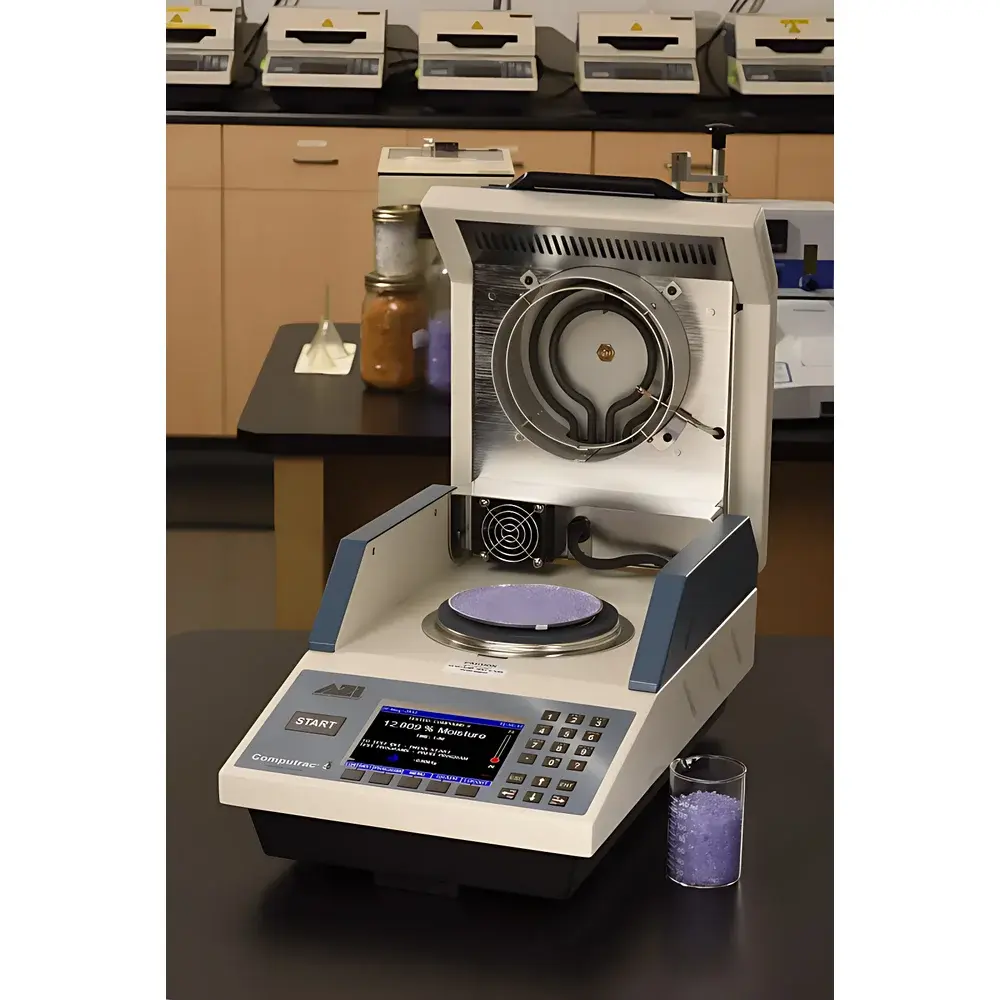
Brookfield Computrac MAX-4000XL Infrared Moisture and Solids Analyzer
| Brand | Brookfield |
|---|---|
| Origin | USA |
| Manufacturer Type | Original Equipment Manufacturer (OEM) |
| Import Status | Imported |
| Model | Computrac MAX-4000XL |
| Price Range | USD $12,500 – $37,500 |
Overview
The Brookfield Computrac MAX-4000XL Infrared Moisture and Solids Analyzer is a precision-engineered loss-on-drying (LOD) instrument that utilizes controlled infrared heating combined with high-resolution mass measurement to determine moisture content and total solids in solid, semi-solid, and powdered samples. Unlike conventional oven-drying methods requiring hours, the MAX-4000XL delivers statistically robust, ASTM-compliant results in minutes—enabling real-time quality control decisions across regulated and non-regulated manufacturing environments. Its core architecture integrates a calibrated analytical balance (0.0001 g resolution), a programmable halogen or ceramic infrared heating source, and closed-loop thermal management to ensure repeatability under variable ambient conditions. Designed for ISO/IEC 17025-aligned laboratories and GMP-compliant production floors, the instrument operates on the fundamental principle of gravimetric moisture determination: continuous monitoring of sample mass loss during controlled thermal desorption, followed by algorithmic endpoint detection based on rate-of-change thresholds.
Key Features
- Robust industrial-grade housing with corrosion-resistant stainless steel chassis and nickel-chromium heating elements—engineered for long-term stability in laboratory, cleanroom, and factory-floor deployments.
- Active forced-air cooling system reduces post-test cooldown time by up to 25%, enabling rapid sequential analysis without thermal carryover or operator intervention.
- Multi-stage method programming allows users to define cascaded temperature ramps, dynamic endpoint criteria (e.g., Δm/Δt ≤ 0.1 mg/min), and dwell times per stage—critical for differentiating free water, bound water, and volatile organic components.
- Full-color VGA touchscreen interface with intuitive menu navigation, real-time moisture loss curve visualization, and on-screen trend overlays for immediate method validation.
- Configurable pass/fail logic with user-defined tolerance bands, automatic result flagging, and integrated statistical process control (SPC) triggers for out-of-specification events.
- Onboard data retention: stores up to 250 customizable test methods, the latest 1,000 test results (including timestamps, operator IDs, and environmental metadata), and the most recent 100 full-resolution moisture vs. time profiles.
Sample Compatibility & Compliance
The MAX-4000XL accommodates diverse sample matrices—including hygroscopic polymers, pharmaceutical actives and excipients, food powders (e.g., milk powder, starches), agrochemicals, ceramics, and battery electrode materials—without requiring solvent extraction or chemical reagents. It complies with multiple internationally recognized standard test methods, including ASTM D6980-12 (moisture in plastics), ASTM D7232-06 (non-volatile content in coatings), and ASTM C471M-16a (gypsum analysis). Optional 21 CFR Part 11 compliance package provides electronic signature capability, audit-trail logging with immutable timestamps, role-based access control, and encrypted data export—meeting FDA expectations for computerized systems in pharmaceutical and medical device manufacturing. The system supports GLP/GMP documentation workflows and is compatible with LIMS integration via ASCII or CSV output formats.
Software & Data Management
The instrument’s embedded firmware supports seamless data handling through both local and networked interfaces. An optional web server module enables secure remote access via standard HTTP/HTTPS—allowing authorized personnel to view live instrument status, monitor active tests, download calibration certificates, retrieve audit logs, and upload/download test protocols and result archives. All data exports include metadata headers (sample ID, operator, method name, start/end time, ambient humidity/temperature if logged), ensuring traceability and regulatory readiness. Calibration records are digitally signed and version-controlled; balance verification routines follow USP and ISO 17025 requirements. Data integrity safeguards include write-once storage for audit trails and automatic checksum validation upon file transfer.
Applications
- Pharmaceutical QC: Rapid verification of residual solvents and moisture in APIs and final dosage forms per USP and ICH Q5C guidelines.
- Plastics & Polymers: In-process monitoring of pellet moisture prior to extrusion or injection molding to prevent hydrolysis-induced degradation.
- Food & Beverage: Batch release testing of low-moisture ingredients (e.g., flour, sugar, spices) where water activity correlates directly with microbial stability.
- Coatings & Adhesives: Quantification of non-volatile matter (NVM) in solvent-borne formulations to ensure batch consistency and VOC compliance.
- Advanced Materials: Moisture profiling in lithium-ion battery cathode/anode powders, where ppm-level water impacts slurry rheology and cell cycle life.
FAQ
Does the MAX-4000XL require daily calibration verification?
Yes—per ISO/IEC 17025 and internal SOPs, users must perform balance verification using certified weights before first use each day and after any physical relocation or maintenance event.
Can test methods be exported to other Computrac instruments?
Yes—method files (.cmp format) are interoperable across the Computrac MAX series (e.g., MAX-4000XL, MAX-3000XL) when running identical firmware versions.
Is the infrared heating source replaceable in the field?
Yes—the halogen or ceramic heating module is a user-serviceable component with documented replacement procedures and no alignment tools required.
What environmental conditions affect measurement accuracy?
Ambient temperature fluctuations > ±2°C/hour or relative humidity > 80% RH may impact thermal equilibrium; operation within 15–30°C and 30–60% RH is recommended for optimal reproducibility.
How does the instrument handle samples that decompose before reaching target moisture endpoints?
Multi-stage programming permits lower initial drying temperatures followed by gradual ramping—minimizing thermal degradation while preserving endpoint detection fidelity for thermally labile materials.
Related Products





