
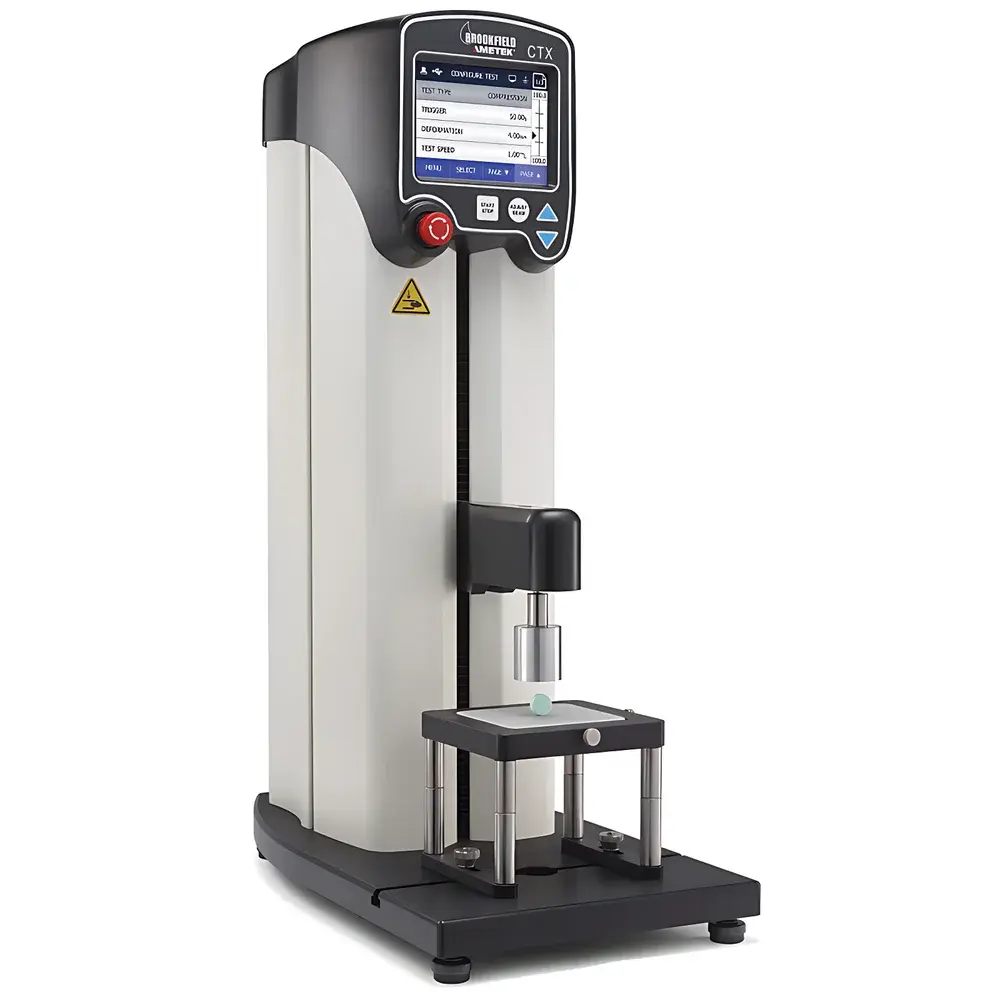
Brookfield CTX Texture Analyzer
| Brand | Brookfield |
|---|---|
| Origin | USA |
| Manufacturer Type | Manufacturer |
| Origin Category | Imported |
| Model | CTX |
| Price Range | USD 42,000 – 70,000 |
Overview
The Brookfield CTX Texture Analyzer is a high-precision, motorized single-column force measurement system engineered for objective mechanical property evaluation of food, pharmaceutical, and consumer product materials. Based on the fundamental principle of controlled axial compression, tension, and shear deformation under programmable speed and distance profiles, the CTX delivers repeatable force–distance curves essential for quantifying textural attributes such as hardness, fracturability, cohesiveness, adhesiveness, elasticity, chewiness, and gumminess. Designed to meet the rigorous demands of quality control laboratories, R&D facilities, and regulatory-compliant environments, the CTX adheres to standardized test methodologies defined by AACC (American Association of Cereal Chemists), ASTM International, and ISO 11357 (for thermoplastic behavior assessment in related applications). Its modular architecture supports both static and dynamic testing protocols, with force resolution down to 0.01 g and displacement accuracy of ±0.01 mm—enabling detection of subtle structural transitions in soft solids, gels, semi-solids, and elastic films.
Key Features
- Motor-driven precision actuator with programmable speed range from 0.01 to 100 mm/s, ensuring reproducible ramp-and-hold profiles across diverse sample rheologies.
- Integrated load cell with dual-range capability (e.g., 500 g and 5 kg full-scale options) for high sensitivity in low-force applications (e.g., gel rupture) and robustness in high-load tests (e.g., meat tenderness or packaging seal strength).
- Universal mounting platform compatible with all Brookfield texture fixtures—including rotational base units for torsional or angular peel tests—and engineered for rapid tool-free fixture interchange.
- Real-time force–displacement data acquisition at up to 200 Hz sampling rate, synchronized with positional feedback for accurate peak detection and slope analysis.
- Compliance-ready firmware architecture supporting audit trail logging, user access levels, electronic signatures, and data export formats compliant with FDA 21 CFR Part 11 requirements when used with optional software modules.
Sample Compatibility & Compliance
The CTX accommodates a broad spectrum of physical forms—from discrete tablets and capsules to viscous pastes, brittle snacks, viscoelastic gels, flexible films, and irregularly shaped confections. Its fixture ecosystem includes AACC-certified probes (e.g., TA-AACC36 P for bilayer tablet shear), ASTM D1894–compliant sliding friction fixtures (TA-DGF T P G), and USP -aligned penetration tools for pharmaceutical dosage forms. All standard probes conform to BS 7582 and AACC Method 74-09 specifications. The system supports GLP/GMP-aligned workflows through traceable calibration certificates, documented maintenance logs, and configurable pass/fail criteria per test method. Optional IQ/OQ documentation packages are available for regulated environments requiring validation per ISO/IEC 17025.
Software & Data Management
Operated via Brookfield Texture Pro™ software (Windows-based), the CTX enables intuitive test method creation using drag-and-drop protocol builders, real-time curve overlay, statistical batch reporting, and customizable report templates (PDF, Excel, CSV). Raw data files include metadata tags for operator ID, timestamp, environmental conditions (if linked to optional temperature/humidity sensors), and instrument calibration status. Advanced analytics modules support texture profile analysis (TPA), springiness ratio calculation, work-of-shear integration, and comparative statistical testing (ANOVA, t-test). Data integrity safeguards include encrypted local storage, automatic backup scheduling, and role-based permissions for editing, executing, and reviewing test results.
Applications
- Pharmaceutical: Tablet hardness, capsule shell rupture force, powder compaction behavior, and excipient–API binding strength assessment per USP .
- Food Science: Gel strength of dairy desserts, firmness of tofu and custards (using TA-P-KIT3 probes), crispness of baked goods, chew resistance of confectionery gums, and peel adhesion of laminated packaging seals.
- Packaging: Seal integrity testing of pouches and blister packs (TA-AVJ T P G), coefficient of friction (COF) of film surfaces (TA-DGF T P G), and syringe plunger glide force (TA-JMPA P).
- Academic & Regulatory Research: Standardized texture mapping for sensory correlation studies, shelf-life stability monitoring, and method transfer between QC labs under ISO 5725 guidelines.
FAQ
What standards does the CTX comply with for food texture testing?
The CTX supports methods aligned with AACC Approved Methods (e.g., 74-09 for dough firmness, 10-05 for cookie break strength), ASTM F2739 for food package opening force, and ISO 11357 Annex E for thermal-mechanical characterization of thermo-sensitive matrices.
Can the CTX perform both compression and tensile tests without hardware modification?
Yes—the CTX’s bidirectional drive system and reversible fixture interface allow seamless switching between compression, tension, and shear modes using appropriate fixtures such as TA-AVJ T P G (biaxial stretch) or TA-STJ P (peel adhesion).
Is calibration traceable to NIST or equivalent national metrology institutes?
All factory calibrations are performed using NIST-traceable deadweight standards; certificate of calibration includes uncertainty budget and is valid for 12 months under normal operating conditions.
Does the system support automated test sequences for unattended operation?
Yes—Texture Pro™ allows batch programming of up to 99 sequential tests with variable parameters, auto-save functionality, and email/SMS alerts upon completion or error detection.
How is probe wear managed during routine use?
Brookfield provides wear-check templates and replacement schedules based on cumulative test cycles; stainless-steel probes are designed for autoclave sterilization and long-term dimensional stability per ISO 80000-4.





