
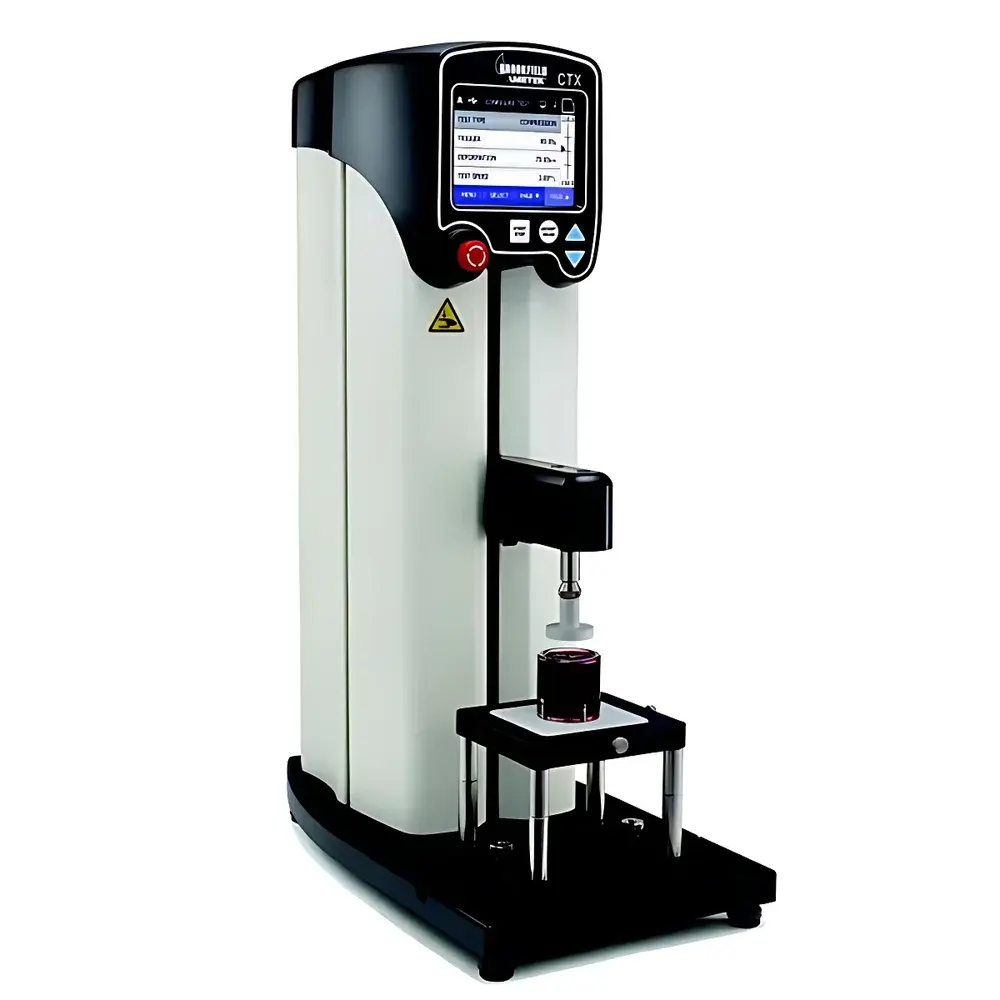
Brookfield CTX Texture Analyzer
| Brand | Brookfield |
|---|---|
| Origin | USA |
| Manufacturer Type | Authorized Distributor |
| Origin Category | Imported |
| Model | CTX |
| Pricing | Upon Request |
Overview
The Brookfield CTX Texture Analyzer is a high-precision, motor-driven mechanical testing system engineered for objective, quantitative evaluation of the mechanical properties of soft solids and semi-solids. Based on fundamental principles of uniaxial compression, tension, penetration, and shear deformation, the CTX applies controlled force and displacement to samples while recording real-time load–displacement profiles at up to 500 Hz sampling frequency. This enables precise capture of transient mechanical events—such as yield point, fracture onset, adhesion loss, or viscoelastic recovery—that define functional performance in food, pharmaceuticals, cosmetics, and packaging materials. Designed for laboratories requiring both regulatory compliance and operational efficiency, the CTX integrates metrological traceability, modular hardware architecture, and software-controlled test protocols aligned with international standards including ASTM STP 1376 (Texture Analysis of Foods), USP , and ISO 11357-3 (Thermal analysis — Differential scanning calorimetry — Part 3: Determination of crystallinity).
Key Features
- Modular load cell system with eight interchangeable transducers covering a full range from 100 g to 100 kg (0.1 g to 1.0 g resolution), each calibrated to ±0.2% full-scale accuracy.
- Motorized crosshead with programmable speed control: 0.01–40 mm/s in fine increments (0.01 mm/s below 0.1 mm/s; 0.1 mm/s above), with maximum test speeds limited by load capacity (e.g., 10 mm/s at 100 kg, 20 mm/s at 50 kg).
- 280 mm vertical travel range accommodates tall or layered samples—including multi-compartment food containers, blister packs, and gel-filled vials—without repositioning.
- High-resolution positional feedback (0.0005 mm) and 500 Hz data acquisition ensure temporal fidelity during rapid deformation events such as snap fracture or film delamination.
- Three adjustable base platform options (standard, elevated, and low-profile) support diverse sample geometries and fixture configurations, including Bloom gel strength testing setups with integrated water bath compatibility.
- Intuitive front-panel interface with backlit LCD display, tactile navigation buttons, and real-time graphical preview of force–distance curves prior to test execution.
Sample Compatibility & Compliance
The CTX supports standardized and application-specific testing across regulated and non-regulated environments. Common applications include: compression testing of tablets (USP ), puncture resistance of fruit skins (ASTM F3052), peel strength of laminated pouches (ASTM F88), spreadability of creams (ISO 16128), and Bloom strength of gelatin gels (AOAC 976.22). All load cells are NIST-traceable and certified per ISO/IEC 17025 requirements when used with accredited calibration services. The system meets mechanical safety standards IEC 61010-1 and complies with electromagnetic compatibility directives (EN 61326-1). For GxP environments, optional TexturePro software includes 21 CFR Part 11-compliant audit trails, electronic signatures, and role-based user access controls.
Software & Data Management
TexturePro software provides full instrument control, method development, real-time visualization, statistical analysis, and report generation. Users define test parameters—including pre-test conditioning, target force/displacement limits, trigger conditions, and post-test hold phases—via drag-and-drop workflow templates. Raw data exports are supported in CSV, Excel (.xlsx), PDF, and XML formats, with metadata embedding (operator ID, timestamp, instrument serial number, calibration certificate ID). Batch processing tools enable automated analysis of multiple curves using customizable pass/fail criteria. Data integrity safeguards include write-protected archives, version-controlled method libraries, and automatic backup to network drives or cloud storage endpoints compliant with HIPAA and GDPR data residency policies.
Applications
- Food Science: Hardness of cheeses, cohesiveness of dough, springiness of gummy candies, chewiness of meat analogs, and syneresis quantification in yogurts.
- Pharmaceuticals: Tablet friability, capsule shell rupture force, ointment extrudability, and transdermal patch tack/adhesion profiling.
- Cosmetics: Lipstick break strength, mascara film flexibility, serum viscosity under shear, and powder compactibility.
- Packaging: Seal integrity of thermoformed trays, puncture resistance of barrier films, and cap torque-to-peel transition in flip-top closures.
- Materials R&D: Gel modulus mapping, hydrogel swelling kinetics, biopolymer network resilience, and temperature-dependent rheomechanical transitions using optional thermal probe integration.
FAQ
What standards does the CTX comply with for pharmaceutical quality control?
The CTX hardware meets ISO 17025-accredited calibration requirements when serviced by Brookfield-certified labs. With TexturePro software enabled, it supports 21 CFR Part 11 compliance for electronic records and signatures in FDA-regulated environments.
Can the CTX perform temperature-controlled texture testing?
Yes—via optional calibrated temperature probes and environmental chambers compatible with standard fixtures; full thermal integration requires third-party chamber synchronization or manual protocol coordination.
Is custom fixture design available for unique sample geometries?
Brookfield offers engineering consultation and CNC fabrication of application-specific probes, grips, and mounting assemblies—validated for mechanical repeatability and documented per client SOP requirements.
How is system verification performed between calibrations?
Users may execute daily performance checks using NIST-traceable calibration weights and reference standards (e.g., Bloom gel sets, aluminum foil puncture discs), with results logged automatically in TexturePro’s QC dashboard.
Does the CTX support automated pass/fail decision logic in production QA?
Yes—TexturePro allows definition of upper/lower specification limits per parameter (e.g., peak force, work-to-compression, strain at fracture), with real-time flagging and exportable summary reports for SPC charting.
Related Products







