
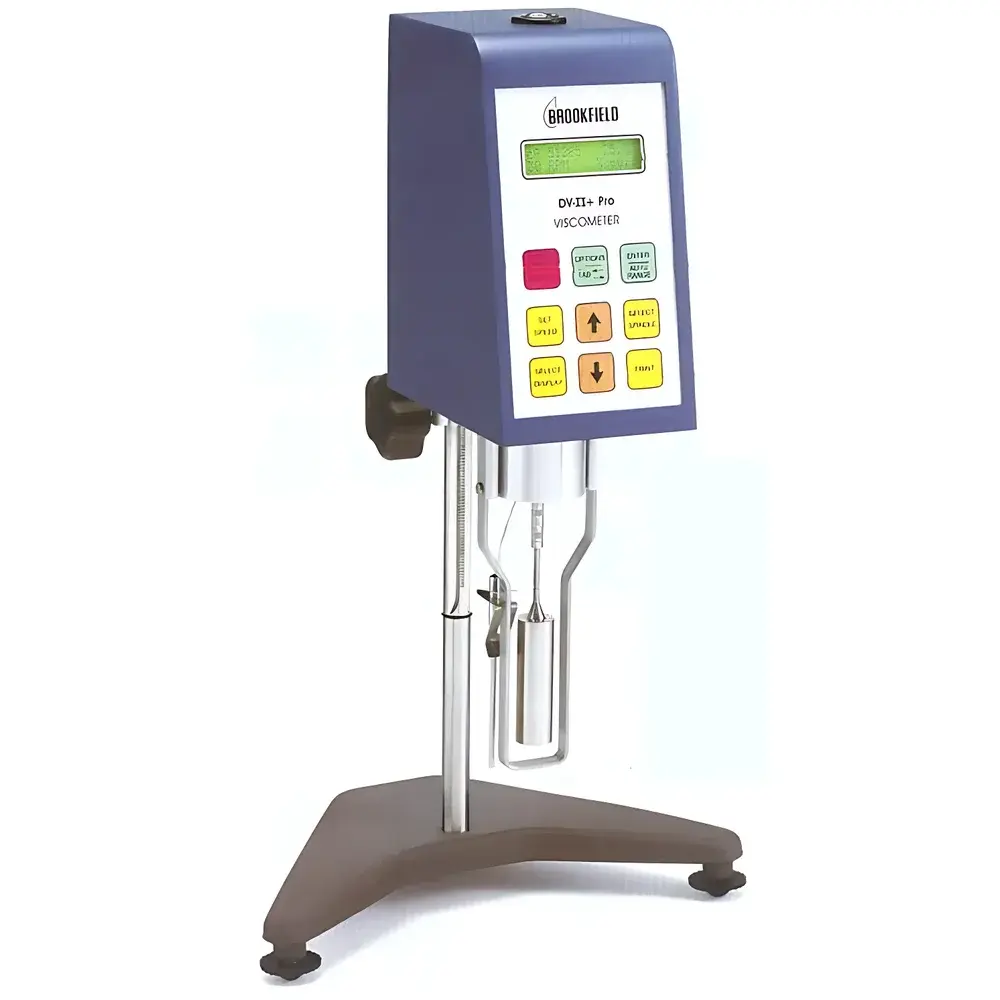
Brookfield DV-II+ Pro Viscometer
| Origin | USA |
|---|---|
| Manufacturer Type | Authorized Distributor |
| Origin Category | Imported |
| Model | DV-II+ Pro |
| Pricing | Available Upon Request |
| Torque | 673.7 dyn·cm |
| Speed Range | 0.01–200 rpm (54 programmable speeds) |
| Spindles | 4 standard spindles included |
| Viscosity Range | 15–2,000,000 cP |
| Display | Digital LCD showing viscosity (cP), % torque, temperature (°C), rotational speed (rpm), and spindle identification |
| Control Interface | Microprocessor-based touchpad control with RS-232 interface for PC connectivity |
| Temperature Sensing | Compatible with RTD temperature probes (e.g., PT100) for real-time thermal monitoring |
| Data Acquisition | Supports DV-Gather™ software for multi-curve overlay (up to 5 simultaneous datasets), synchronized temperature logging, and time-stamped data export |
| Output | RS-232 port for connection to chart recorders or thermal printers for scheduled hard-copy reporting |
| Power Supply | AC 220 V, 50 Hz |
Overview
The Brookfield DV-II+ Pro Viscometer is a precision-engineered rotational viscometer designed for reliable, repeatable measurement of dynamic viscosity across a broad range of Newtonian and non-Newtonian fluids. Operating on the principle of coaxial cylinder (Couette) flow, the instrument quantifies resistance to shear by measuring the torque required to rotate a spindle at a defined angular velocity within the sample. Its microprocessor-controlled architecture enables stable speed regulation and high-resolution torque detection—critical for characterizing yield stress behavior, thixotropy, and shear-thinning/thickening profiles in industrial and research settings. The DV-II+ Pro serves as a foundational tool in quality control laboratories, R&D facilities, and production environments where compliance with standardized test methods—including ASTM D2196, ISO 2555, and USP —is essential.
Key Features
- Wide operational speed range from 0.01 to 200 rpm, adjustable in 54 discrete steps, supporting both low-shear and high-shear characterization.
- Maximum measurable torque of 673.7 dyn·cm ensures accurate quantification of highly viscous materials—including polymer melts, greases, and pastes—without mechanical overload.
- Digital LCD display simultaneously presents viscosity (cP), percent torque, sample temperature (°C), rotational speed (rpm), and active spindle identifier—enabling real-time process verification.
- Integrated RS-232 serial interface allows bidirectional communication with Windows-based PCs for automated data capture, method storage, and remote instrument control.
- RTD temperature probe compatibility (e.g., PT100 sensors) supports precise thermal monitoring during viscosity profiling—essential for temperature-dependent rheological studies per ASTM D1084 and ISO 3219.
- Onboard microprocessor enables touchpad-driven operation, eliminating dependency on external controllers while maintaining full parameter programmability and recall functionality.
Sample Compatibility & Compliance
The DV-II+ Pro accommodates a wide spectrum of liquid and semi-solid samples—including coatings, adhesives, food emulsions, pharmaceutical suspensions, and lubricants—using its four standard spindles (SC4-18, SC4-21, SC4-27, SC4-29). Each spindle is calibrated traceably to NIST standards, ensuring metrological integrity across the specified viscosity range (15–2,000,000 cP). The system meets key regulatory expectations for instrument qualification under GLP and GMP frameworks: it supports audit-trail-capable data acquisition via DV-Gather™ software, maintains uneditable timestamps for all measurements, and permits configuration locking to prevent unauthorized parameter changes—a prerequisite for FDA 21 CFR Part 11–aligned workflows.
Software & Data Management
DV-Gather™ software provides a validated platform for advanced data handling. Users can acquire, visualize, and compare up to five independent viscosity vs. time or viscosity vs. shear rate curves on a single plot—facilitating comparative analysis of formulation variants or aging effects. Temperature data from connected RTD probes are automatically synchronized and overlaid, enabling Arrhenius modeling and activation energy calculations. Export options include CSV, TXT, and XLS formats compatible with LIMS integration. All raw datasets retain embedded metadata—including operator ID, date/time stamps, spindle ID, temperature, and calibration certificate references—ensuring full traceability per ISO/IEC 17025 requirements.
Applications
- Quality assurance of paint and ink formulations, verifying batch-to-batch consistency against target viscosity windows.
- Rheological screening of topical pharmaceutical gels and ointments to ensure patient-appropriate spreadability and stability.
- Process optimization of edible oils and dairy products, correlating viscosity shifts with thermal history or homogenization parameters.
- Characterization of drilling muds and cement slurries in oilfield services, supporting API RP 13B-1 compliance testing.
- Educational use in university laboratories for teaching fundamental fluid mechanics principles and empirical viscosity modeling (e.g., Power Law, Bingham Plastic).
FAQ
Is the DV-II+ Pro compliant with FDA 21 CFR Part 11?
Yes—when used with DV-Gather™ software configured for electronic signatures, audit trails, and secure user access controls, the system supports Part 11–compliant documentation practices.
Can I use custom spindles or geometry with this model?
The DV-II+ Pro accepts all Brookfield standard spindles and optional accessories (e.g., UL adapter, small sample adapters, thermosel systems), but third-party spindles are not supported due to calibration traceability requirements.
What is the recommended calibration frequency?
Annual calibration is advised per ISO/IEC 17025; however, daily verification using NIST-traceable standard oils is required prior to critical measurements.
Does the instrument support continuous data logging without a PC?
No—the DV-II+ Pro lacks internal memory; continuous logging requires connection to a PC running DV-Gather™ or an external chart recorder via RS-232.
Is temperature control built into the base unit?
No—temperature control is achieved externally via heated/circulating baths or Peltier-based accessories (e.g., TC-502); the instrument only monitors temperature via optional RTD probes.



