
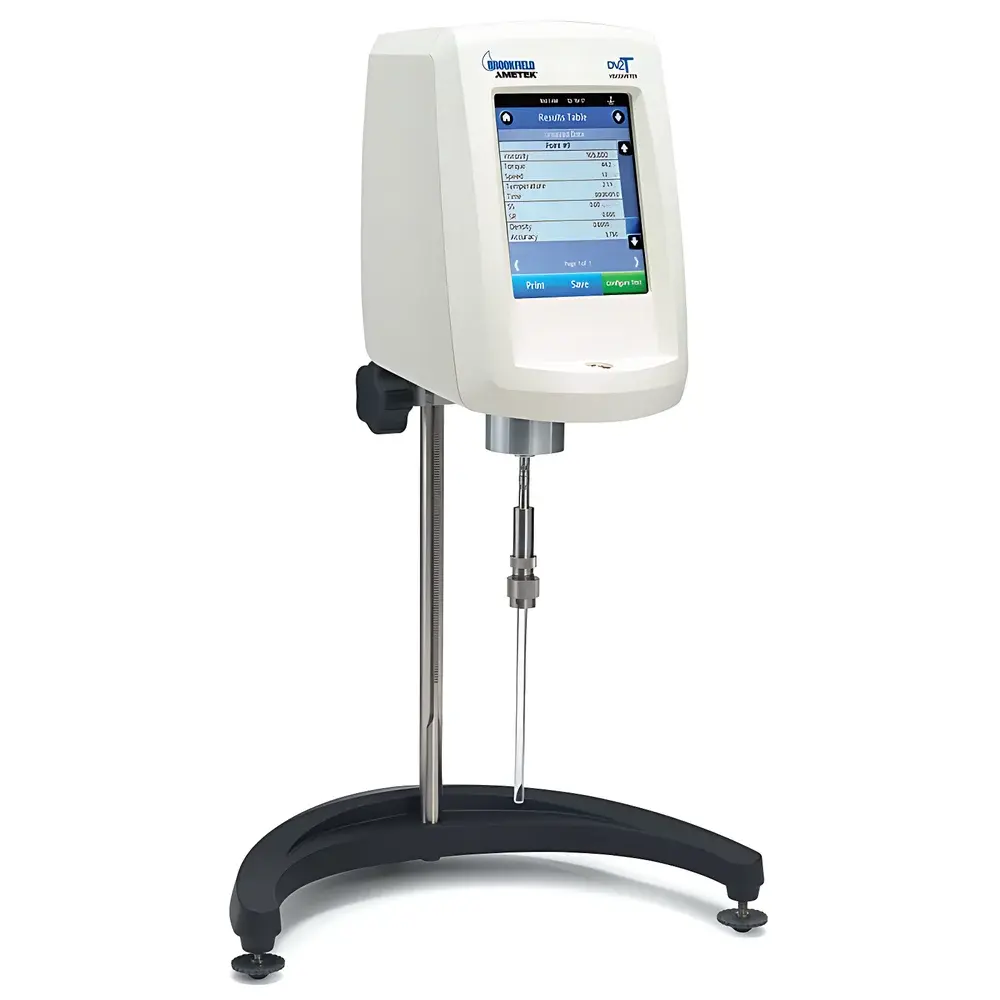
Brookfield DV2T Gel Timer Rheometer
| Brand | Brookfield |
|---|---|
| Origin | USA |
| Manufacturer Type | Manufacturer |
| Origin Category | Imported |
| Model | DV2T Gel Timer |
| Price | Upon Request |
Overview
The Brookfield DV2T Gel Timer is a dedicated rotational rheometer engineered for precise, real-time determination of gel time in thermosetting resins, encapsulants, adhesives, and coating formulations. It operates on the principle of controlled shear-induced structural evolution: a standardized 6 mm glass rod rotates at a constant low shear rate (1 rpm) within the sample while torque is continuously monitored. As crosslinking progresses, the material transitions from a viscous liquid to an elastic network; the point at which measured torque exceeds a user-defined threshold—indicating onset of solid-like mechanical resistance—is recorded as the gel time. This method aligns with ASTM D2471 (Standard Test Method for Gel Time of Thermosetting Resins) and supports GLP-compliant process validation in R&D, QC, and production environments.
Key Features
- Dedicated Time-to-Torque measurement mode optimized for gel point detection with fixed 1 rpm rotation speed and programmable torque setpoint
- Integrated temperature probe (standard with DV2T and DV3T models) enabling simultaneous real-time temperature monitoring (°C or °F) during gelation
- Magnetic coupling system ensuring robust, backlash-free transmission between instrument head and 6 mm glass rod
- Brake-equipped instrument stand for reproducible, depth-controlled immersion of the glass rod into the sample cup
- Automatic test termination and data capture upon torque threshold crossing—no manual intervention required
- Quick-release mechanism allows rapid separation of the glass rod post-test, minimizing sample carryover and enabling efficient cleaning
Sample Compatibility & Compliance
The DV2T Gel Timer accommodates a broad range of low- to medium-viscosity reactive systems including epoxy, phenolic, polyurethane, and silicone-based resins, as well as UV-curable coatings and gel-coating formulations. Its geometry—using a standardized 6 mm cylindrical glass rod—ensures consistent shear history and minimizes wall effects compared to spindle-based configurations. The system complies with industry-standard test protocols referenced in ASTM D2471 and ISO 2535, and supports traceable documentation required under FDA 21 CFR Part 11 when used with Rheocalc T software (DV2T/DV3T) featuring audit trail, electronic signature, and secure user access controls.
Software & Data Management
Rheocalc T software (included with DV2T and DV3T configurations) provides full control over test parameters, real-time torque–time–temperature visualization, automatic gel time calculation, and export-ready reporting in CSV, PDF, or XML formats. All raw data—including timestamped torque, rotational speed, and temperature values—are stored with metadata (operator ID, sample ID, environmental conditions) to satisfy GMP/GLP documentation requirements. The software supports multi-user permission levels, version-controlled method templates, and encrypted database storage. For DV1M-based configurations, Wingather SQ software delivers comparable functionality with simplified interface design tailored for routine QC workflows.
Applications
- Quality control of resin batches prior to molding or casting processes
- Formulation development of curable polymers and encapsulants
- Accelerated aging studies correlating gel time with shelf life and storage conditions
- Validation of catalyst concentration and cure schedule optimization
- Comparative analysis of inhibitor effectiveness in unsaturated polyester systems
- Process troubleshooting in coil coating, composite layup, and printed electronics manufacturing
FAQ
What is the standard geometry used for gel time measurement on the DV2T Gel Timer?
A 6 mm diameter glass rod coupled via magnetic drive is the standard geometry, providing consistent surface area and shear profile across tests.
Can the DV2T Gel Timer operate without a temperature probe?
Yes—though temperature monitoring is highly recommended for kinetic analysis, the gel time measurement itself relies solely on torque response; the probe is optional only for DV1M configurations.
Is the Time-to-Torque method compliant with regulatory standards for pharmaceutical excipients?
While not explicitly mandated for excipients, the method is scientifically validated for polymer network formation and widely accepted in medical device and biocompatible material development under ISO 10993 and USP .
How is calibration verified for gel time accuracy?
Calibration is performed using NIST-traceable reference oils and certified torque standards; annual verification per ISO/IEC 17025 is recommended for regulated environments.
What maintenance is required for long-term reliability?
Routine cleaning of the glass rod and magnetic coupler, periodic inspection of probe cable integrity, and annual recalibration of torque and temperature sensors ensure sustained metrological performance.



