
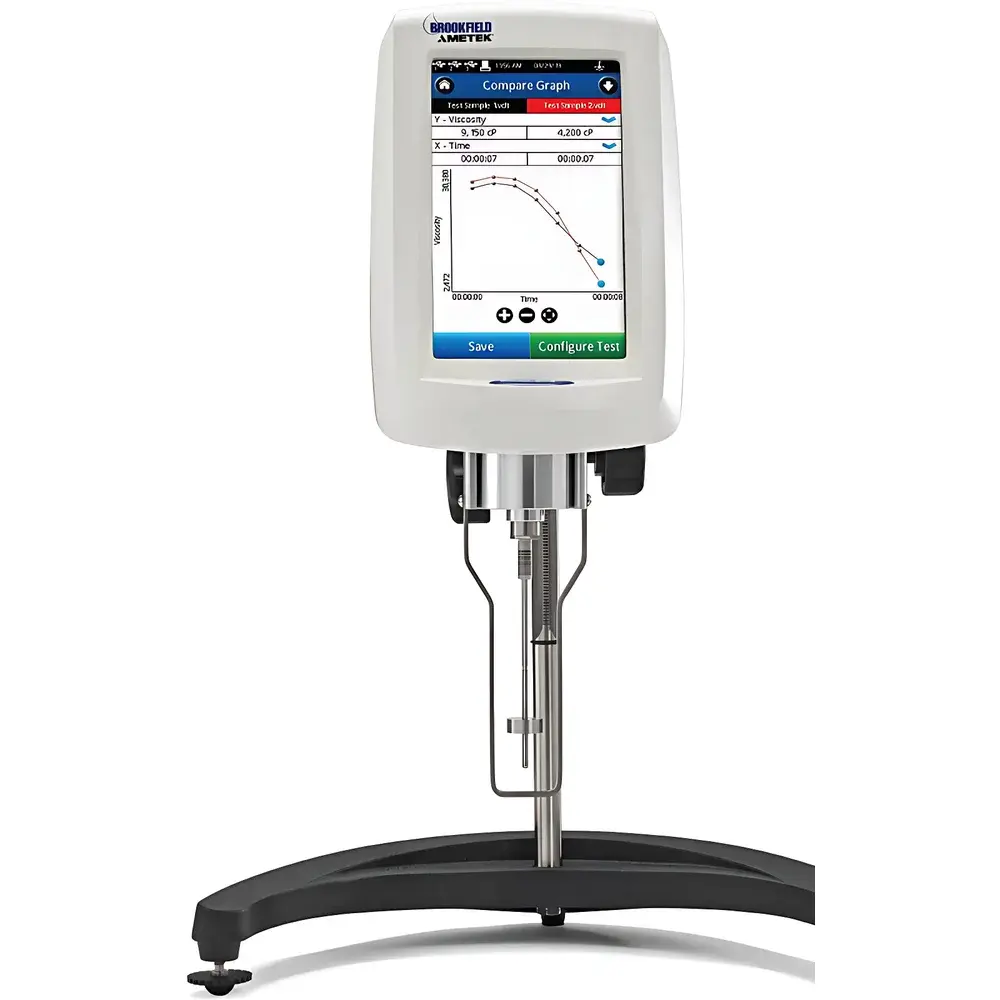
Brookfield DVNext Advanced Rotational Rheometer
| Brand | Brookfield |
|---|---|
| Origin | USA |
| Manufacturer Type | Manufacturer |
| Origin Category | Imported |
| Model | DVNext |
| Instrument Type | Rotational Viscometer/Rheometer |
| Viscosity Range | 1–320M mPa·s |
| Display | 7-inch Full-Color Touchscreen |
| Compliance | 21 CFR Part 11, GAMP 5 |
| Temperature Accuracy | ±1% of full scale (with PT-100 probe) |
| Internal Storage | 150 MB |
| Connectivity | USB, LIMS-ready, optional Ethernet/Wi-Fi |
| Control Mode | Standalone or PC-controlled (RheocalcT software) |
| Spindle Coupling | Magnetic coupling system |
| Leveling | Digital auto-leveling |
| Test Modes | Single-step & multi-step programmable protocols |
| Yield Stress & Flow Curve Analysis | Built-in Casson, Bingham, Power Law, Thix Index models |
| Temperature Integration | Compatible with AP/SD series circulators and high-temperature systems |
| Accessories Support | Cone/plate geometry, UL adapter, small-volume adapter, gel time coupler, DIN/ISO adapters, spiral, T-bar, paddle rotors, roller bearing spindles (HA/HB), RV/HA/HB-1 spindles |
Overview
The Brookfield DVNext Advanced Rotational Rheometer is a precision-engineered, microprocessor-controlled instrument designed for comprehensive viscoelastic characterization of liquids, pastes, gels, and semi-solids under controlled shear conditions. Based on the Couette principle—where torque generated by rotational motion of a spindle (or cone/plate geometry) in a sample is measured to determine resistance to flow—the DVNext delivers high reproducibility across a broad dynamic range. It functions as both a high-resolution rotational viscometer and a yield-stress-capable rheometer, enabling users to quantify viscosity, shear-thinning/thickening behavior, thixotropy, and static yield point—all without requiring external software. Its architecture supports regulatory-compliant operation in GLP, GMP, and FDA-regulated environments, with native adherence to 21 CFR Part 11 and GAMP 5 validation frameworks.
Key Features
- 7-inch full-color capacitive touchscreen interface with intuitive icon-driven navigation and real-time graphical display of viscosity, shear stress/strain, temperature, torque %, RPM, and step status
- Digital auto-leveling system ensures mechanical stability and measurement integrity across variable lab surfaces—critical for low-torque, high-sensitivity measurements
- Integrated magnetic coupling mechanism enables rapid, tool-free spindle attachment/detachment while maintaining precise axial alignment and minimizing vibration-induced noise
- Onboard mathematical modeling suite—including Casson, Bingham Plastic, Power Law (Ostwald-de Waele), and Thixotropy Index calculations—for immediate interpretation of flow curves and structural breakdown/recovery kinetics
- Standalone operational capability: fully functional data acquisition, multi-step method programming, statistical analysis, and PDF report generation without PC connection
- Comprehensive temperature management support via PT-100 probe input and seamless integration with Brookfield AP/SD-series recirculating baths or high-temperature test systems (up to 200°C)
- Regulatory-grade data governance: electronic signatures, immutable audit trails, user-role-based access control, time-stamped raw data files, and tamper-proof PDF exports compliant with 21 CFR Part 11 §11.10 and §11.30
Sample Compatibility & Compliance
The DVNext accommodates diverse sample types—from low-viscosity solvents (1 mPa·s with UL adapter) to highly structured polymer melts and drilling muds (up to 320 million mPa·s with HB-1 spindle). Cone/plate, cylindrical, and vane geometries allow optimization for yield stress quantification, non-Newtonian profiling, or minimal disturbance testing of fragile gels. All hardware and firmware comply with ISO/IEC 17025 calibration traceability requirements, and its design facilitates validation against ASTM D2196 (viscosity of paints), ISO 2555 (resin solutions), USP <911> (rheological properties of semisolids), and internal QC specifications. The instrument meets IEC 61000-4 electromagnetic compatibility standards and carries CE, UKCA, and FCC markings for global deployment.
Software & Data Management
RheocalcT software (optional) extends functionality with advanced curve fitting, comparative overlay analysis, batch reporting, and automated pass/fail evaluation against preconfigured QC limits. Raw data (.csv, .txt) and formatted reports (.pdf, .xlsx) are exportable via USB or network share. LIMS integration is supported through configurable metadata tagging (sample ID, operator, SOP version, instrument serial number) and HL7-compatible data streaming. Audit trail records include user login/logout timestamps, parameter modifications, calibration events, and electronic signature logs—retained for ≥15 years per internal archive policy. All data files embed digital watermarks and SHA-256 checksums to verify authenticity during regulatory inspections.
Applications
- Pharmaceutical formulation: topical gel yield stress, suspension stability assessment, ointment extrudability, and IV bag solution viscosity verification
- Food R&D: ketchup thixotropic recovery, chocolate tempering behavior, yogurt syneresis prediction, and batter consistency profiling
- Coatings & inks: sag resistance evaluation, spray atomization modeling, leveling time determination, and pigment dispersion stability
- Chemical manufacturing: polymer solution molecular weight estimation, catalyst slurry homogeneity monitoring, and adhesive open-time validation
- Petroleum & energy: drilling fluid gel strength, lubricant shear stability, and bitumen penetration index correlation
- Academic research: structure-property relationships in colloidal gels, biopolymer network dynamics, and microstructural evolution under oscillatory shear
FAQ
Does the DVNext require a computer to operate?
No—it runs full-featured standalone methods, stores data internally (150 MB), and generates compliant PDF reports directly on the touchscreen.
Can it measure yield stress without cone/plate geometry?
Yes—using vane or T-bar spindles with built-in yield algorithms (Casson/Bingham), though cone/plate provides highest accuracy for true yield point determination.
Is calibration traceable to NIST standards?
Yes—Brookfield-certified calibration kits (e.g., NIST-traceable silicone oils) and documented procedures align with ISO/IEC 17025 requirements.
How is data integrity ensured during remote LIMS upload?
Each transmitted dataset includes embedded digital signature, timestamp, instrument ID, and cryptographic hash—verifiable at destination node prior to ingestion.
What validation documentation is provided?
Factory-issued IQ/OQ protocols, URS summary, risk assessment (FMEA), and 21 CFR Part 11 configuration checklist are included with purchase.



