
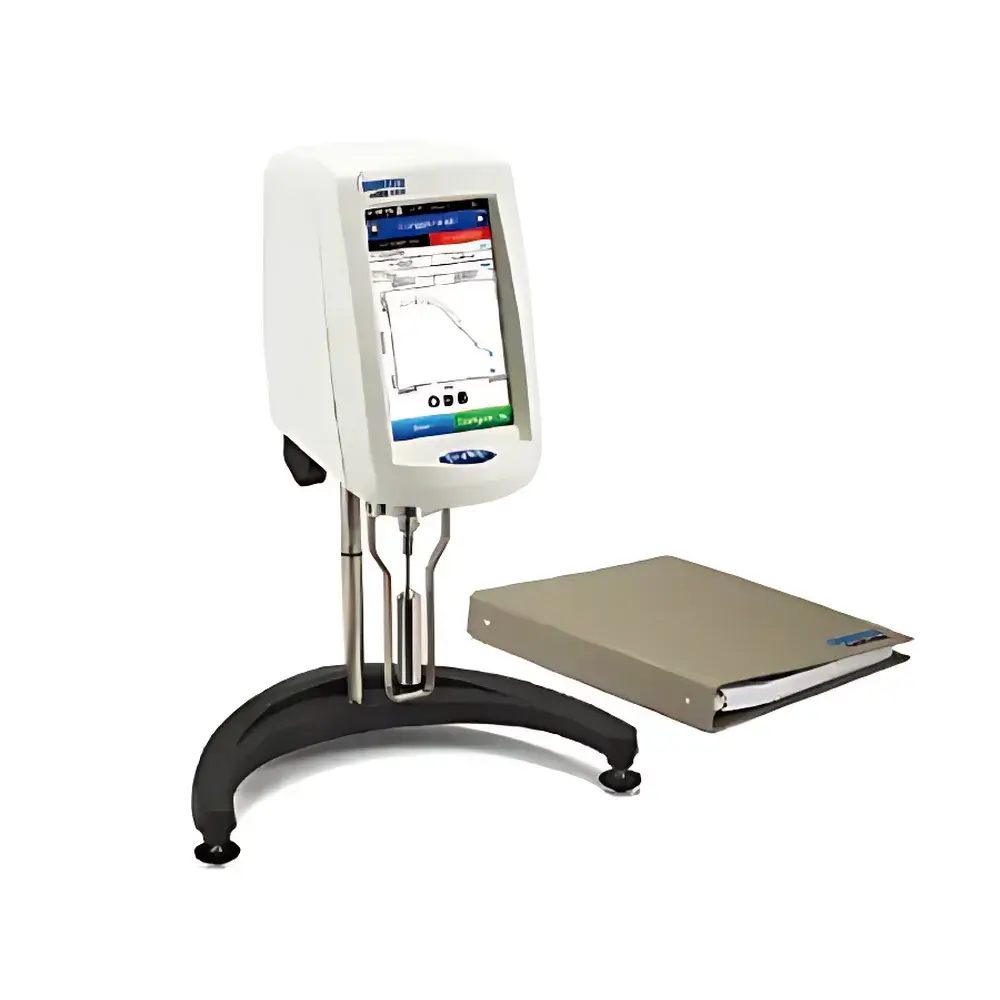
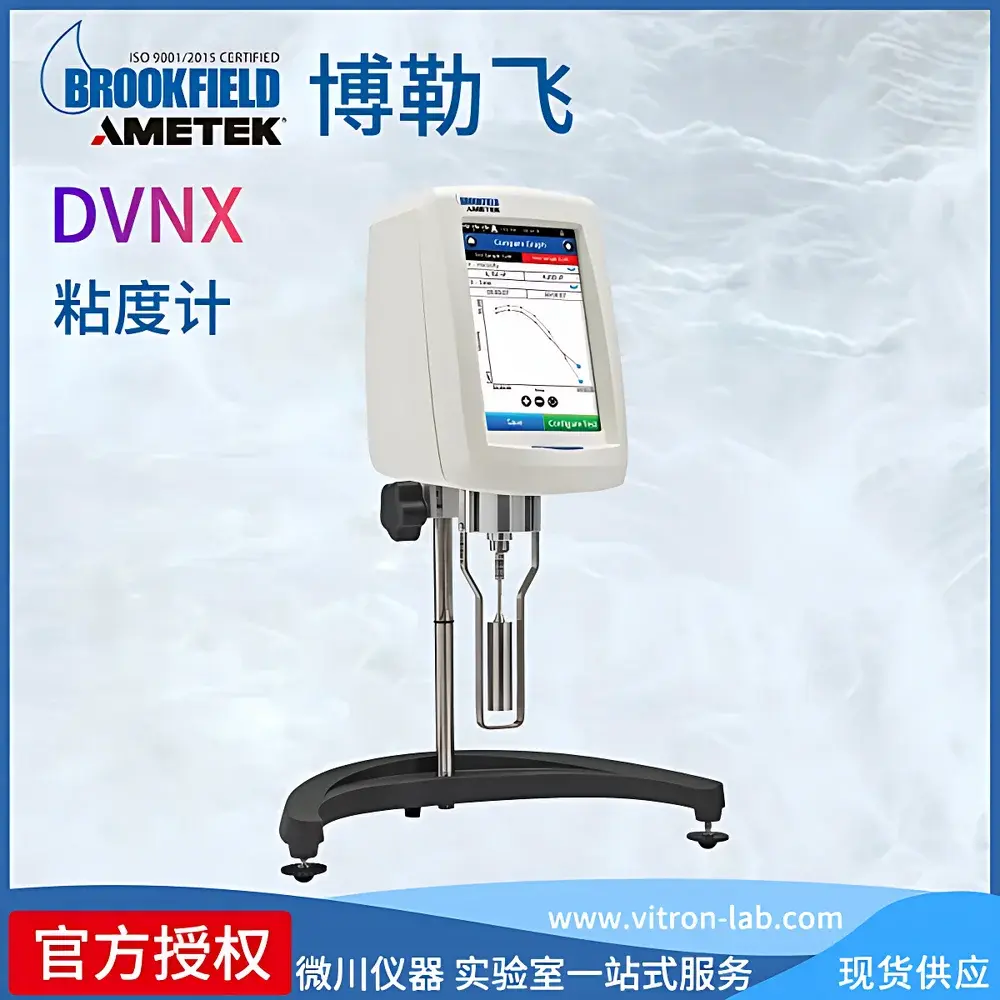
Brookfield DVNext Advanced Rotational Viscometer
| Brand | Brookfield |
|---|---|
| Origin | USA |
| Model | DVNext |
| Viscosity Range | 0.01–250 mPa·s |
| Instrument Type | Benchtop (with portable operational flexibility) |
| Compliance | Fully compliant with FDA 21 CFR Part 11 in standalone mode |
| Connectivity | Ethernet and LIMS integration supported |
| Rotor Mounting | One-hand quick-coupling mechanism |
| Leveling | Integrated electronic auto-leveling system |
| Operating Environment | Ambient temperature (15–30 °C) |
| Application Class | General-purpose rotational viscometry for QC, R&D, and production environments |
Overview
The Brookfield DVNext Advanced Rotational Viscometer is an engineered solution for precise, repeatable, and auditable viscosity measurement across laboratory, quality control, and manufacturing settings. Based on the well-established Couette principle—where torque generated by a rotating spindle immersed in a fluid is proportional to its dynamic viscosity—the DVNext delivers high reproducibility across a broad shear rate range. Unlike capillary or falling-ball viscometers, this instrument operates under controlled rotational conditions, enabling direct quantification of apparent viscosity at user-defined speeds (0.01–250 rpm equivalent), making it suitable for Newtonian and mildly non-Newtonian fluids. Its benchtop form factor integrates portability-oriented ergonomics without compromising mechanical stability, supporting both routine single-point checks and multi-speed flow curve analysis.
Key Features
- Electronic auto-leveling system ensures measurement integrity by eliminating manual bubble-level dependency—critical for regulatory compliance and inter-laboratory reproducibility.
- One-hand rotor coupling mechanism enables rapid, tool-free spindle exchange—reducing operator-induced variability and accelerating throughput in high-volume testing environments.
- FDA 21 CFR Part 11 compliance in standalone operation, including electronic signatures, audit trails, and secure user access controls—fully aligned with GLP and GMP documentation requirements.
- Ethernet interface supports seamless integration into enterprise LIMS platforms and centralized data repositories, facilitating automated report generation and real-time process monitoring.
- Intuitive touchscreen interface with guided test workflows—including Quick Test Mode and Step-by-Step Measurement Wizard—minimizes training time and reduces procedural errors.
- Robust aluminum chassis and precision-machined bearing assembly ensure long-term calibration stability and resistance to mechanical drift under continuous use.
Sample Compatibility & Compliance
The DVNext accommodates standard Brookfield spindles (LV, RV, HA, HB series) and compatible geometry accessories (e.g., small-sample adapters, thermosel jackets, and ultra-low-volume cups), supporting sample volumes from 0.5 mL to 500 mL. It is validated for use with aqueous solutions, polymer melts, paints, coatings, pharmaceutical suspensions, food emulsions, and personal care formulations. Regulatory alignment includes adherence to ASTM D2196 (Standard Test Methods for Rheological Properties of Non-Newtonian Materials), ISO 2555 (Plastics—Determination of Apparent Viscosity), and USP <911> (Rheology). All firmware and software modules undergo periodic validation per ICH Q7 and Annex 11 guidelines for computerized systems in regulated environments.
Software & Data Management
The DVNext operates natively with Brookfield’s Rheo3000 software suite (v4.2+), which provides full traceability: timestamped test logs, version-controlled method templates, digital signature capture, and export-ready CSV/PDF reports compliant with ALCOA+ principles (Attributable, Legible, Contemporaneous, Original, Accurate). Data encryption (AES-256) and role-based permissions (Admin, Technician, Reviewer) enforce separation of duties. Audit trail records include all parameter modifications, login/logout events, and calibration history—retained for ≥36 months per internal SOP and FDA expectations. Optional cloud synchronization allows remote method deployment and centralized firmware updates across multi-site installations.
Applications
This viscometer serves as a primary metrology tool in formulation development (e.g., optimizing thixotropic behavior in adhesives), batch release testing (e.g., verifying viscosity consistency of injectable suspensions per USP monographs), stability studies (e.g., monitoring viscosity drift during accelerated aging), and supplier qualification protocols. It is routinely deployed in ISO/IEC 17025-accredited labs for accredited viscosity testing services and supports trending analysis via SPC charts integrated into the software dashboard. Cross-industry utility spans cosmetics (cream viscosity profiling), battery electrolyte QC, inkjet ink rheology screening, and biopharmaceutical buffer characterization—where low-shear sensitivity and repeatability are essential.
FAQ
Does the DVNext require external calibration standards for daily verification?
No—built-in torque calibration verification using NIST-traceable reference oils is performed automatically at startup and can be scheduled pre-test; full recalibration is recommended annually or after mechanical impact.
Can the DVNext operate without network connectivity while maintaining 21 CFR Part 11 compliance?
Yes—standalone mode retains complete electronic signature functionality, immutable audit trails, and user authentication without requiring server infrastructure.
Is the electronic leveling system affected by ambient vibration or table instability?
The system incorporates adaptive filtering and a 3-axis MEMS accelerometer to distinguish between static tilt and transient vibration; it only engages correction when stable inclination exceeds ±0.2° over 2 seconds.
What spindle geometries are certified for use with the DVNext under ISO 2555?
All Brookfield-standard spindles (SC4-18, LV-1 through LV-4, RV-1 through RV-7) and ULV (Ultra-Low Volume) spindles are certified for ISO 2555-compliant measurements when used with appropriate calibration certificates.
How does the DVNext handle temperature-sensitive samples?
While the base unit operates at ambient temperature, it is fully compatible with Brookfield’s Peltier-controlled Thermosel systems (sold separately), enabling precise temperature regulation from 0 °C to 150 °C with ±0.1 °C stability.



