
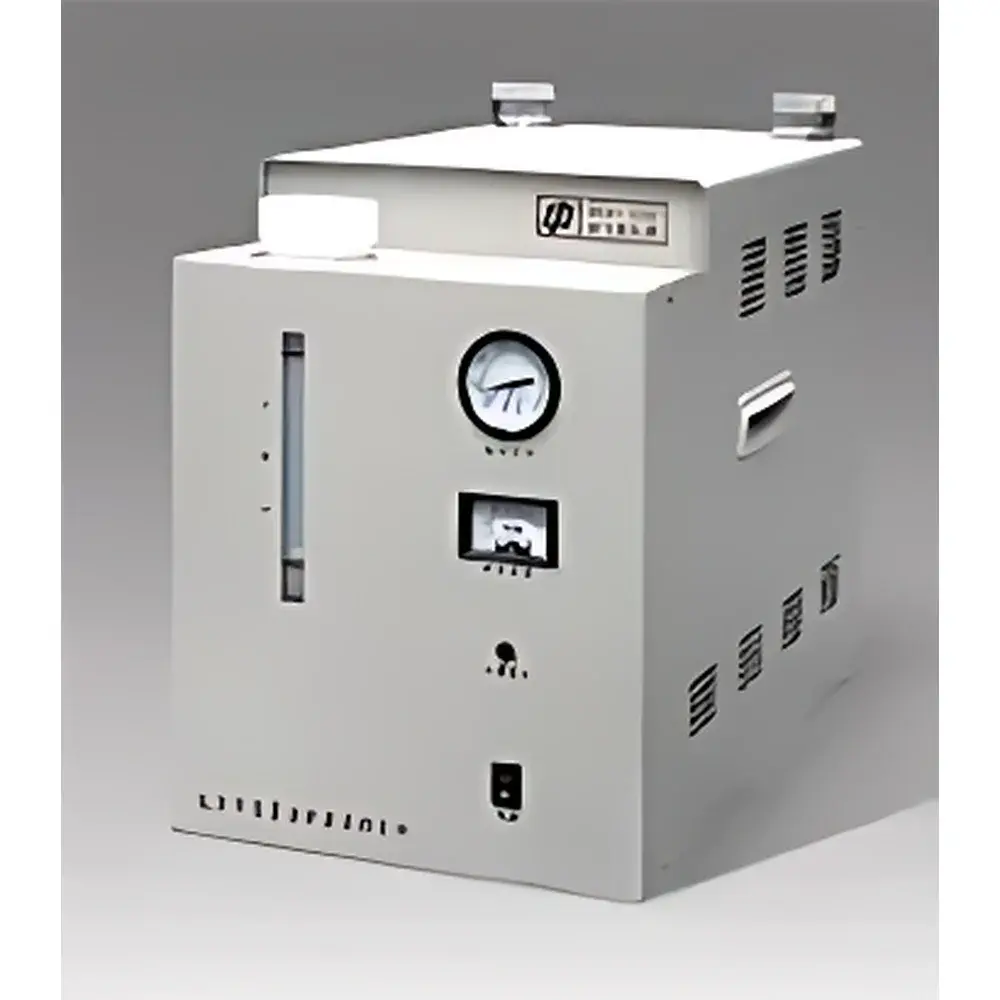
Brookfield GCN-1000 Membrane-Based Nitrogen Generator
| Key | Purity <3 ppm O₂, Dew Point −56°C, Flow 0–1000 mL/min, Output Pressure 0–0.4 MPa, Pressure Stability <0.003 MPa (air-source dependent), Power 220 V ±10%, 50 Hz, 300 W, Operating Temp 1–40°C, RH <85%, Dimensions 460 × 360 × 350 mm, Net Weight ~20 kg |
|---|
Overview
The Brookfield GCN-1000 is a membrane-based nitrogen generator engineered for continuous, on-demand supply of high-purity nitrogen gas in analytical laboratory environments—particularly for gas chromatography (GC), liquid chromatography–mass spectrometry (LC-MS) nitrogen drying gas, and inert atmosphere purging. It employs hollow-fiber polymeric membrane separation technology to selectively permeate oxygen, water vapor, carbon dioxide, and other trace gases from compressed ambient air, retaining nitrogen with consistent purity and flow stability. Unlike pressure swing adsorption (PSA) systems, the GCN-1000 operates without molecular sieves or regeneration cycles, eliminating downtime, valve wear, and periodic consumable replacement. Its design prioritizes long-term reliability, low maintenance, and seamless integration into existing lab infrastructure where stable, oil-free, and particle-free nitrogen is required at flow rates up to 1000 mL/min.
Key Features
- Real-time digital display of output pressure and nitrogen flow rate, enabling immediate operational verification and process monitoring.
- Automatic pressure and flow regulation via integrated proportional control valves—maintains setpoint stability even under variable downstream demand.
- Dual-stage stainless-steel filtration: pre-filter removes particulates and oil aerosols; secondary filter contains proprietary oxygen-scavenging media that requires no thermal activation or periodic regeneration—ensuring sustained O₂ removal below 3 ppm.
- Low-sulfur silicone elastomer seals throughout the gas path minimize sulfur compound outgassing, critical for maintaining baseline stability in sulfur-sensitive detectors (e.g., pulsed flame photometric detector, PFPD) and preventing column degradation in GC applications.
- Integrated safety architecture includes automatic anti-backflow protection, overpressure cutoff, and fail-safe shutdown triggered by abnormal inlet pressure, dew point excursion, or internal temperature rise—fully compliant with IEC 61010-1 safety requirements for laboratory equipment.
Sample Compatibility & Compliance
The GCN-1000 is compatible with all standard laboratory-grade compressed air sources meeting ISO 8573-1 Class 2:2:2 specifications (i.e., ≤0.1 µm particles, ≤0.1 mg/m³ oil content, dew point ≤−40°C). It does not require external dryers or coalescing filters when paired with appropriately conditioned air. The generated nitrogen meets ASTM D6349–21 specifications for carrier and purge gas in chromatographic analysis and satisfies the inert gas quality criteria outlined in USP and EP 2.5.27 for pharmaceutical residual solvent testing. Instrument firmware supports audit-trail-enabled operation per FDA 21 CFR Part 11 when connected to validated LIMS or CDS platforms.
Software & Data Management
The GCN-1000 operates as a standalone hardware system with no embedded software stack or network interface. All operational parameters are monitored and controlled via front-panel LED indicators and tactile push-button inputs—eliminating cybersecurity exposure, firmware update dependencies, or OS compatibility constraints. For laboratories requiring centralized gas monitoring, analog 0–5 V or 4–20 mA output signals (optional configuration) enable connection to building management systems (BMS) or PLC-controlled utility networks. Raw sensor data—including real-time flow, pressure, and internal temperature—is accessible via RS-232 serial port for integration into custom SCADA or lab automation frameworks under GLP/GMP-compliant validation protocols.
Applications
- Carrier gas for capillary GC and GC–MS systems requiring consistent 99.9997% N₂ (O₂ <3 ppm) and moisture control (dew point −56°C).
- Purge gas for headspace samplers, autosampler needle wash stations, and detector exhaust lines.
- Inert blanket gas for sample vial storage, reagent handling, and solvent evaporation workstations.
- Nitrogen supply for electrospray ionization (ESI) and atmospheric pressure chemical ionization (APCI) sources in LC–MS.
- Process gas for glovebox inerting, catalyst handling, and thin-film deposition preparation in materials science labs.
FAQ
What compressed air quality is required for optimal GCN-1000 performance?
The unit requires feed air meeting ISO 8573-1 Class 2:2:2:2—specifically ≤0.1 µm particulates, ≤0.1 mg/m³ total oil (including aerosol and vapor), and pressure dew point ≤−40°C. Failure to meet these specifications may reduce membrane lifespan and compromise purity consistency.
Does the GCN-1000 require routine consumable replacement?
The oxygen-scavenging media in the secondary filter is non-regenerable but exhibits >12 months of service life under typical lab usage (≤8 hrs/day, 5 days/week). The primary particulate/oil filter should be replaced every 6 months or after 2000 operating hours—whichever occurs first.
Can the GCN-1000 be used with mass spectrometry systems requiring ultra-high purity?
While suitable for most LC–MS nitrogen curtain/gas assist applications, it is not certified for use as source gas in high-resolution time-of-flight (TOF) or Orbitrap MS systems where hydrocarbon or siloxane contamination must be below sub-ppb levels; supplemental hydrocarbon traps or cryogenic polishing are recommended in such cases.
Is the output pressure adjustable during operation?
Yes—pressure setpoint can be modified continuously within the 0–0.4 MPa range using the front-panel control knob, with closed-loop feedback ensuring deviation remains below ±0.003 MPa under steady-state conditions.
What safety certifications does the GCN-1000 hold?
It complies with IEC 61010-1:2010 for electrical safety in laboratory equipment and carries CE marking under the EU Low Voltage Directive (2014/35/EU) and Electromagnetic Compatibility Directive (2014/30/EU). No ATEX or IECEx certification is provided, as it is not intended for hazardous area installation.
Related Products



