
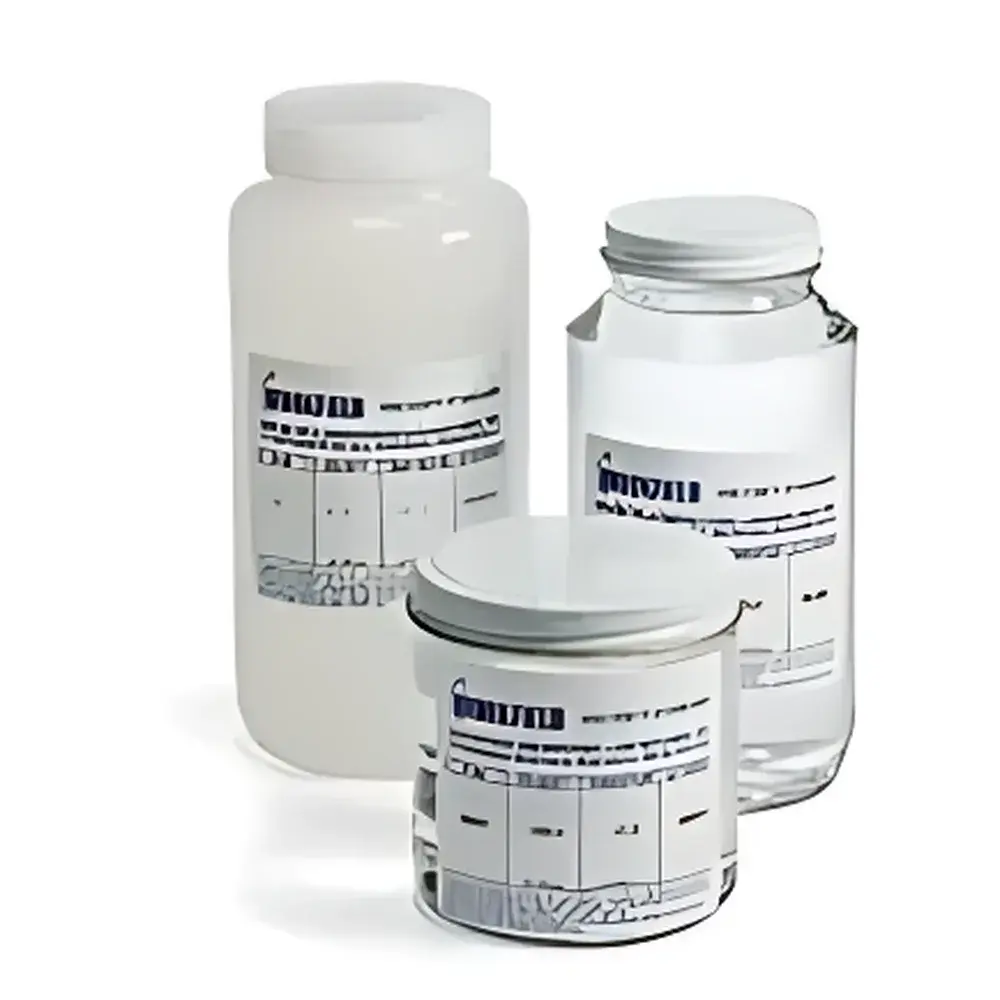
Brookfield Generic Silicone Oil Viscosity Standards
| Brand | Brookfield |
|---|---|
| Origin | USA |
| Type | NIST-Traceable Newtonian Calibration Fluid |
| Viscosity Range | 5–100,000 cP (mPa·s) at 25 °C |
| Accuracy | ±1% of stated value |
| Temperature Stability | Low thermal sensitivity (dη/dT ≈ 0.5–0.7 %/°C) |
| Packaging | 500 mL for ≥30,000 cP |
| Certificate | Included (NIST-traceable calibration report) |
Overview
Brookfield Generic Silicone Oil Viscosity Standards are precision-engineered Newtonian reference fluids designed specifically for routine calibration, verification, and performance validation of rotational viscometers and rheometers—including all Brookfield DV, RV, HA, HB, and CAP series instruments, as well as third-party rotational systems compliant with ASTM D2196, ISO 2555, and USP <911>. These standards operate on the fundamental principle that Newtonian fluids exhibit constant shear viscosity independent of applied shear rate—enabling unambiguous assessment of instrument torque response, spindle geometry correction, and temperature-controlled measurement fidelity. Unlike mineral oil-based standards, silicone oils demonstrate significantly lower thermal sensitivity (typical dη/dT of 0.5–0.7 %/°C), ensuring stable readings across standard laboratory temperature fluctuations (±0.5 °C). Each lot is certified against NIST-traceable reference materials and validated per ISO/IEC 17025-accredited procedures.
Key Features
- NIST-traceable viscosity certification with documented uncertainty budgets and full metrological traceability to SRM 2490c and SRM 2491
- Guaranteed Newtonian behavior verified via controlled-shear-rate sweep testing (0.1–100 s⁻¹) with ≤0.3% viscosity deviation
- Extended shelf life (>24 months unopened) due to oxidative stability and absence of volatile fractions
- Low vapor pressure and non-reactive composition—safe for use with stainless steel, PTFE, and anodized aluminum spindles
- Viscosity range spans five decades: 5, 10, 50, 100, 500, 1,000, 5,000, 12,500, 30,000, 60,000, and 100,000 cP at 25 °C
- Batch-specific calibration certificates include temperature-viscosity coefficients (α and β) for interpolation to 15–35 °C per ASTM D445 Annex A1
Sample Compatibility & Compliance
These silicone oil standards are chemically inert toward common viscometer wetted materials—including 316 stainless steel, Hastelloy C-276, borosilicate glass, and fluoropolymer seals—ensuring no leaching, swelling, or hysteresis effects during repeated use. They comply with GLP and GMP requirements for instrument qualification (IQ/OQ/PQ) when used in regulated environments. Documentation supports FDA 21 CFR Part 11 compliance for electronic records: each certificate includes unique batch ID, analyst signature, calibration date, expiration date, and uncertainty statement. The standards meet ASTM D1076 (specification for silicone fluids), ISO 12212 (viscosity standards for rotational instruments), and EU Pharmacopoeia 2.2.10 criteria for Newtonian reference materials.
Software & Data Management
When used with Brookfield’s Rheo3000 or ViscoQC software, viscosity standards enable automated calibration workflows with pass/fail thresholds configurable per user-defined SOPs. The software logs calibration events—including ambient temperature, bath temperature, spindle ID, and measured torque—with timestamped audit trails exportable as CSV or PDF. All certificates are digitally archived with SHA-256 hash integrity verification. For laboratories implementing LIMS integration, Brookfield provides API-accessible metadata fields (e.g., cert_no, viscosity_cP_25C, uncertainty_pct, expiry_date) compatible with LabWare, Thermo Fisher SampleManager, and Agilent OpenLab platforms.
Applications
- Annual or semi-annual instrument calibration per ISO/IEC 17025 Clause 6.4.10
- Daily system suitability checks prior to QC testing of polymers, coatings, pharmaceutical suspensions, and food emulsions
- Verification of temperature control accuracy in Peltier or water-bath viscometry systems
- Validation of new spindle installation or geometry change (e.g., switching from LV-1 to UL adapter)
- Inter-laboratory comparison studies under ILAC MRA frameworks
- Training personnel on proper immersion depth, spindle cleaning protocols, and zero-torque baseline verification
FAQ
Are these standards suitable for non-Brookfield viscometers?
Yes—provided the instrument measures rotational viscosity using coaxial cylinder (Couette), cone-and-plate, or spindle geometries and accepts Newtonian calibration references.
Do I need to recalibrate if ambient lab temperature deviates from 25 °C?
No—each certificate includes empirical temperature-viscosity coefficients enabling accurate interpolation between 15–35 °C per ASTM D445.
Can I reuse the same bottle across multiple calibration sessions?
Yes—provided the container remains sealed between uses and the fluid is filtered through a 5-µm syringe filter before dispensing to prevent particulate contamination.
Is the ±1% accuracy specification valid across the entire shear rate range?
Yes—verified under steady-state shear conditions from 0.1 to 100 s⁻¹; deviations exceed tolerance only below 0.05 s⁻¹ due to bearing drag limitations inherent to mechanical viscometers.
How often should I replace an opened bottle?
Use within 6 months of first opening; store upright at 15–25 °C away from direct UV exposure to maintain specification integrity.
Related Products



