
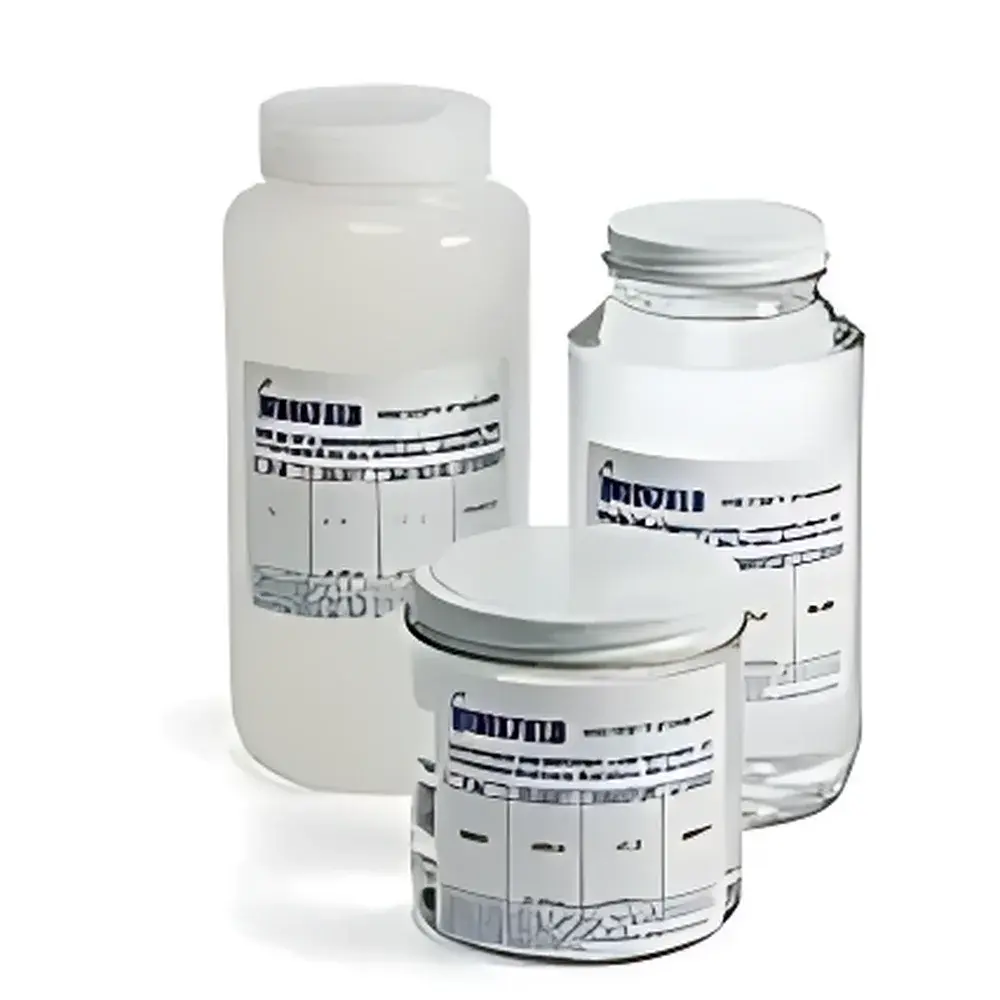
Brookfield High-Temperature Silicone Oil Viscosity Standards
| Brand | Brookfield |
|---|---|
| Origin | USA |
| Model | High-Temperature Silicone Oil Viscosity Standards |
| Certified Accuracy | ±1% of stated viscosity value |
| Available Temperatures | 25°C (77°F), 93.3°C (200°F), 149.0°C (300°F) |
| Packaging | 500 mL (1 US pint) bottle with NIST-traceable calibration certificate |
| Compliance | ASTM D2196, ISO 2555, USP <911> |
| Recommended Accessories | Brookfield Thermosel temperature-controlled bath system |
| Newtonian Behavior | Confirmed across full operational temperature range |
Overview
Brookfield High-Temperature Silicone Oil Viscosity Standards are precision-engineered Newtonian reference fluids designed for rigorous calibration and verification of rotational viscometers operating at elevated temperatures. These standards leverage high-purity, thermally stable silicone oils whose rheological behavior remains invariant under shear rate—ensuring consistent, repeatable viscosity values across a wide temperature spectrum (25°C to 149°C). Unlike polymeric or hydrocarbon-based standards, silicone oils exhibit minimal thermal degradation, negligible volatility, and exceptional oxidative stability, making them ideal for validating instruments in QC labs, R&D facilities, and regulated manufacturing environments where long-term reproducibility is mandatory. Each batch undergoes independent gravimetric and capillary viscometry traceable to NIST SRMs, and is certified to ±1% of the nominal viscosity value at three critical reference points: ambient (25°C), intermediate (93.3°C), and high-temperature (149.0°C) conditions—aligning with common industrial process setpoints.
Key Features
- Triple-point certified viscosity values at 25°C (77°F), 93.3°C (200°F), and 149.0°C (300°F) for comprehensive thermal calibration coverage
- Strictly Newtonian behavior confirmed via rotational shear sweep testing (0.1–100 s⁻¹) at all certified temperatures
- ±1% accuracy tolerance relative to nominal viscosity, validated per ASTM D2196 Annex A2 and ISO 2555 Annex B
- Supplied in inert, amber-glass 500 mL (1 US pint) bottles with tamper-evident seals to prevent oxidation and contamination
- Included NIST-traceable calibration certificate listing batch-specific measured values, uncertainty budgets, and measurement methodology
- Optimized compatibility with Brookfield Thermosel heating systems, ensuring precise thermal equilibration and minimal temperature gradient (<±0.1°C)
- No evaporation loss or compositional drift observed after 12 months of storage at ≤30°C in sealed containers
Sample Compatibility & Compliance
These standards are compatible with all rotational viscometers employing coaxial cylinder (Couette), cone-and-plate, or spindle geometries—including Brookfield DVNext, AMETEK CAP2000+, Anton Paar Physica MCR series, and Thermo Scientific HAAKE Viscotester iQ. They meet the fluid performance requirements of ISO/IEC 17025-accredited calibration laboratories and support compliance with FDA 21 CFR Part 11 when used within validated software workflows. Documentation satisfies audit requirements for GLP and GMP environments, particularly for viscosity-critical processes such as thermal interface material qualification, high-temp lubricant formulation, and aerospace-grade polymer melt characterization. All certificates include expanded uncertainty calculations per GUM (JCGM 100:2018) and are issued by an ILAC-MRA signatory laboratory.
Software & Data Management
When integrated with Brookfield Rheo3000 or PC-based viscosity analysis software (e.g., RheoVision v4.x), these standards enable automated calibration curve generation and deviation trending across temperature cycles. The software logs timestamped calibration events, operator IDs, instrument serial numbers, and environmental parameters (ambient humidity, bath stability time), supporting full audit trails required under 21 CFR Part 11. Raw viscosity data can be exported in CSV or XML format for LIMS integration, and certificate metadata is embeddable into electronic lab notebooks (ELNs) via standard metadata tags (ISO/IEC 11179-compliant).
Applications
- Calibration and performance verification of high-temperature rotational viscometers in polymer processing labs
- Validation of thermal stability claims for heat-transfer fluids and synthetic lubricants
- Reference material for ASTM D1092 (viscosity of asphalt binders at elevated temperature) interlaboratory studies
- Baseline verification of rheometer temperature control accuracy during ISO 6721-10 dynamic mechanical thermal analysis (DMTA) method transfers
- Traceable viscosity anchoring for in-line process viscometers deployed in continuous reactor monitoring systems
- Supporting technical documentation for ISO 9001:2015 Clause 7.1.5 (monitoring and measuring resources)
FAQ
Are these standards suitable for non-Brookfield viscometers?
Yes—they are formulated and certified for universal use with any rotational viscometer meeting ISO 2555 geometry and speed specifications.
How often should I recalibrate using these standards?
Per ISO/IEC 17025, recalibration frequency depends on usage intensity and risk assessment; typical intervals range from quarterly (high-use QC labs) to annually (R&D validation labs).
Can I request custom viscosity values or temperatures?
Yes—Brookfield offers custom-certified batches upon request, with lead times of 4–6 weeks and full traceability documentation.
Do the certificates include measurement uncertainty?
Yes—each certificate reports expanded uncertainty (k=2) derived from repeatability, temperature control error, density correction, and reference standard uncertainty components.
What is the shelf life after opening?
Unopened bottles retain certification for 24 months; opened bottles remain valid for 6 months if stored under nitrogen purge at ≤30°C and protected from light.



