
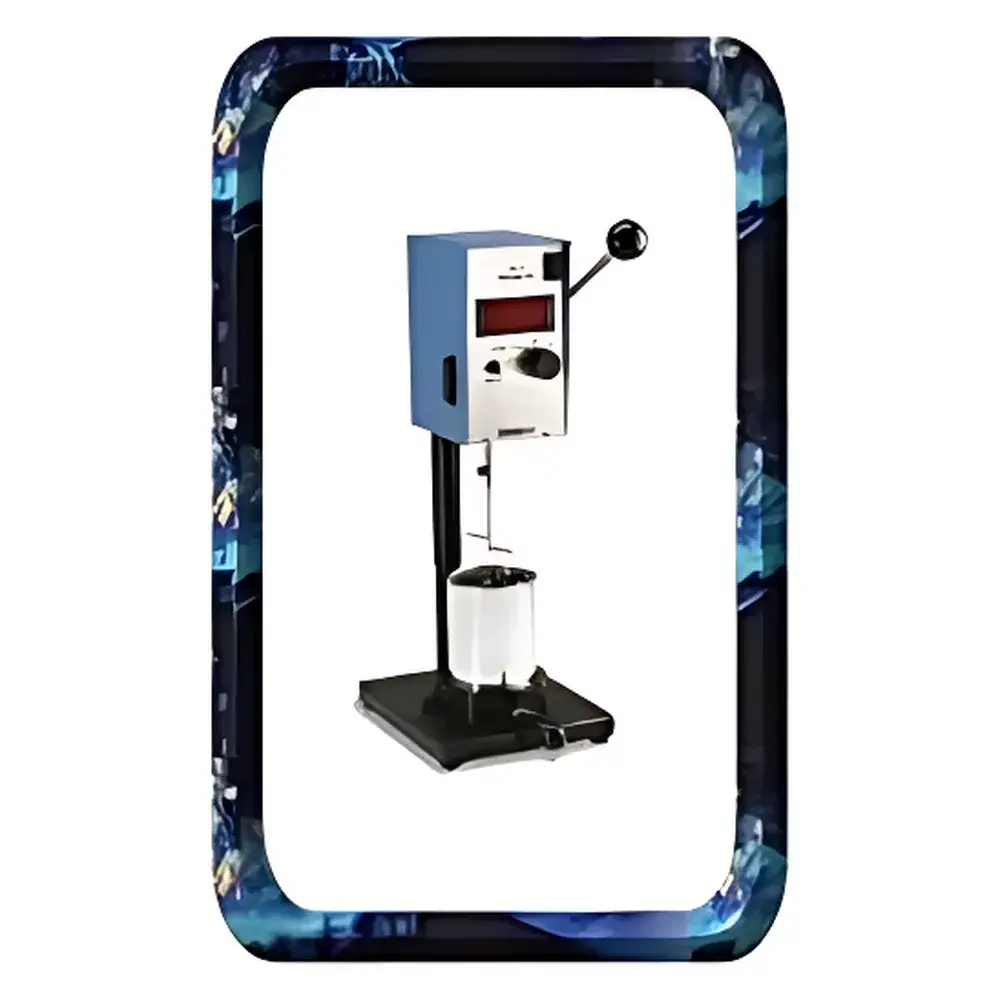
Brookfield KU-2 Krebs Unit Viscometer
| Brand | Brookfield |
|---|---|
| Origin | USA |
| Model | KU-2 |
| Instrument Type | Rotational Viscometer |
| Measurement Range | 40–141 KU (Krebs Units), 32–1099 g, 27–5274 cP |
| Compliance | ASTM D562, ISO 2555, GB/T 9269 |
| Output | Analog voltage (0–5 V DC) for optional printer or data logger |
| Sample Volume | ~500 mL |
| Power Supply | 100–240 V AC, 50/60 Hz |
| Dimensions | 22.9 × 15.2 × 30.5 cm |
| Weight | 6.8 kg |
Overview
The Brookfield KU-2 Krebs Unit Viscometer is a precision-engineered rotational viscometer specifically designed for the rapid, standardized measurement of viscosity in architectural coatings, industrial paints, printing inks, and related non-Newtonian suspensions. It operates on the principle of torque-based resistance measurement using a standardized Krebs spindle (ASTM D562 geometry) rotating at a fixed speed of 200 rpm in a defined sample volume. Unlike general-purpose rotational viscometers, the KU-2 delivers direct readouts in Krebs Units (KU), grams (g), and centipoise (cP) — eliminating manual conversion and reducing operator error. Its mechanical architecture follows the legacy of the Stormer viscometer but incorporates modern electronic sensing, digital display, and enhanced repeatability through regulated motor control and thermal-stable bearing design. The instrument is calibrated traceably to NIST-traceable standards and conforms to key international test methods governing coating rheology.
Key Features
- Direct dual-scale digital display showing simultaneous readings in Krebs Units (KU), grams (g), and centipoise (cP)
- Fixed-speed operation at 200 ± 0.5 rpm ensures strict adherence to ASTM D562 requirements
- Integrated Krebs spindle (standardized geometry per ASTM D562) — no rotor selection or calibration required
- Analog output (0–5 V DC) supports connection to external printers, chart recorders, or laboratory data acquisition systems
- Robust cast-aluminum housing with vibration-dampening base for stable measurements in production or QC lab environments
- Self-contained electronics with automatic zeroing and real-time torque compensation for consistent inter-laboratory reproducibility
- No consumable parts beyond standard cleaning; maintenance-free operation over extended service intervals
Sample Compatibility & Compliance
The KU-2 is optimized for Newtonian and mildly shear-thinning liquid systems typical of water-based and solvent-based architectural coatings, latex paints, enamel formulations, and pigment dispersions. It accommodates samples with densities up to 2.0 g/cm³ and particle loadings common in commercial paint formulations. Its measurement protocol aligns with ASTM D562 (“Standard Test Method for Viscosity of Paints, Varnishes, Lacquers, and Related Products by Krebs-Unit Viscometer”), ISO 2555 (“Plastics — Resins in the liquid state or as emulsions or dispersions — Determination of apparent viscosity”), and GB/T 9269 (“Determination of viscosity of paint and varnish — Krebs unit method”). The instrument meets GLP documentation requirements when paired with compliant data logging software and supports audit-ready records for FDA-regulated environments under 21 CFR Part 11 when integrated with validated third-party systems.
Software & Data Management
While the KU-2 operates as a stand-alone analog/digital instrument, its 0–5 V DC analog output enables seamless integration with LabVIEW, MATLAB, or custom SCADA platforms for automated batch logging. When connected to Brookfield’s optional PC interface (e.g., via USB-to-analog converter), raw torque and time-stamped KU values can be exported to CSV or Excel formats. All stored data retain full metrological traceability: timestamp, operator ID (manually entered), ambient temperature (optional external probe), and instrument serial number. The system supports configurable pass/fail thresholds aligned with internal QC specifications, generating immediate visual alerts during in-line quality checks.
Applications
- Routine QC testing of paint viscosity prior to canning or spray application
- Formulation development of high-solids architectural coatings where KU correlates strongly with sag resistance and brushability
- Batch-to-batch consistency verification in contract manufacturing facilities serving OEM paint suppliers
- Raw material screening of thickeners (e.g., associative HASE, cellulose ethers) and dispersants in R&D labs
- Regulatory submission support for product registrations requiring ASTM D562-compliant viscosity data
- Training platform for new technicians due to intuitive operation and minimal procedural variability
FAQ
What standards does the KU-2 comply with?
ASTM D562, ISO 2555, and GB/T 9269 are fully supported through its fixed-speed operation, spindle geometry, and calibration protocol.
Can the KU-2 replace a traditional Stormer viscometer?
Yes — it is engineered as a direct functional replacement with improved accuracy, digital readout, and reduced operator dependency.
Is calibration required before each use?
No. The KU-2 performs automatic zeroing upon startup and maintains calibration stability across ambient temperatures from 15–30°C without daily recalibration.
Does it require special sample preparation?
Samples must be homogenized and degassed if air entrapment is suspected; viscosity measurements are performed at ambient temperature unless otherwise specified in the test method.
How is traceability ensured for regulatory audits?
Each unit ships with a NIST-traceable calibration certificate; users may maintain ongoing traceability through periodic verification using certified reference oils (e.g., Cannon-Kent or Brookfield Standard Fluids).



