
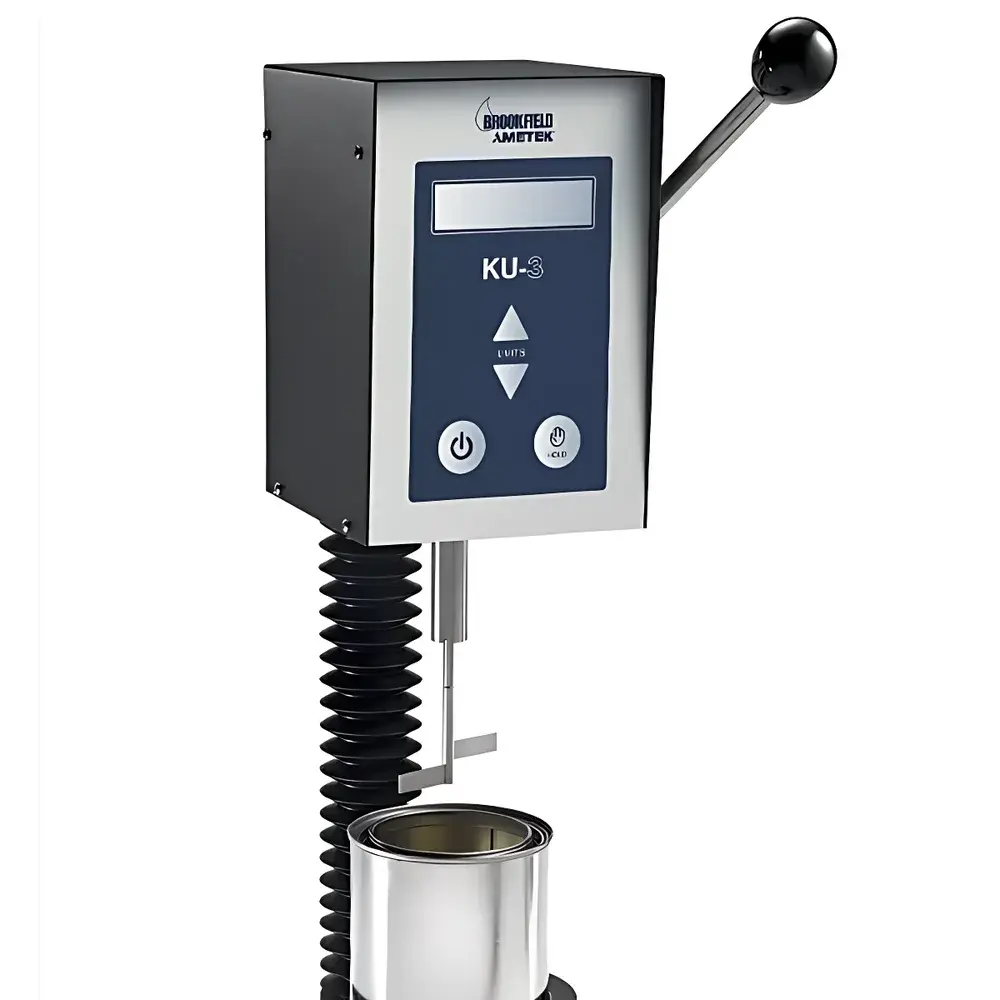
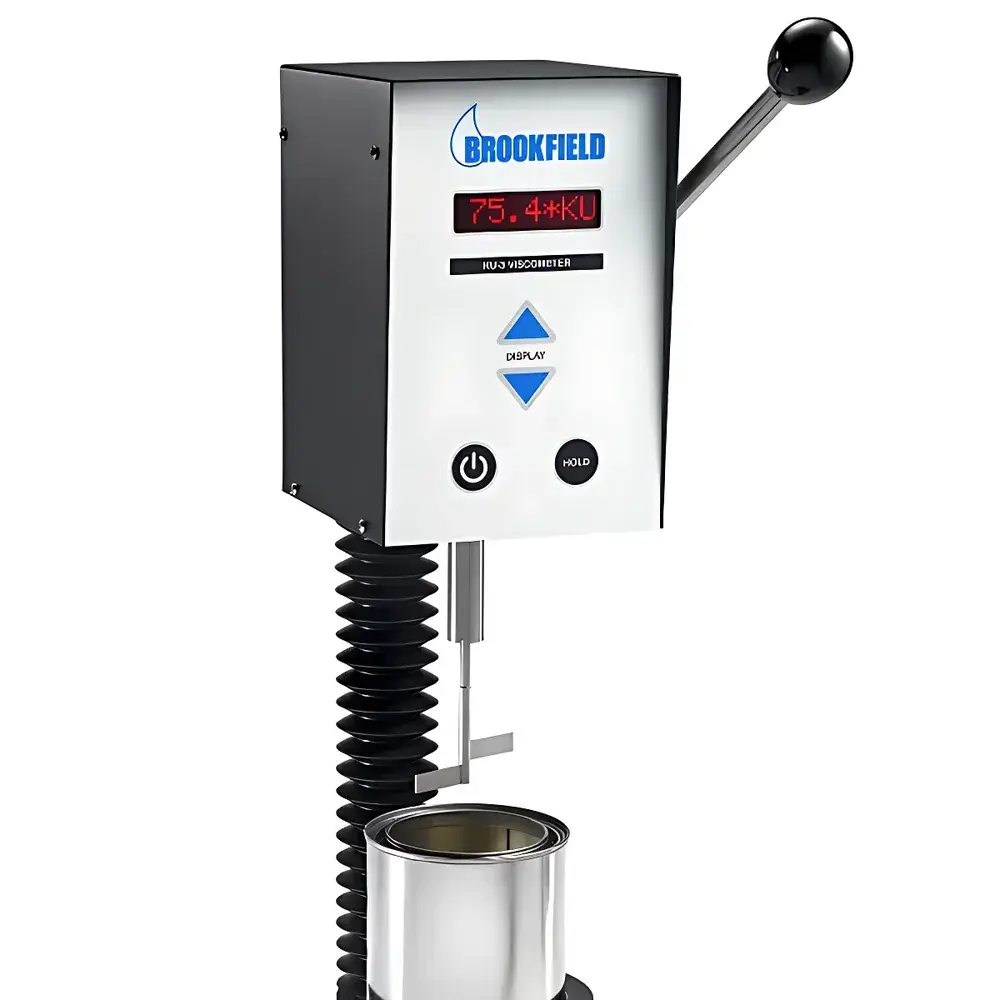
Brookfield KU-3 Krebs Unit Viscometer
| Brand | Brookfield |
|---|---|
| Origin | USA |
| Manufacturer Type | Manufacturer |
| Origin Category | Imported |
| Model | KU-3 |
| Instrument Type | Rotational Viscometer |
| Mounting Style | Benchtop (Fixed) |
| Operating Environment | Ambient Temperature |
| Viscosity Range | 40–141 KU (Krebs Units) |
| Compliance | ASTM D562 |
| Core Component | KU-3 Viscometer Main Unit |
Overview
The Brookfield KU-3 Krebs Unit Viscometer is a precision-engineered benchtop rotational viscometer specifically designed for quality control and R&D laboratories in the coatings, paints, inks, and adhesives industries. It operates on the fundamental principle of torque measurement under controlled rotational shear—applying a defined angular velocity to a standardized Krebs-type paddle rotor immersed in the sample, and quantifying the resistance as torque. This method directly correlates to the empirical Krebs Unit (KU), a widely accepted industry metric for assessing consistency and application behavior of non-Newtonian, moderately viscous dispersions. Unlike gravity-driven or capillary-based systems, the KU-3 delivers repeatable, operator-independent measurements by eliminating manual weight loading and mechanical lever adjustments. Its design adheres strictly to ASTM D562, ensuring data comparability across global manufacturing sites and regulatory submissions.
Key Features
- Magnetic rotor coupling system—enables rapid, tool-free attachment and alignment of the standard KU-1030 Krebs paddle rotor, minimizing setup time and mechanical wear.
- Dual-mode digital display with real-time switching between Krebs Units (KU), grams-force (g), and centipoise (cP)—the latter derived via ASTM D562’s standardized conversion algorithm.
- Integrated HOLD function for result locking and documentation, supporting GLP-compliant data capture during routine QC checks.
- Benchtop-fixed architecture with dedicated sample cup holders for both 1-pint (473 mL) and ½-pint (237 mL) containers—ensuring consistent immersion depth and thermal equilibration per ASTM requirements.
- Calibration traceability supported through factory-certified verification; accuracy ±1.0% of full-scale range, reproducibility ±0.5% under controlled ambient conditions (23 ± 2°C).
- Optional accessories include the KU-1031 paste paddle rotor for higher-yield-stress materials such as mastics and thick gels, extending applicability beyond conventional liquid coatings.
Sample Compatibility & Compliance
The KU-3 accommodates Newtonian and shear-thinning formulations typical of architectural paints, industrial enamels, UV-curable inks, water-based adhesives, and semi-solid pastes. Sample volume requirements are strictly governed by ASTM D562: minimum fill level must cover the rotor blade to a depth of 102 mm ± 2 mm when using standard pint containers. The instrument is not intended for low-viscosity solvents (<40 KU), highly abrasive suspensions, or thermally unstable media requiring temperature-controlled shearing. Regulatory alignment includes full conformance with ASTM D562 for Krebs Unit determination, and its fixed mechanical architecture supports audit readiness for ISO 9001, ISO/IEC 17025, and FDA-regulated environments where instrument qualification (IQ/OQ/PQ) protocols are required.
Software & Data Management
While the KU-3 operates as a standalone instrument without embedded PC connectivity, its analog output signal (0–5 V DC) is compatible with third-party data acquisition systems for automated logging and trending. All displayed parameters—including KU, g, and cP—are stored in volatile memory during active measurement and can be manually transcribed into LIMS or Excel-based QC databases. For laboratories implementing 21 CFR Part 11 compliance, the HOLD function provides timestamped visual confirmation of final values, and optional external USB loggers (e.g., Brookfield’s DV3T-PC interface kit) enable electronic record generation with audit trails, user authentication, and electronic signatures.
Applications
- Batch release testing of architectural and industrial coatings against viscosity specifications.
- Formulation development of waterborne and solvent-borne systems to optimize sag resistance and spray atomization.
- In-process monitoring of pigment dispersion stability during milling and letdown stages.
- Quality assurance of ink rheology for flexographic and gravure printing processes.
- Viscosity benchmarking of caulks, sealants, and construction adhesives prior to extrusion performance validation.
- Supporting ASTM D562-compliant reporting for customer technical data sheets (TDS) and safety data sheets (SDS).
FAQ
What is the difference between Krebs Units (KU) and centipoise (cP) on the KU-3?
KU is an empirical unit defined by ASTM D562, based on torque resistance measured with a specific paddle geometry at fixed speed. cP values shown on the display are mathematically derived from KU readings using the standard ASTM conversion equation—not measured directly. They serve as a reference only and are not substitutes for true rotational cP measurements obtained with spindle-based viscometers.
Can the KU-3 measure temperature-dependent viscosity?
No—the KU-3 operates exclusively at ambient temperature and lacks integrated Peltier or jacketed bath control. For temperature-sensitive characterization, users must precondition samples externally and verify thermal stability prior to measurement.
Is calibration required before each use?
Daily verification using a certified reference fluid or geometrically verified empty cup is recommended per ASTM D562 Section 8. Full recalibration is performed annually or after mechanical service, using Brookfield’s NIST-traceable calibration standards.
Does the KU-3 comply with FDA 21 CFR Part 11?
The base instrument does not include electronic signature or audit trail functionality. However, when paired with Brookfield’s compliant PC interface and validated software (e.g., Rheo3000 v5.2), it supports Part 11 requirements for electronic records and signatures in regulated pharmaceutical or medical device coating applications.



