
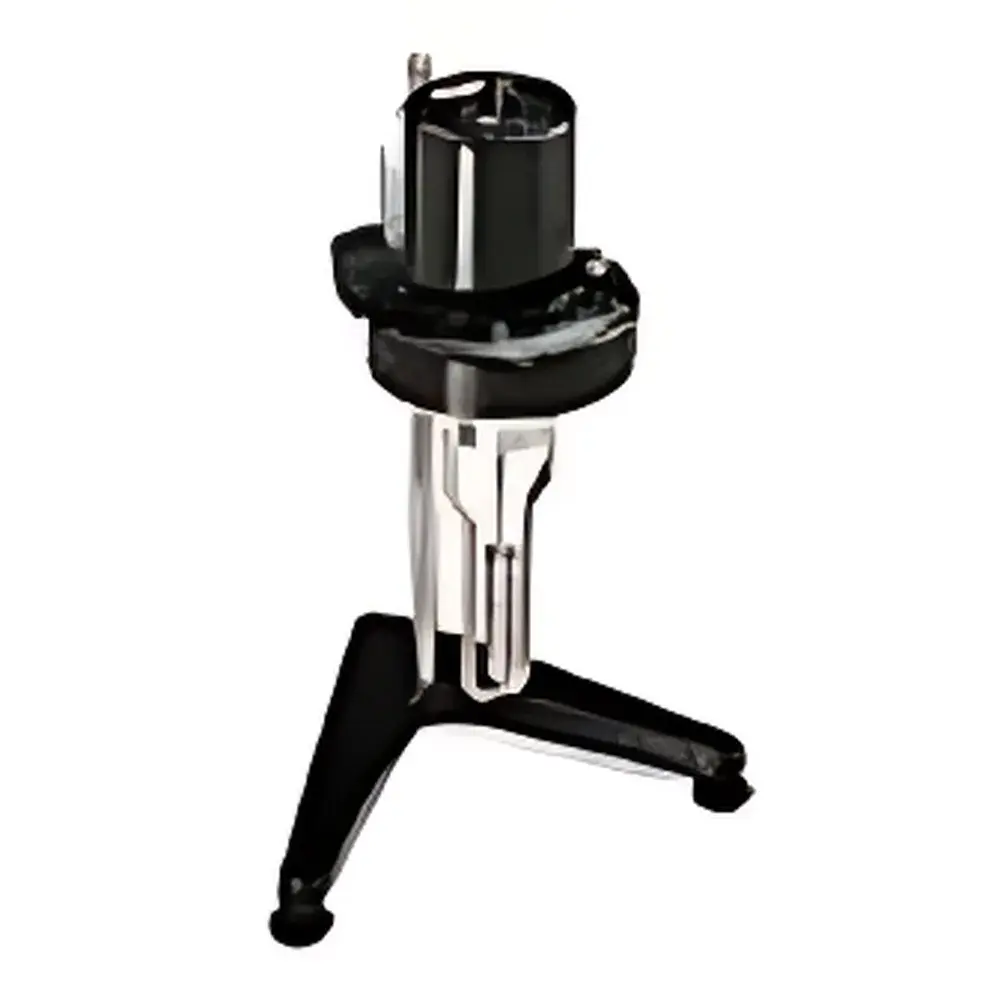
Brookfield LVT/RVT/HAT/HBT Dial-Reading Rotational Viscometers
| Brand | Brookfield |
|---|---|
| Origin | USA |
| Model | LVT/RVT/HAT/HBT |
| Instrument Type | Analog Dial-Reading Rotational Viscometer |
| Mounting Style | Benchtop Fixed Configuration |
| Operating Environment | Ambient Temperature (15–30°C) |
| Viscosity Range (cP) | LVT: 1–2M |
| RVT | 100–10M |
| HAT | 200–16M |
| HBT | 800–64M |
| Minimum Measurable Viscosity | 0.3 cP (LVT, with UL adapter) |
| Speed Range | 0.3–100 RPM (6–10 programmable speeds depending on model) |
| Spindle Count | 4 (LVT), 6 (RVT/HAT), 6 (HBT) |
| Accuracy | ±1% of full-scale reading |
| Repeatability | ±0.2% of reading |
| Compliance | Designed for ASTM D2196, ISO 2555, ISO 3219, and USP <911> viscosity testing protocols |
Overview
The Brookfield LVT/RVT/HAT/HBT series represents the foundational analog dial-reading rotational viscometers engineered for precision, reliability, and long-term operational stability in routine quality control and R&D laboratories. These instruments operate on the principle of Couette flow: torque generated by a rotating spindle immersed in a fluid is directly proportional to the fluid’s dynamic viscosity. The mechanical analog dial display provides immediate, drift-free % torque indication—calibrated to centipoise (cP) or millipascal-seconds (mPa·s) via standardized spindle/speed combinations. Unlike digital systems requiring firmware updates or software calibration, the LVT/RVT/HAT/HBT architecture relies on a robust, gear-driven synchronous motor and precision-machined torsion spring mechanism—ensuring consistent performance across decades of use without recalibration drift. Designed for ambient-temperature operation (15–30°C), these viscometers are widely deployed in regulated environments where auditability, simplicity, and mechanical traceability are prioritized over automated data logging.
Key Features
- True analog torque measurement system with direct-dial % torque readout—no electronics, no battery dependency, no software latency
- Selectable spindle configurations: LVT (4 spindles), RVT/HAT (6 spindles), HBT (6 spindles); all fully interchangeable across the LVT/RVT/HAT/HBT platform
- Standard speed ranges from 0.3 to 100 RPM (6 or 10 discrete speeds per model), enabling precise shear rate selection for Newtonian and non-Newtonian characterization
- Optional UL Class 1, Group D explosion-proof configuration available (motorless version) for solvent-handling areas compliant with NEC Article 500
- High mechanical repeatability (±0.2% of reading) and accuracy (±1% of full-scale range) validated per ASTM D2196 Annex A2
- Modular accessory compatibility—including UL adapters (for sub-1 cP measurements), small-sample adapters, thermosel jackets, and custom fixtures for non-standard containers
- Integrated A-frame stand with leveling feet and protective foot (excluded on HA/HB models due to high-torque structural requirements)
Sample Compatibility & Compliance
The LVT/RVT/HAT/HBT series accommodates a broad spectrum of sample geometries and rheological behaviors—from low-viscosity solvents (e.g., acetone, ethanol, aqueous buffers) to highly structured pastes (e.g., epoxy gels, roofing mastics, chocolate mass). Each model targets defined viscosity windows: LVT (0.3–2 × 10⁶ cP), RVT (100–10 × 10⁶ cP), HAT (200–16 × 10⁶ cP), and HBT (800–64 × 10⁶ cP). All units comply with ISO 2555 (aqueous polymer solutions), ISO 3219 (rheologically complex fluids), and USP (pharmaceutical viscosity standards). When operated with documented spindle/speed pairs and calibrated against NIST-traceable standard oils (e.g., Cannon-Manning series), data meets GLP/GMP documentation requirements for batch release testing in food, cosmetics, and pharmaceutical manufacturing. No electronic data capture is required—manual logbook entries paired with instrument ID, spindle number, speed, temperature, and observed % torque satisfy FDA 21 CFR Part 11 predicate rules for paper-based records.
Software & Data Management
As purely electromechanical instruments, the LVT/RVT/HAT/HBT viscometers do not incorporate embedded processors, USB ports, or wireless interfaces. Data acquisition follows manual transcription protocols: operators record % torque, selected speed, spindle ID, and ambient bath temperature into laboratory notebooks or LIMS-integrated spreadsheets. For labs requiring digital integration, Brookfield’s optional DV2T-Viscometer Controller (sold separately) can be retrofitted to drive the motor and digitize torque output—but this modifies the native analog architecture and voids the intrinsic “zero-software” compliance advantage. All models include a comprehensive calibration certificate referencing ASTM E29 rounding rules and uncertainty budgets derived from spindle geometry tolerances (±0.5% dimensional tolerance) and speed encoder resolution (±0.1 RPM).
Applications
- LV-series: Solvent-based adhesives, latex emulsions, biofluids (serum, synovial fluid), light mineral oils, cosmetic lotions, pharmaceutical suspensions, photoresists, molten waxes, dilute polymer solutions, inkjet inks, fruit juices
- RV-series: Hot-melt adhesives, architectural paints, asphalt binders (SHRP PG grading), paper coatings, ceramic slips, starch slurries, food pastes (ketchup, mustard), surface coatings, resin systems, toothpaste, screen-printing inks
- HA/HB-series: Roofing bitumens, caulking compounds, peanut butter, chocolate, plaster, epoxy putties, sealants, gravure inks, SMC/BMC molding compounds, molasses, coal tar pitch, heavy greases
FAQ
Can the LVT/RVT/HAT/HBT viscometers be used for non-Newtonian fluid characterization?
Yes—by conducting multi-speed sweeps at fixed temperature and calculating apparent viscosity (cP = k × %Torque / RPM), users generate flow curves compliant with ASTM D2196 Section 7.
Is temperature control integrated?
No—these are ambient-temperature instruments. External circulation baths (e.g., Julabo F25) or Brookfield TC-550 thermal jackets must be used for controlled-temperature testing.
What is the minimum sample volume required?
Standard spindles require ≥400 mL in a 600-mL Griffin beaker; UL adapters reduce volume to 2–16 mL depending on spindle geometry.
Are calibration standards included?
No—NIST-traceable viscosity standards (e.g., Cannon SRM oils) must be purchased separately and verified annually per ISO/IEC 17025 requirements.
Can data be exported to LIMS?
Only via manual entry or third-party digitization hardware; no native CSV or XML export capability exists in the analog design.



