
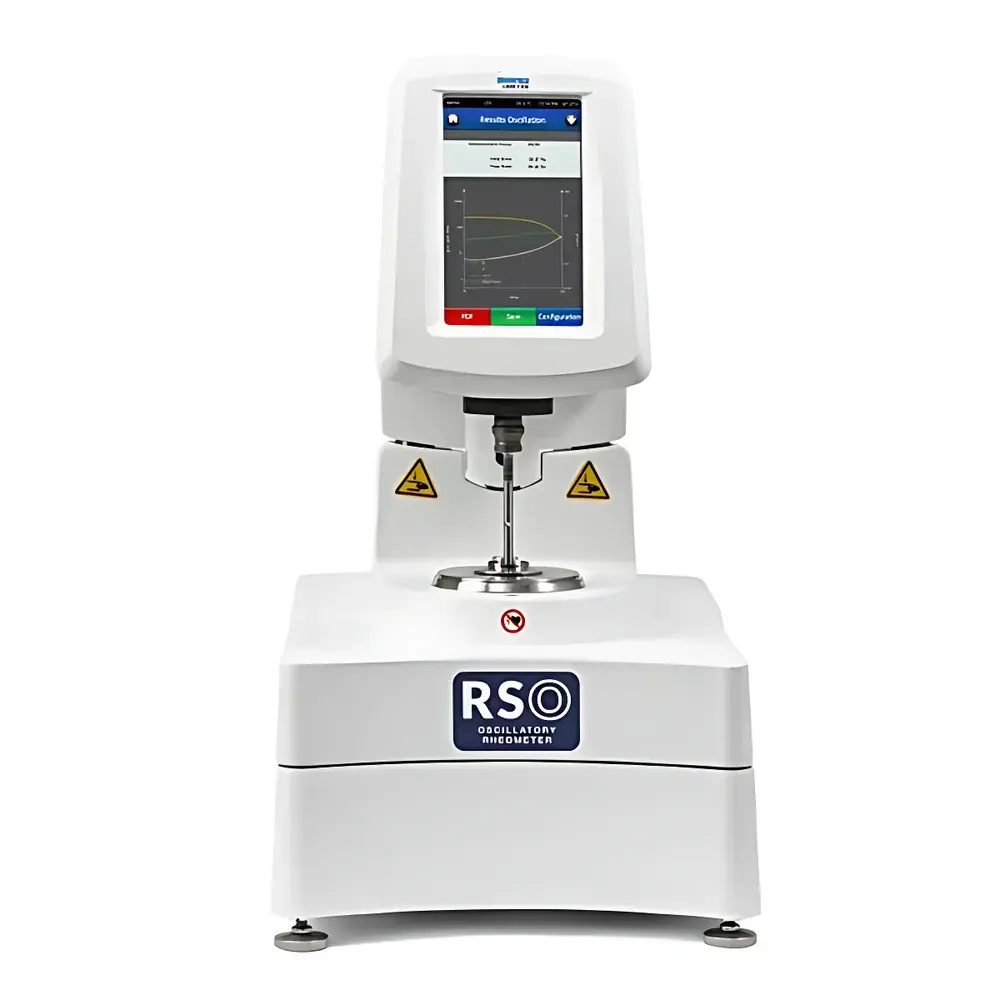
Brookfield RSO Oscillatory Rheometer
| Brand | Brookfield |
|---|---|
| Origin | USA |
| Manufacturer Type | Authorized Distributor |
| Origin Category | Imported |
| Model | RSO |
| Price | Upon Request |
Overview
The Brookfield RSO Oscillatory Rheometer is a high-precision, air-bearing–based rotational rheometer engineered for advanced viscoelastic characterization of complex fluids and soft solids. Operating on the principle of controlled-strain and controlled-stress oscillatory testing, the RSO implements Couette and cone-and-plate geometries to quantify dynamic moduli (G′, G″), complex viscosity (η*), phase angle (δ), and yield behavior across wide frequency (0.001–20 Hz) and temperature (0–180 °C) ranges. Its design adheres to fundamental rheological standards including ASTM D4402, ISO 6721-10, and ISO 3219, supporting method development and validation in QC, R&D, and regulatory environments where reproducibility and traceability are critical.
Key Features
- Air-bearing torque sensor with ultra-low minimum torque (5 µN·m) and high dynamic range (up to 100 mN·m), delivering exceptional sensitivity for weak gel structures and low-viscosity dispersions.
- Torque resolution of 0.02 µN·m and angular deformation resolution of 1.25 µrad enable precise quantification of linear viscoelastic region (LVR) boundaries and subtle structural transitions.
- Wide rotational speed range (0.001–1500 rpm) and oscillatory frequency range (0.001 Hz to 20 Hz / 0.006–126 rad/s) support both steady-shear flow curves and time-resolved small-amplitude oscillatory shear (SAOS) sweeps.
- Integrated Peltier or water-jacketed temperature control enables rapid, stable thermal ramping (±0.1 °C accuracy) — essential for constructing Arrhenius plots, WLF modeling, and temperature-dependent yield stress analysis.
- Automatic rotor identification via embedded barcode scanning eliminates manual geometry input errors and ensures correct parameter mapping during method recall.
- Motorized gap adjustment system provides repeatable, operator-independent sample loading — reducing variability in cone-and-plate and parallel-plate configurations.
- 10.1-inch capacitive touchscreen interface supports standalone operation with real-time graphing, live parameter monitoring, and on-device method storage — ideal for routine QC workflows under GLP/GMP conditions.
Sample Compatibility & Compliance
The RSO accommodates diverse sample types including polymer melts, emulsions, suspensions, gels, pastes, and biological macromolecular solutions. Its minimal sample volume requirement (as low as 0.1 mL for cone-and-plate, ~2 mL for concentric cylinder) reduces material consumption and accelerates cleaning cycles. Geometry interchangeability allows seamless switching between cone-and-plate (standard 25 mm, 40 mm, 60 mm options), parallel-plate, and concentric cylinder systems without recalibration. All hardware and firmware comply with IEC 61000-6-3 (EMC) and IEC 61010-1 (safety). When paired with Rheo3000 software, audit trails, electronic signatures, and 21 CFR Part 11–compliant data handling are fully supported.
Software & Data Management
The optional Rheo3000 software provides comprehensive instrument control, automated test sequencing, multi-file comparative analysis, and export-ready reporting (PDF, CSV, XML). It includes built-in models for Cox-Merz equivalence, time-temperature superposition (TTS), and van Gurp–Palmen plots. Data integrity safeguards include timestamped method logs, user access levels, and encrypted database storage. Export formats conform to ASTM E1447 and ISO/IEC 17025 documentation requirements, facilitating integration into LIMS and enterprise QA systems.
Applications
- Determining yield stress and thixotropic recovery kinetics in coatings and inks
- Characterizing temperature-dependent gelation and melting behavior of food hydrocolloids (e.g., carrageenan, pectin)
- Evaluating structural stability of pharmaceutical suspensions and topical gels under shear and thermal stress
- Mapping linear viscoelasticity of thermoplastic elastomers and polymer melts for extrusion and injection molding process modeling
- Validating shelf-life performance of cosmetic emulsions using frequency sweep and creep-recovery protocols
FAQ
What sample geometries are supported on the RSO?
Cone-and-plate, parallel-plate, and concentric cylinder systems are all compatible; geometry changes require no recalibration due to automatic recognition and motorized gap control.
Is the RSO suitable for FDA-regulated environments?
Yes — when used with Rheo3000 software, it supports full 21 CFR Part 11 compliance, including electronic signatures, audit trails, and role-based access control.
Can the RSO perform both oscillatory and steady-shear tests?
Yes — it delivers true hybrid capability: SAOS, LAOS, creep/recovery, flow ramps, and hysteresis loops within a single platform.
What is the typical thermal equilibration time using the Peltier module?
From 25 °C to 80 °C: ≤3 minutes; from 25 °C to 150 °C: ≤8 minutes (depending on geometry and sample thermal mass).
Does the RSO require external PC for basic operation?
No — all core measurements and real-time visualization are fully functional via the integrated touchscreen in standalone mode.



