
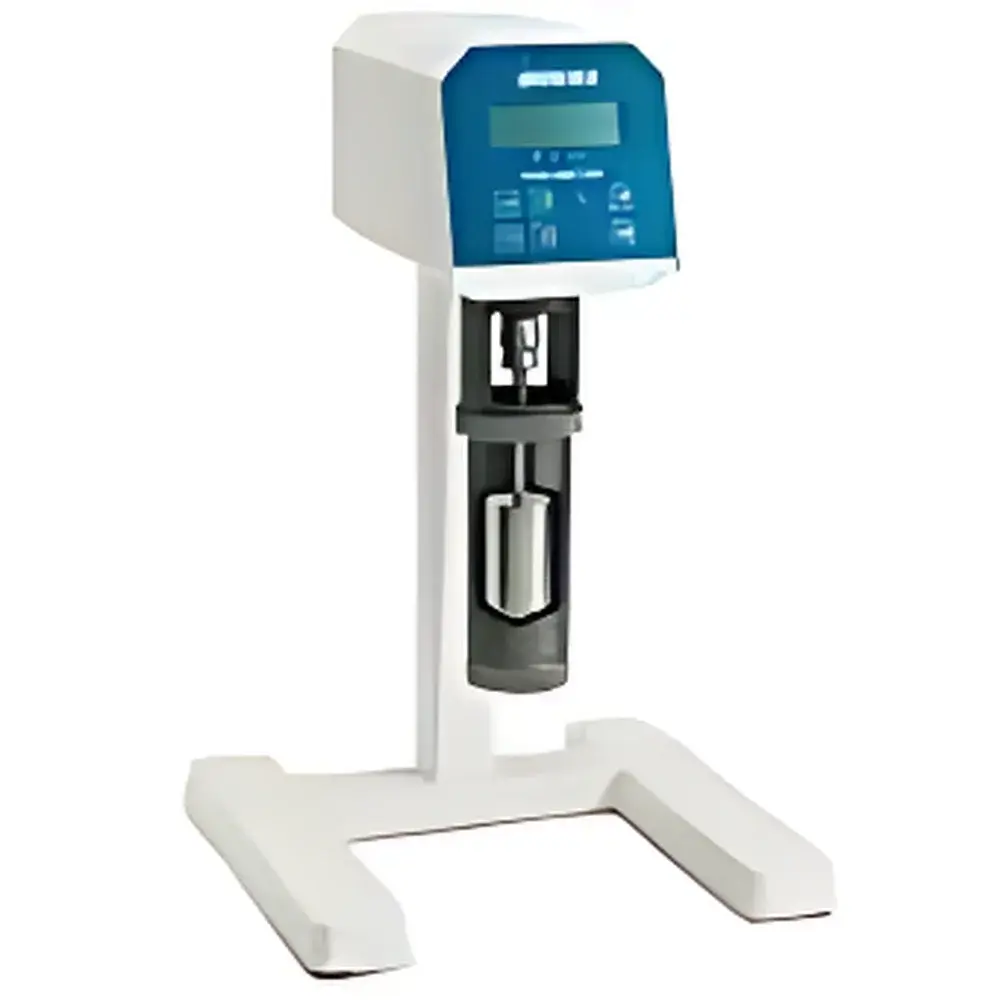
Brookfield RST-CC Controlled-Stress Touchscreen Rheometer
| Brand | Brookfield |
|---|---|
| Origin | USA |
| Model | RST-CC |
| Instrument Type | Controlled-Stress Rotational Rheometer |
| Minimum Rotational Speed | 0.00005 rpm |
| Maximum Rotational Speed | 5.41 rpm (RST-CC) / 1.3 rpm (M0.01–1.3K variant) |
| Torque Range | 0.01–130 mN·m (typical for RST-CC platform) |
| Angular Resolution | < 0.001° |
| Temperature Control Options | Immersion water bath, External recirculating chiller, FTK jacketed geometry support |
| Compliance | ASTM D2196, ISO 3219, ISO 6721-10, USP <911> |
Overview
The Brookfield RST-CC is a high-precision, controlled-stress rotational rheometer engineered for fundamental and applied rheological characterization of complex fluids and soft solids. Utilizing Couette or cone-and-plate geometries, it operates on the principle of torque-controlled deformation to quantify shear stress, shear rate, viscosity, yield stress, viscoelastic moduli (G′, G″), and time-dependent behavior—including thixotropy, creep, recovery, and oscillatory response. Designed for laboratory and pilot-scale environments, the RST-CC delivers reproducible measurements across an exceptionally wide dynamic range: from ultra-low shear rates (as low as 0.00005 rpm, equivalent to ~10⁻⁶ s⁻¹) to moderate rotational speeds, enabling accurate capture of material yielding, structural breakdown, and flow curve development. Its integrated touchscreen interface eliminates dependency on external PCs during routine operation while retaining full compatibility with advanced software for method automation and regulatory-compliant data handling.
Key Features
- Intuitive 7-inch capacitive touchscreen interface with real-time graphical display of torque, stress, strain, and viscosity—enabling immediate assessment without external hardware.
- True controlled-stress architecture with high-resolution motor and optical encoder, ensuring precise application of defined shear stresses (0.01–130 mN·m) and measurement of resulting deformation.
- Quick-connect geometry system supporting standard cone-and-plate, parallel-plate, and concentric cylinder configurations; tool-free mounting minimizes alignment error and reduces setup time.
- Robust mechanical design with rigid base and vibration-damped frame, validated for stable operation in non-laboratory settings including QC labs adjacent to production lines.
- Low sample volume requirement (as little as 0.5 mL with 25 mm cone geometry), reducing material cost and facilitating testing of high-value or limited-availability formulations.
- Integrated temperature management pathways compatible with multiple thermal control strategies: direct immersion baths, Peltier-based plates (optional), and FTK fluid-jacketed geometries for precise ±0.1 °C stability.
Sample Compatibility & Compliance
The RST-CC accommodates diverse sample classes—including polymer melts, suspensions, gels, pastes, emulsions, pharmaceutical ointments, food matrices, and cementitious slurries—without requiring dilution or pre-conditioning. Geometries are selected based on expected yield behavior and viscosity range: narrow-gap cones for high-shear applications; wide-gap cylinders for heterogeneous or particle-laden systems. The instrument supports compliance with internationally recognized standards: ASTM D2196 (non-Newtonian fluid viscosity), ISO 3219 (rheological terms and definitions), ISO 6721-10 (dynamic mechanical properties), and USP (rheological characterization of semisolid dosage forms). When operated with compliant software and audit-trail-enabled configuration, it meets GLP and GMP documentation requirements per FDA 21 CFR Part 11 for regulated pharmaceutical and biotech environments.
Software & Data Management
The RST-CC is fully interoperable with Brookfield’s Rheo3000 software suite, which provides method scripting, multi-step test protocols (e.g., ramped stress, frequency sweeps, amplitude sweeps), automated yield point detection, and linear viscoelastic region (LVR) identification. Data export options include CSV, Excel, and XML formats, with embedded metadata (operator ID, timestamp, geometry calibration ID, environmental conditions). Software modules support 21 CFR Part 11 compliance through electronic signatures, role-based access control, and immutable audit trails. All raw sensor data—including torque, angle, temperature, and motor current—is retained at native acquisition resolution (up to 100 Hz sampling) for retrospective reanalysis.
Applications
- Yield stress quantification in drilling muds, toothpastes, and cosmetic creams using controlled-stress up-ramp tests.
- Structural recovery kinetics of thixotropic paints and adhesives via step-strain and intermittent oscillation protocols.
- Quality control of polymer melts during extrusion process development, correlating melt elasticity (tan δ, G′/G″ crossover) with die swell behavior.
- Rheological profiling of injectable hydrogels under physiological temperature and shear conditions to assess syringeability and depot formation.
- Stability assessment of protein suspensions and nanoparticle colloids via time-sweep and frequency-sweep measurements at low amplitudes.
- Validation of formulation robustness across temperature gradients (e.g., 5–40 °C) using programmable thermal ramps synchronized with rheological interrogation.
FAQ
What distinguishes the RST-CC from torque-controlled versus speed-controlled rheometers?
The RST-CC applies a defined shear stress and measures the resulting angular displacement—ideal for characterizing yield behavior, weak gel structures, and materials exhibiting significant normal forces. In contrast, speed-controlled instruments impose rotation and measure resistance, limiting accuracy near zero-shear conditions.
Can the RST-CC perform oscillatory measurements?
Yes—its controlled-stress architecture enables both amplitude sweeps (to determine LVR) and frequency sweeps (to assess viscoelastic spectra), provided appropriate geometry and temperature control are employed.
Is calibration traceable to NIST standards?
All factory calibrations are performed using Brookfield-certified reference oils and torque standards traceable to NIST-accredited laboratories; certificate of calibration is supplied with each instrument.
How is data integrity ensured during long-duration tests (e.g., 24+ hours)?
The embedded firmware includes automatic data buffering, power-loss recovery, and timestamp synchronization with network time protocol (NTP) servers when connected to enterprise networks.
Does the RST-CC support third-party automation integration?
Yes—via RS-232, USB, and Ethernet interfaces, it accepts SCPI commands and exposes a COM API for integration into LIMS, MES, or robotic sample-handling platforms.



