
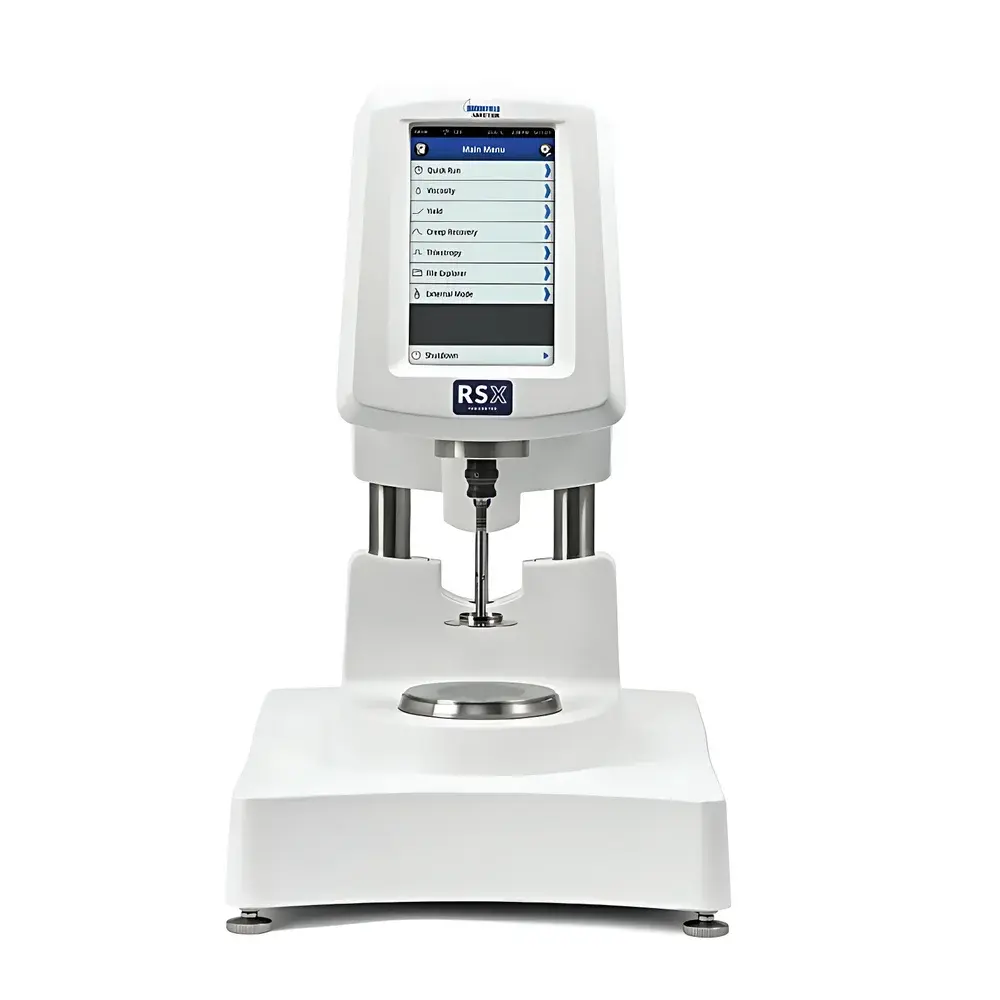
Brookfield RSX Advanced Rotational Rheometer
| Brand | Brookfield |
|---|---|
| Origin | USA |
| Manufacturer Type | Original Equipment Manufacturer (OEM) |
| Origin Category | Imported |
| Model | RSX |
| Instrument Type | Rotational Rheometer |
| Sample Type | Low-Viscosity Fluids |
| Sample State | Liquid |
| Bearing Type | Mechanical Bearing |
| Minimum Speed | 0.01 RPM |
| Maximum Speed | 1300 RPM |
| Maximum Torque | 200 mNm |
| Torque Resolution | 1.2 µNm |
Overview
The Brookfield RSX Advanced Rotational Rheometer is an engineered solution for precise, reproducible rheological characterization of low-viscosity liquid materials under controlled shear conditions. Based on Couette flow geometry and torque-controlled rotational measurement principles, the RSX delivers high-fidelity data across a wide dynamic range—from yield stress onset through steady-state flow curves and transient response analysis. Its modular architecture supports both controlled shear rate (CSR) and controlled shear stress (CSS) operation modes, enabling rigorous evaluation of structural breakdown, thixotropy, viscoelastic recovery, and time-dependent deformation behavior. Designed for integration into R&D laboratories, QC environments, and production-floor testing stations, the RSX maintains metrological integrity while delivering operational robustness in non-climate-controlled industrial settings.
Key Features
- True dual-mode operation: programmable shear rate or shear stress control with real-time feedback loop adjustment
- High-resolution torque transduction system (1.2 µNm resolution) coupled with mechanical bearing design for long-term stability and minimal drift
- Intuitive 7-inch capacitive touchscreen interface with graphical real-time curve display—enabling full stand-alone operation without external PC
- Quick-connect rotor system with integrated barcode recognition: automatic identification and parameter loading for CC, SST, and paddle geometries
- Motorized lift column (standard on CC/SST configurations) ensures repeatable sample gap setting and precise immersion depth control
- Minimal sample volume requirement (as low as 0.5 mL for SST geometry), reducing material consumption and accelerating cleaning cycles
- Rotor-agnostic auto-immersion protocol: dynamically positions paddle rotors to optimal depth without disturbing sample microstructure
- Modular thermal management options—including Peltier-based semiconductor temperature control units (TCU) and circulating bath compatibility (e.g., FTKY3 jacketed cup systems)
Sample Compatibility & Compliance
The RSX is optimized for Newtonian and non-Newtonian low-viscosity liquids, including aqueous dispersions, polymer solutions, pharmaceutical suspensions, food emulsions, ink formulations, and light hydrocarbon fractions. It complies with core international test method frameworks, supporting method development aligned with ASTM D2196 (viscosity of paints), ISO 2555 (solution viscosity), USP (rheological properties of semisolid dosage forms), and ISO 3219 (rotational viscometry). All firmware and hardware configurations meet GLP/GMP documentation requirements, including audit-trail-enabled user authentication, electronic signature support, and configurable data retention policies per 21 CFR Part 11 guidelines when used with Rheo3000 software.
Software & Data Management
The optional Rheo3000 PC-based software suite provides comprehensive instrument control, multi-file experiment sequencing, and advanced post-processing capabilities—including yield stress modeling (Casson, Herschel-Bulkley), thixotropic loop quantification (area ratio, structural recovery rate), and time sweep trend analysis. Data export conforms to ASTM E1447-compliant CSV formats and includes metadata tagging for traceability (operator ID, timestamp, environmental conditions, calibration history). Batch reporting templates support automated generation of summary tables and comparative plots across multiple lots or formulations. Software validation packages are available for regulated environments requiring IQ/OQ/PQ documentation.
Applications
The RSX serves critical quality and development functions across diverse sectors:
- Adhesives & Sealants: characterization of open-time, tack development, and cohesive failure thresholds
- Biofuels & Biomass Liquids: viscosity-temperature profiling of biodiesel blends and pyrolysis oils
- Foods & Beverages: texture mapping of dairy alternatives, plant-based creams, and low-sugar syrups
- Pharmaceuticals: suspension stability assessment, injectable vehicle rheology, and topical gel consistency verification
- Coatings & Inks: anti-settling performance prediction, roller spatter resistance, and spray atomization modeling
- Petroleum Products: cold-flow improver efficacy testing and lubricant base stock screening
- Construction Materials: rheology-driven optimization of gypsum slurries and lightweight cementitious grouts
FAQ
What sample volumes are required for different geometries?
For concentric cylinder (CC) measurements, typical sample volume is 15–20 mL; for spiral (SST) and paddle geometries, volumes range from 0.5 mL to 3 mL depending on cup size and immersion depth.
Is the RSX compatible with ASTM D445 or ISO 3104 standard kinematic viscosity protocols?
No—the RSX performs dynamic (rotational) rheometry, not capillary-based kinematic viscosity measurement. However, it supports shear-rate-dependent apparent viscosity reporting aligned with ASTM D2196 Annex A1.
Can the RSX perform oscillatory tests such as amplitude sweeps or frequency sweeps?
No—oscillatory capability is not supported on the RSX platform. For small-amplitude oscillatory shear (SAOS), users should consider the Brookfield AMVn or DVNext series with parallel-plate or cone-plate accessories.
Does the RSX support automated calibration verification?
Yes—Rheo3000 software includes guided calibration routines using certified Brookfield viscosity standards (NIST-traceable oils), with pass/fail criteria logged to audit trail.
What is the maximum operating temperature with the FTKY3 water bath jacket?
When paired with a compatible external circulator, the FTKY3 jacket enables temperature control from 5 °C to 80 °C with ±0.1 °C stability over 30-minute dwell periods.
Related Products



