
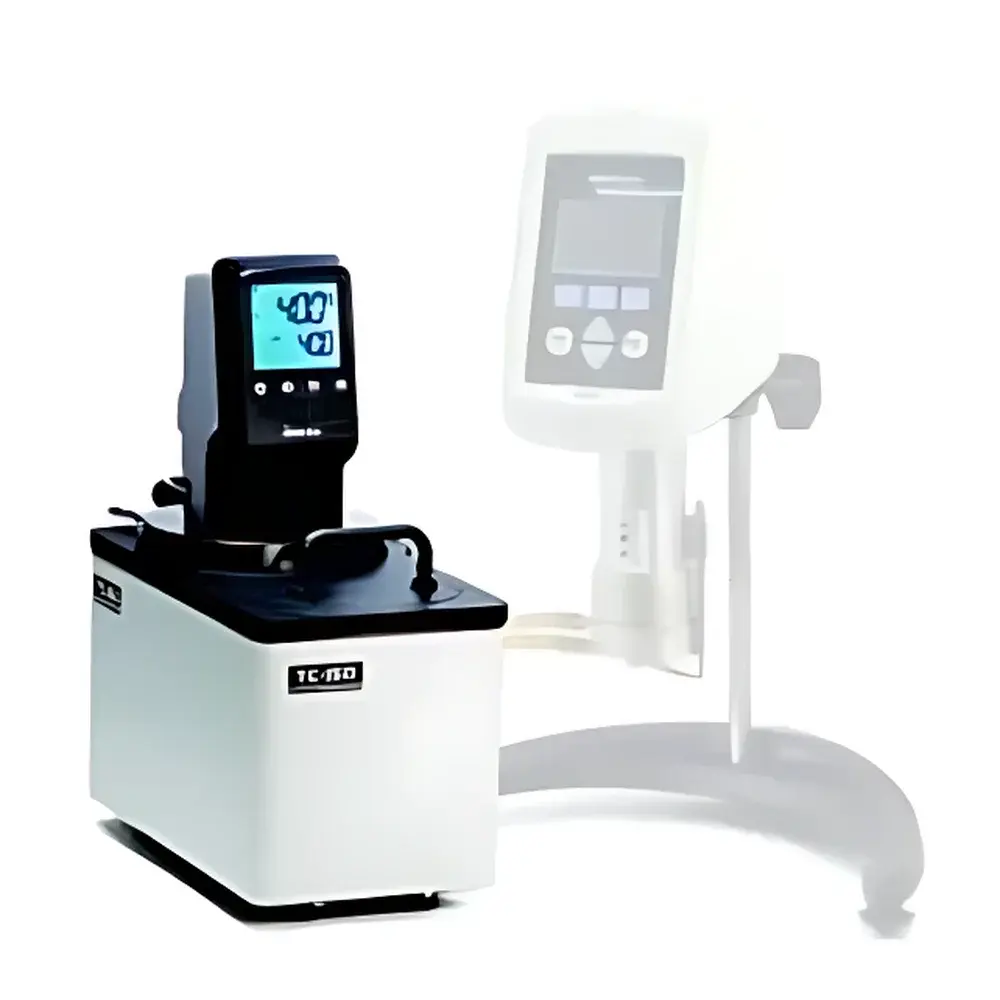
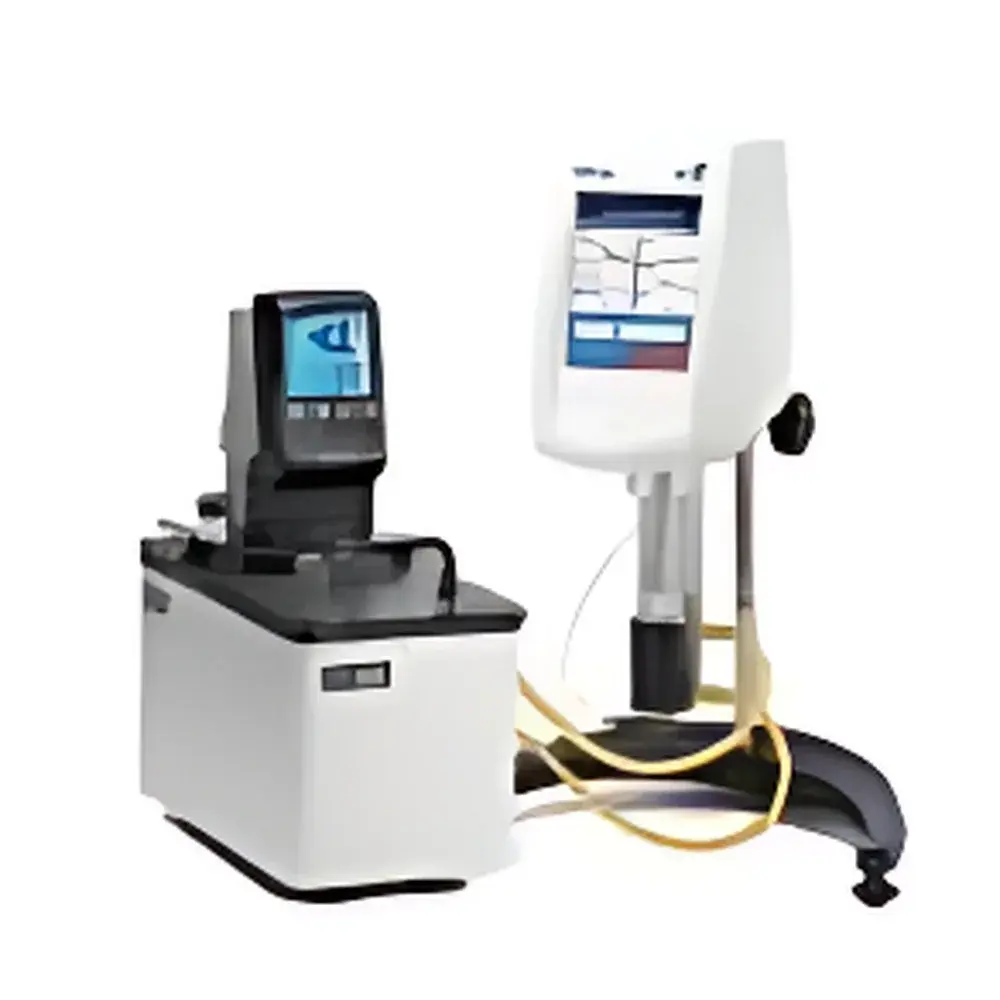
Brookfield TC Series Precision Temperature-Controlled Circulating Baths
| Brand | Brookfield |
|---|---|
| Origin | USA |
| Controller Options | AP (touchscreen), SD (LCD scroll), MX (basic LCD) |
| Bath Types | Refrigerated (TC-650/TC-550) and Tap-Water-Cooled (TC-250/TC-150) |
| Reservoir Capacity | 6 L (TC-150), 10 L (TC-250), 7 L (TC-550/TC-650) |
| Temperature Range | −20 °C to +200 °C (refrigerated models) |
| Temperature Stability | ±0.01 °C (AP), ±0.04 °C (SD), ±0.07 °C (MX) |
| Pump Configuration | Variable-speed (AP), dual-speed (SD), single-speed (MX) |
| Max Flow Rate | 12–16 L/min |
| Internal Work Area (D×W×H, in) | 4.5×4.0×6.0 (TC-150) to 6.18×5.59×5.0 (TC-550/TC-650) |
| Compliance | Designed for integration with Brookfield rheometers (DV2T/DV3T/DVNext), cone-plate viscometers (Wells-Brookfield), R/S-CC & R/S-CPS rheometers, SSA, ULA, and DIN adapters |
Overview
The Brookfield TC Series Precision Temperature-Controlled Circulating Baths are engineered to deliver thermally stable, reproducible environments for viscosity and rheological measurements under controlled thermal conditions. These baths operate on a closed-loop circulation principle, utilizing either integrated refrigeration (TC-650/TC-550) or external tap-water cooling (TC-250/TC-150) to maintain setpoint temperatures across wide operational ranges—from sub-zero (−20 °C) to high-temperature (up to +200 °C) regimes. Each model integrates seamlessly with Brookfield rotational rheometers and viscometers—including DVNext, DV2T, DV3T, R/S-CC, R/S-CPS, and cone-plate systems—ensuring thermal uniformity at the sample interface during dynamic shear or steady-state flow experiments. The TC series is not a standalone heating bath; it is a metrologically traceable thermal management subsystem designed specifically for analytical instrumentation requiring ISO/IEC 17025-compliant temperature control in QC laboratories, R&D facilities, and GLP-regulated environments.
Key Features
- Three controller tiers: AP-series with full-color touchscreen, programmable via RheocalcT software or local interface; SD-series offering cost-optimized LCD-based control with dual pump speeds and scroll navigation; MX-series providing essential functionality with large-character display and single-speed pumping.
- Refrigerated models (TC-650/TC-550) achieve −20 °C minimum without external chiller dependency, using proprietary compressor-based cooling architecture compatible with glycol/water mixtures and high-temp heat-transfer fluids (e.g., TC-Fluid 3/4).
- Tap-water-cooled variants (TC-250/TC-150) support ambient +10 °C to +150 °C operation, enabling rapid thermal ramping while minimizing utility infrastructure requirements.
- Internal recirculation ensures laminar flow profiles within the reservoir, minimizing thermal gradients and supporting ASTM D2196 and ISO 3219 compliance for viscosity testing protocols.
- All units feature precision platinum RTD sensors, PID-controlled heating/cooling algorithms, and real-time digital readouts calibrated per NIST-traceable procedures.
- Modular accessory compatibility includes TC-351 auxiliary refrigeration units, PVS-152 high-temp thermal fluid, TC-Fluid 5 for low-evaporation cryogenic operation, and VS-CRA-18S vertical extension stands for elevated sample positioning.
Sample Compatibility & Compliance
The TC Series is validated for use with Brookfield’s full portfolio of rotational measurement systems: Wells-Brookfield cone-plate viscometers, R/S-CC concentric cylinder rheometers, R/S-CPS parallel-plate rheometers, Small Sample Adapters (SSA), Ultra-Low Viscosity Adapters (ULA), and DIN adapter kits. Its internal work dimensions accommodate standard geometry fixtures while maintaining clearance for torque sensor calibration and spindle immersion depth verification. Temperature stability specifications (±0.01 °C for AP controllers) meet USP requirements for viscosity apparatus qualification and align with FDA 21 CFR Part 11 data integrity expectations when paired with RheocalcT software audit trails. Bath fluid selection follows ISO 17025 Clause 6.4 guidelines—TC-Fluid 2 (−20 °C to +100 °C), TC-Fluid 3 (+50 °C to +150 °C), and TC-Fluid 4 (+100 °C to +200 °C) are formulated for oxidative stability, low vapor pressure, and minimal thermal drift over extended dwell times.
Software & Data Management
RheocalcT software serves as the primary interface for remote programming, real-time monitoring, and automated method execution across all TC models equipped with AP or SD controllers. It supports multi-step temperature ramps, hold durations, and synchronized acquisition triggers with Brookfield rheometers—enabling full compliance with GLP documentation standards. Audit trail functionality records operator ID, timestamp, parameter changes, and calibration events in encrypted binary logs exportable as CSV or PDF. The AP controller’s onboard memory retains up to 100 user-defined programs, each with independent setpoint, ramp rate, and dwell parameters. All controller firmware updates are distributed via Brookfield’s secure customer portal and undergo IEC 62304 Class B medical device software validation protocols.
Applications
- Temperature-dependent viscosity profiling of polymers, resins, and coatings per ASTM D1084 and ISO 2555.
- Rheological characterization of pharmaceutical suspensions and ointments across storage and administration temperature ranges (2 °C–8 °C, 25 °C/60% RH, 40 °C/75% RH).
- Thermal stability assessment of lubricants, greases, and functional fluids under shear (ASTM D2983, ISO 6743-9).
- Calibration verification of rotational viscometers per ISO/IEC 17025 Clause 6.5.2, including repeatability and intermediate precision studies at multiple setpoints.
- Support of accelerated aging protocols in materials science labs where thermal history impacts structural relaxation behavior.
FAQ
What is the lowest achievable temperature for tap-water-cooled TC models?
When operated without the TC-351 auxiliary chiller, TC-250 and TC-150 models maintain temperatures no lower than ambient +10 °C. With TC-351 integration, the effective range extends to −20 °C.
Can TC baths be used with non-Brookfield instruments?
Yes—provided the instrument features a compatible external temperature-sensing port and accepts 0–5 V or 4–20 mA feedback signals. However, full controller synchronization and RheocalcT integration are exclusive to Brookfield measurement platforms.
Which thermal fluid should be used above 100 °C?
TC-Fluid 4 is specified for continuous operation between +100 °C and +200 °C. For intermittent exposure up to +200 °C, PVS-152 synthetic heat-transfer fluid may be substituted per manufacturer safety data sheet (SDS) guidance.
Is GLP-compliant data archiving supported?
Yes—RheocalcT software generates time-stamped, operator-identified, tamper-evident logs compliant with FDA 21 CFR Part 11 Subpart B requirements, including electronic signatures and audit trail review functions.
How often does the TC bath require preventive maintenance?
Annual inspection of refrigerant charge (for TC-650/TC-550), pump impeller integrity, and RTD calibration verification is recommended. Fluid replacement intervals depend on operating temperature and usage frequency—typically every 6–12 months for TC-Fluid 2/3/4 under continuous duty.



