
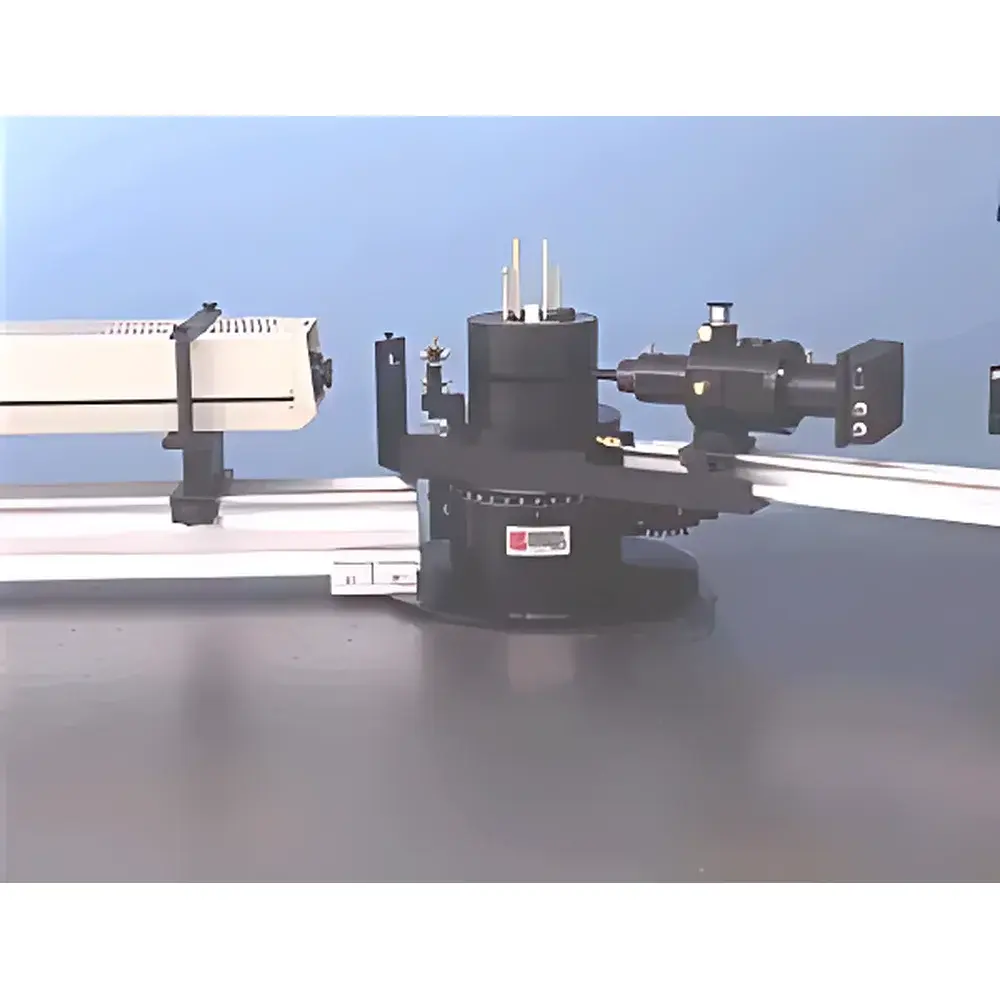
Brookhaven BI-200SM Wide-Angle Dynamic and Static Light Scattering Instrument
| Brand | Brookhaven Instruments |
|---|---|
| Origin | USA |
| Model | BI-200SM |
| Particle Size Range | 1 nm – 6 µm |
| Molecular Weight Range | 500 – 10⁹ Da |
| Hydrodynamic Size Range | 10 – 1000 nm |
| Scattering Angle Range | 8°–162°, ±0.01° |
| Temperature Control Range | −20 °C to 80 °C (optional −20 °C to 150 °C), ±0.1 °C |
| Laser Wavelength Options | 632.8 nm, 532 nm, 514.5 nm, 488 nm |
| Aperture Wheel Sizes | 100 µm, 200 µm, 400 µm, 1 mm, 2 mm, 3 mm |
| Correlator | TurboCorr digital photon correlator |
Overview
The Brookhaven BI-200SM is a research-grade wide-angle dynamic and static light scattering (DLS/SLS) instrument engineered for precision characterization of macromolecular and colloidal systems in solution. It operates on the fundamental principles of quasi-elastic (dynamic) light scattering and Rayleigh–Mie scattering theory, enabling simultaneous determination of hydrodynamic size distribution, absolute molar mass, radius of gyration (Rg), and second virial coefficient (A2) from a single sample measurement setup. Unlike conventional multi-angle instruments constrained by fixed angular configurations, the BI-200SM features motorized, high-resolution angular positioning (±0.01° accuracy) across an extended range of 8°–162°, supporting rigorous Zimm, Berry, and Debye analyses without interpolation artifacts. Its modular optical architecture accommodates multiple laser wavelengths and precisely calibrated aperture wheel selections—critical for optimizing signal-to-noise ratio across diverse sample classes, from sub-nanometer polyelectrolytes to micron-scale aggregates.
Key Features
- Wide-angle scanning capability (8°–162°) with in situ angular calibration and repeatability ≤ ±0.01°
- TurboCorr digital autocorrelator providing 4,096 channels and real-time correlation function acquisition at up to 10 MHz sampling rate
- Integrated Peltier-based temperature control system with stability ±0.1 °C over −20 °C to 80 °C (extended range available up to 150 °C)
- Multi-wavelength laser selection (632.8 nm He–Ne, 532 nm DPSS, 514.5 nm Ar⁺, 488 nm Ar⁺) for optimized scattering intensity and refractive index matching
- Motorized aperture wheel with six precision-machined pinholes (100 µm to 3 mm) to minimize stray light and tailor detection geometry per sample opacity
- Dual-mode operation: fully independent DLS and SLS modules controlled via unified software interface with hardware-synchronized data acquisition
Sample Compatibility & Compliance
The BI-200SM supports aqueous and organic solvent-based samples—including polymer solutions, surfactant micelles, liposomes, microemulsions, protein complexes, DNA constructs, and nanoscale drug delivery vehicles. Sample cells are compatible with standard quartz cuvettes (10 mm path length), low-volume capillaries (≥20 µL), and high-temperature/pressure flow cells (optional). The system complies with ISO 22412:2017 for DLS particle sizing and ASTM D7855-14 for static light scattering molecular weight determination. Data acquisition and processing workflows support audit trails and electronic signatures required under FDA 21 CFR Part 11 when deployed in GLP/GMP-regulated environments. All optical components meet IEC 60825-1 laser safety standards (Class IIIB).
Software & Data Management
Instrument control, data acquisition, and advanced analysis are managed through Brookhaven’s proprietary BI-200SM Software Suite. The platform includes automated angular sweep routines, batch processing for multi-concentration/multi-angle datasets, and built-in algorithms for cumulant analysis (DLS), Zimm/Berry/Debye plot generation (SLS), and A2 extrapolation. Raw correlation functions and intensity-vs-angle matrices are stored in HDF5 format with embedded metadata (timestamp, temperature, laser wavelength, aperture ID, angle position). Export options include CSV, TXT, and XML for integration with third-party statistical or modeling tools (e.g., MATLAB, Python SciPy, OriginPro). Audit logs record all parameter changes, user logins, and report generations—fully traceable for regulatory review.
Applications
- Polymer characterization: Determination of Mw, Rg, and A2 for synthetic and natural polymers; conformational analysis (e.g., coil vs. rod) via Rg/Rh ratios
- Liposome & vesicle analysis: Size distribution, polydispersity, and structural stability assessment under varying pH, ionic strength, or thermal stress
- Micelle thermodynamics: Critical micelle concentration (CMC) mapping, aggregation number estimation, and temperature-dependent structural transitions
- Protein aggregation kinetics: Real-time monitoring of nucleation, growth, and phase separation in crystallization screens or formulation development
- Polysaccharide & polyelectrolyte behavior: Screening of salt screening effects, charge shielding validation, and conformational response to ionic environment
- Ultra-high-molecular-weight systems: Accurate Mw and Rg for PAM, polyolefins, and cellulose derivatives where SEC/GPC fails due to shear degradation or column exclusion
- Self-assembly mechanisms: Quantitative tracking of Rg, A2, and diffusion coefficients during stimuli-responsive reorganization
FAQ
What is the minimum detectable particle size using DLS on the BI-200SM?
The instrument achieves reliable DLS detection down to 1 nm in hydrodynamic diameter under optimal conditions (low polydispersity, high scattering contrast, minimal dust contamination).
Can the BI-200SM measure both DLS and SLS in a single run?
No—DLS and SLS require distinct acquisition modes and detector configurations; however, angular positioning and sample environment remain identical between runs, enabling rapid sequential measurement with full experimental reproducibility.
Is the system compatible with non-aqueous solvents such as THF or chloroform?
Yes, provided appropriate quartz cuvettes and laser wavelength selection (e.g., 532 nm or 488 nm) are used to match solvent refractive index and minimize absorption losses.
Does the software support GPC-MALS coupling workflows?
While the BI-200SM is not a flow-through detector, its SLS module can be synchronized with external HPLC/GPC systems via TTL triggers for offline MALS integration; raw intensity and angular data are exportable for post-run deconvolution.
How is temperature calibration verified across the full operating range?
Each instrument ships with NIST-traceable Pt100 sensor calibration certificates; users may perform in-situ verification using certified reference materials (e.g., polystyrene latex standards) at multiple setpoints.



